Act 122 Replaced the Decennial Report
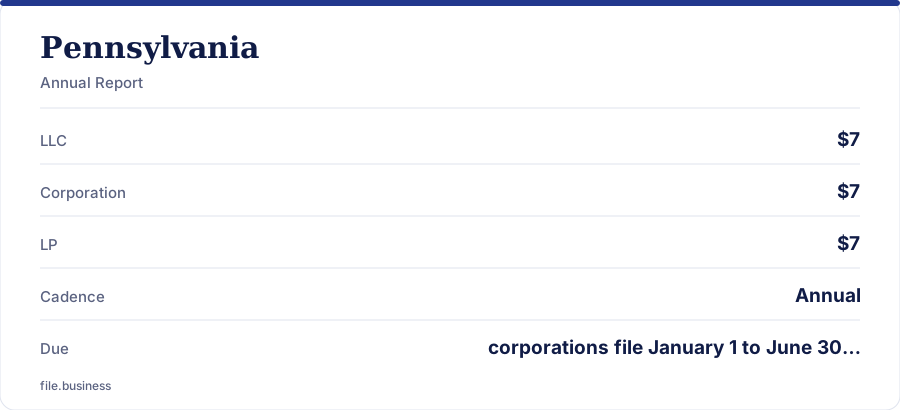

Pennsylvania spent decades as the state with almost no recurring paperwork. Entities on the register filed a decennial report once every ten years, in years ending in 1. The Commonwealth otherwise left them alone. That system no longer exists. Act 122 of 2022 repealed the decennial report and put an annual report in its place. The first annual reports came due in 2025. Every LLC, corporation, limited partnership, limited liability partnership, business trust and professional association on the Pennsylvania register now files once a year.
The fee is $7 for LLCs, business corporations, limited partnerships and limited liability partnerships. Nonprofit corporations pay nothing. So do LPs and LLCs organized for a not-for-profit purpose. Filing runs through the Department of State portal at file.dos.pa.gov. A report backed by current records takes a few minutes.
What the decennial report was, and why it is gone
The decennial report existed to police names rather than to gather information. Pennsylvania used it once a decade to find out which entities were still trading. Abandoned names could then be released to somebody else. It produced a register that was accurate one year in ten and stale for the other nine. It also caught owners out. A filing that arrives once every ten years belongs to nobody in particular by the time it falls due.
Ownership changes and bookkeepers change. So the obligation is usually discovered by whoever inherits the file, rather than by the person who created it.
Act 122 replaced that cycle for exactly those reasons. Your entity records may still carry a note saying the next Pennsylvania filing is due in 2031. That note is wrong, and the obligation it describes has been repealed. The practical change for most owners is small in money and large in rhythm. It is $7 a year instead of $70 a decade, on a date you will actually see.
Who has to file the annual report
The requirement reaches further than the decennial report did. Domestic business corporations, nonprofit corporations, LLCs, limited partnerships, limited liability partnerships, business trusts and professional associations all file. So does every foreign entity registered to do business in the Commonwealth. A Delaware LLC with a Pennsylvania registration files a Pennsylvania annual report in its own right. The Delaware filing does not satisfy it.
Sole proprietorships and general partnerships that never registered with the Department of State have nothing to file. They are not on the register in the first place. Fictitious name registrations run on their own track, and our Pennsylvania fictitious name guide covers them.
Deadlines, Fees, and What the Form Asks For
Pennsylvania Annual Report at a Glance
| Item | Value |
|---|---|
| Report name | Annual Report |
| Statutory basis | Act 122 of 2022, replacing the repealed decennial report |
| Filing frequency | Annual, from 2025 onward |
| Corporation deadline | January 1 to June 30 |
| LLC deadline | January 1 to September 30 |
| LP, LLP, business trust, professional association | January 1 to December 31 |
| LLC and corporation fee | $7 |
| Nonprofit corporation fee | $0 |
| Filing portal | file.dos.pa.gov |
| Filing agency | Pennsylvania Department of State |
Three deadlines, not one
Pennsylvania does not run a single annual report date. The deadline follows the entity type, and confusing them is the most common way to miss a filing. Corporations file between January 1 and June 30, business and nonprofit alike, domestic and foreign. LLCs file between January 1 and September 30, domestic and foreign. Limited partnerships, limited liability partnerships, business trusts and professional associations have until December 31.
So a group that owns an LLC and a corporation carries two dates three months apart. A group with an LP in it carries three.
There is no extension mechanism and no late fee schedule. The window opens on January 1, so nothing stops an LLC from filing in February rather than in late September. There is a good reason to do so.
The report is the only routine moment when the Commonwealth asks you to confirm that the register is right. Confirm it in February and you leave seven months to fix whatever turns out to be wrong. Costs across the whole Pennsylvania lifecycle are set out on our Pennsylvania annual report cost page.
The seven items the form asks for
The report is short. Pennsylvania asks for the business name and the jurisdiction of formation. It asks for the registered office address and the principal office address. It asks for the name of at least one governor: a director for a corporation, a member or manager for an LLC, a general partner for an LP.
It asks for the names and titles of the principal officers, if the entity has any. And it asks for the entity number the Department of State assigned at registration. There is nothing about revenue, nothing about ownership percentages, and no financial statement.
The registered office line is where Pennsylvania departs from most states. The Commonwealth requires a registered office, which is an address available during normal business hours. It does not require a registered agent, which elsewhere is a person or company appointed to accept service.
Under 15 Pa.C.S. § 109 an entity with no Pennsylvania premises of its own may name a Commercial Registered Office Provider instead. The provider's address then becomes the registered office of record. Our Pennsylvania registered office guide and the state registered office page explain how the address is designated and changed.
Filing through the Department of State portal
Filings go through file.dos.pa.gov. You find the entity by name or entity number. You confirm the record the Department already holds. You correct the address and governor lines where they have drifted. Then you pay the $7 by card. Acceptance on a clean online submission is quick compared with Pennsylvania's paper channel.
What the report cannot do is change the formation document. A name change needs its own filing. So does a change of registered office, or a switch between member-managed and manager-managed. Attempting one inside the annual report is the fastest route to a rejection. Our Pennsylvania amendment guide and our guide to changing the registered office cover those separate filings.
File your Pennsylvania annual report
We pull your record from the state, prefill every field, and track next year’s deadline. Or keep reading and file it yourself; this guide covers both.
What Happens If You Skip a Pennsylvania Annual Report
Act 122 attached a consequence to the annual report that the decennial report never carried. An entity that does not file becomes subject to administrative dissolution, cancellation or termination. That happens six months after its deadline passes.
The Department of State chose not to apply that sanction to the first two cycles. Reports due in 2025 and 2026 do not trigger dissolution, and enforcement begins with reports due in 2027. An LLC that skipped 2025 and 2026 is therefore still on the register today. The 2027 report is the one that decides whether it stays there.
The name is the real penalty
Pennsylvania runs no escalating late fee. There is no charge per month, no doubling penalty and no interest. What the Commonwealth takes is the name. An entity that is administratively dissolved forfeits the exclusive right to its business name. Another business may register that name the following week.
Think of a company whose name is on its vans, its invoices, its domain, its signage and a professional license. That costs a multiple of the $7 that would have prevented it. It is also the one consequence money cannot reliably undo. Reinstatement restores the entity, not the name, if somebody else has taken it in the meantime.
A dissolved entity also cannot get a Subsistence Certificate. That is what Pennsylvania issues in place of a certificate of good standing. It costs $40 on standard handling, or $100 expedited. A bank, a landlord, an acquirer or another state's filing office asks for it before a transaction closes. Our Subsistence Certificate guide covers what it shows and when it is needed.
The cost of getting back
The route back is an Application for Reinstatement. In Pennsylvania the expensive part is not the state fee. The Commonwealth requires tax clearance from the Department of Revenue before it restores an entity. So every corporate net income, sales and use, and employer withholding account has to be brought current. That includes periods with no activity.
Clearance typically runs 30 to 60 days. Add the accounting to produce returns for each dormant year. Add our reinstatement service at $297 plus state fees. Add each missed annual report at $7. A lapse that began with a $7 filing routinely settles between $1,000 and $4,000.
Our Pennsylvania reinstatement guide sets out each stage. And the Pennsylvania dissolution guide covers the alternative of closing deliberately at $70, rather than lapsing by accident.
Three Pennsylvania Filings in Practice
Example 01: a Philadelphia single-member LLC
A consultant formed a single-member LLC in Philadelphia in 2019, at the $125 Certificate of Organization fee. She used a Commercial Registered Office Provider to keep her home address off the public record. Her file note said the next state filing was the decennial report in 2031. Her accountant flagged the change in March 2026. Action taken: she filed the 2026 annual report that week. She confirmed the provider's address as the registered office, and listed herself as the sole governor.
Real cost: $7 to the Department of State. That sat on top of roughly $149 a year for the registered office provider she was already paying. Timeline: under ten minutes online, accepted the same day. Outcome: the entity is current. September 30 now sits in the same calendar as her quarterly estimates, instead of in a note about 2031.
Example 02: a Pittsburgh corporation that missed the June date
A five-shareholder Pittsburgh corporation running a specialty fabrication shop assumed the September date applied to it. It planned to file then. Corporations file by June 30. Action taken: the report went in during July, four weeks late. It listed three officers by name and title. It also corrected a principal office address that had changed in 2024 without anybody updating the register.
Real cost: $7, with no late fee, because Pennsylvania charges none. There was no dissolution exposure either, because reports due in 2026 sit outside the enforcement window. Timeline: filed in July, accepted immediately. Outcome: no financial damage, and a June reminder set for 2027. That is the first year the six-month dissolution clock actually runs.
Example 03: a foreign-qualified LLC filing in three states
A New Jersey LLC in commercial cleaning holds Pennsylvania and Delaware registrations, won through multi-site contracts. Pennsylvania is the cheapest of the three obligations. It is also the easiest to forget, precisely because it is cheap. Action taken: all three recurring filings were mapped onto one calendar. New Jersey's $75 annual report falls on the formation anniversary. Delaware's $400 LLC tax falls on June 1. And Pennsylvania's $7 annual report is due by September 30.
Real cost: $382 a year across the three states. Pennsylvania is under 2 percent of that. Timeline: about 20 minutes a year in total. Outcome: no lapse in any state. The Pennsylvania registration itself is covered in our Pennsylvania foreign qualification guide, and the multi-state calendar in annual report deadlines by state.
Five Mistakes on the Pennsylvania Annual Report
Mistake 1: Working from a decennial calendar
What it is: treating 2031 as the next Pennsylvania filing date, because that is what the entity records say. Why it happens: the decennial report ran for decades. Every checklist, formation packet and inherited file note written before 2023 describes it.
Consequence: the entity misses every annual report from 2025 onward. The 2027 report then starts a six-month dissolution clock against a business that believes it is current. Prevention: delete the decennial entry from the entity records. Replace it with the annual date that matches the entity type.
Mistake 2: Using the LLC deadline for a corporation
What it is: filing, or planning to file, by September 30 when the entity is a corporation. Why it happens: September 30 is the date most Pennsylvania coverage leads with, because LLCs outnumber corporations on the register. Consequence: three months of avoidable delinquency. And from 2027, a live dissolution risk on an entity whose owner thought the filing was in hand. Prevention: file corporations by June 30, LLCs by September 30, and LPs, LLPs, business trusts and professional associations by December 31.
Mistake 3: Assuming a nonprofit has nothing to file
What it is: skipping the report because the entity pays no fee. Why it happens: a $0 fee reads like an exemption. Consequence: a nonprofit corporation that does not file faces the same administrative dissolution as a fee-paying entity. That puts grant eligibility and a charitable solicitation registration at risk at the same time. Prevention: file the nonprofit report by June 30 like any other corporation. Treat $0 as a price rather than as a pass.
Mistake 4: Trying to change the formation document inside the report
What it is: using the annual report to change the entity name, the registered office, or the management structure. Why it happens: the report displays those fields, so the screen looks like an editable record. Consequence: rejection. Or a filed report that never produced the change the owner thought it made, discovered months later when a bank compares two documents. Prevention: file the Certificate of Amendment at $70, or the Statement of Change of Registered Office at $5. Then file the annual report against the corrected record.
Mistake 5: Letting the registered office lapse
What it is: leaving an old address on the register after moving premises or ending a provider agreement. Why it happens: the address belongs to somebody else's job until something is sent to it. Consequence: Department of State notices and service of process go to an address nobody monitors. The entity is treated as properly served regardless. That is how default judgments are entered against businesses that never saw the claim.
Prevention: keep a valid Pennsylvania registered office at all times. Use a Commercial Registered Office Provider where the business has no premises of its own.
Building a Pennsylvania Filing Routine
Practice 1: File early in the window
The window opens on January 1 for every entity type. So the deadline is a backstop rather than a target. Filing in the first quarter converts a hard date into a soft one. It leaves months of slack for the problems that only surface once you open the record. A governor who left. An address that moved. An entity number nobody can find. One calendar entry in January, covering every Pennsylvania entity you hold, is easier to maintain than three separate reminders in June, September and December.
Practice 2: Reconcile the register before you file
Open the Department of State record before you start the report. Compare it line by line against what is true today. Where the two disagree on something the report cannot change, file the correcting document first. That ordering matters most for the registered office and the entity name, which are the two fields other institutions check.
Read the report as an annual audit of the public record and it earns its $7. Treat it as a form to clear and the register drifts a little further out of date each year.
Practice 3: Keep the Pennsylvania record in one place
Hold one document with the entity's legal name, entity number, registered office, principal office, governors and officers. Update it whenever any of those facts change, rather than once a year under deadline. Formation history belongs in the same file, and our Pennsylvania LLC formation guide and Pennsylvania operating agreement guide both cover it. Entities held across several states are easier to keep current under compliance monitoring, which watches each register and files on each deadline.
How File.Business Handles Pennsylvania Annual Reports
File.Business is a private filing service, not a law firm and not a government agency. For a Pennsylvania annual report we pull the current record from the Department of State. We compare it against what you tell us is true now. We flag any change that needs its own filing before the report can be accepted.
We file through the Department of State portal ahead of the June 30, September 30 or December 31 deadline that applies to your entity type. We pay the $7 fee, and we send you the acceptance.
Entities in several states run on one calendar from one dashboard. Start at the annual report filing service, or read the state detail on the Pennsylvania annual report page.
Pennsylvania annual report FAQ
When is the Pennsylvania annual report due?
The deadline depends on the entity type. Corporations file between January 1 and June 30, business and nonprofit alike. LLCs file between January 1 and September 30. Limited partnerships, limited liability partnerships, business trusts and professional associations have until December 31. Foreign entities registered in Pennsylvania follow the same dates as domestic ones.
How much does the Pennsylvania annual report cost?
The fee is $7 for LLCs, business corporations, limited partnerships and limited liability partnerships. Nonprofit corporations pay nothing, and so do LPs and LLCs organized for a not-for-profit purpose. You pay by card in the portal when the report is submitted.
Did Pennsylvania abolish the decennial report?
Yes. Act 122 of 2022 repealed the decennial report, which had been due only in years ending in 1. It replaced it with an annual report starting in 2025. There is no decennial filing in 2031, or in any later year. A file note that still points to 2031 describes an obligation that no longer exists.
Where do I file the Pennsylvania annual report?
Online with the Pennsylvania Department of State, through its business filing portal at file.dos.pa.gov. You locate the entity by name or entity number. You confirm the record and correct anything that has drifted. Then you pay the fee. Most filers finish in a few minutes when the entity records are already current.
What happens if I miss the Pennsylvania annual report deadline?
Pennsylvania charges no late fee. Under Act 122 an entity that fails to file becomes subject to administrative dissolution, cancellation or termination six months after the deadline. The Department of State began enforcing that for reports due from 2027 onward. The lasting cost is the loss of the exclusive right to the business name. Reinstatement cannot recover it once somebody else has registered it.
Do foreign LLCs need to file a Pennsylvania annual report?
Yes. Any LLC or corporation registered to do business in Pennsylvania files the Pennsylvania annual report. It runs on the same schedule as a domestic entity: September 30 for LLCs and June 30 for corporations. The report filed in the home state does not satisfy the Pennsylvania requirement.
File your Pennsylvania annual report
We pull your record from the state, prefill every field, and track next year’s deadline. Or keep reading and file it yourself; this guide covers both.
Doing this in Pennsylvania specifically: Pennsylvania annual report filing and the annual report page at the Pennsylvania Secretary of State cover the detail for this state, including the current fee and the exact form the agency expects.
This guide is written from the official sources below. Fees, forms, and deadlines change. Confirm the current requirement with the agency before you file.
Disclosure. File.Business is a private filing service, not a government agency and not a law firm. We prepare and submit filings at your direction, and nothing on this page is legal or tax advice. Filing fees, deadlines, and statutory references are current as of the last-updated date shown above and can change. Confirm current requirements with the relevant state agency before you file.