One State, Two Deadlines
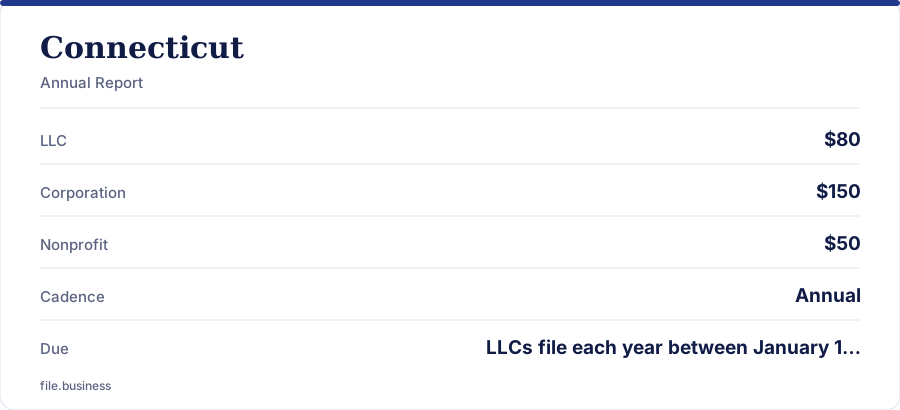

Connecticut asks every registered business to file the same document, an Annual Report: Connecticut General Statutes 34-247k requires one from every LLC and 33-953 requires one from every corporation. But it applies two different deadlines. LLCs file by March 31, a fixed date shared by every LLC in the state. Corporations file in their own anniversary month, which differs for every company. Anyone who owns one of each runs two calendars in a single state. The entity that gets forgotten is almost always the corporation, because the fixed March date is the one people remember.
The fee split is just as wide. An LLC pays $80. A corporation pays $150, nearly double, for a document that asks similar questions. You file through the Secretary of the State's business portal. Processing takes five to ten business days once you submit a clean report.
What the report collects
Connecticut wants the principal office address, the mailing address, and the registered agent's name and Connecticut street address. It also wants the people responsible for the entity: officers and directors for a corporation, managers or members for an LLC. This makes the annual report the state's own leadership record, not just a fee receipt. It is also the natural place to reconcile what the state publishes against what the company's minute book says.
Who is caught by the requirement
Domestic LLCs and corporations must file. So must anything registered through foreign qualification in Connecticut. Registration triggers the requirement, not activity. A company that qualified for one contract and never returned still files every year until it formally withdraws. Price this before you register: a dormant Connecticut corporation costs $150 a year to leave open, and $600 over four years of doing nothing at all.
Connecticut Annual Report at a Glance
| Item | Value |
|---|---|
| Report name | Annual Report |
| Filing frequency | Annual |
| Deadline | March 31 for LLCs, anniversary month for corporations |
| LLC filing fee | $80 |
| Corporation fee | $150 |
| Late penalty | $50 plus interest |
| Processing time | 5-10 business days |
| Filing agency | Connecticut Secretary of the State |
| Reinstatement window | 36 months, with tax clearance |
March 31 falls three weeks after most owners finish their accounts and two weeks before the federal individual deadline. That is a narrow window of attention. Connecticut LLCs that file in the first week of March consistently avoid the problem. Those that wait until the last week compete with everything else happening in those two weeks. See the Connecticut annual report cost page for the full year's cost.
Penalties That Follow a Missed Connecticut Deadline
Connecticut adds a flat $50 to a late report and charges interest on what you owe. The underlying fee differs by entity type, so the totals diverge quickly. A corporation that lets three years go unfiled owes half again as much as an LLC in the same position.
| Years missed | LLC fees at $80 | Corporation fees at $150 | Penalties at $50 | LLC total | Corporation total |
|---|---|---|---|---|---|
| One | $80 | $150 | $50 | $130 | $200 |
| Two | $160 | $300 | $100 | $260 | $400 |
| Three | $240 | $450 | $150 | $390 | $600 |
Interest runs on top of every row from each year's own due date, so treat these totals as the floor. The figures also assume the entity stays on the register, which will not happen indefinitely.
Dissolution at thirty-six months
At around 36 months of non-compliance, Connecticut moves to administrative dissolution. But the practical damage starts earlier: no Connecticut certificate of legal existence will issue. In Connecticut, a large share of commercial work runs through municipal contracts, insurance placements, and bank facilities that each ask for this certificate. So it is the certificate, not the dissolution itself, that stops deals. After dissolution, name protection ends, and the entity loses standing to bring an action in Connecticut courts.
Reinstatement and the clearance step
Connecticut allows reinstatement for 36 months after dissolution, but only after tax clearance. That second condition stretches the timetable. The Department of Revenue Services must be satisfied before the Secretary of the State restores the record. So a company with unfiled state returns is dealing with two agencies, not one. Budget for the arithmetic above, the reinstatement fee the office sets, and the professional time to bring the tax filings current. Our Connecticut reinstatement guide sets out the order that actually works.
File your Connecticut annual report
We pull your record from the state, prefill every field, and track next year’s deadline. Or keep reading and file it yourself; this guide covers both.
Three Connecticut Filings in Practice
Scenario one: a one-owner practice in Stamford
An executive coach operates a single-member Connecticut LLC. Her deadline is March 31, the same as every other Connecticut LLC. She files on March 3. She confirms her agent address and her own details as sole member, pays $80, and gets acceptance inside a week. Total annual cost of keeping the entity current: $80. The four-week head start is worth more than the fee, because a rejected payment in the last week of March turns an $80 filing into a $130 one.
Scenario two: a Hartford corporation on its own clock
An insurance services corporation incorporated in October files each October at $150. The report is where its officer and director list reaches the state. This year that matters: the corporate secretary changed in June, and a director resigned in August. The filing publishes both changes. The corporation also holds an LLC subsidiary that files in March. So the group has two Connecticut deadlines, seven months apart, under one roof.
The controller keeps them as separate lines with separate owners. They learned this by experience: filing the LLC diligently every March while letting the corporation drift into a second unfiled year.
Scenario three: Connecticut plus two heavier jurisdictions
A specialty manufacturer formed as a Connecticut LLC also qualifies in Delaware and Florida. Connecticut wants $80 by March 31. Delaware wants $400 from the LLC by June 1, with a $200 penalty plus 1.5% per month if it slips. Florida wants $139 by May 1, with a $400 penalty the day after. The year costs $519 in fees. The penalty exposure across all three is $650, for filings that total barely more than five hundred dollars.
Three deadlines in three consecutive months are easy to treat as one task and easy to miss as three. So the group runs a single compliance calendar with a named owner per jurisdiction.
Five Ways a Connecticut Filing Goes Wrong
Mistake 1: Waiting for the state to prompt you
What happens. The company files only after a notice arrives. Why it fails. Notices go to the agent and addresses on record, so they depend on both being current. The filing obligation does not depend on the notice. No state treats a returned letter as an excuse. Consequence. $50 plus interest attaches on April 1 for an LLC, or the day after the anniversary month for a corporation. Prevention. Diary the date yourself with a thirty-day lead. Verify the entity's status on the state portal rather than trusting an inbox.
Mistake 2: Applying one entity's deadline to the other
What happens. An owner with an LLC and a corporation files both in March, or waits for an anniversary that applies to only one of them. Why it fails. Connecticut runs two real systems: a fixed March 31 for LLCs and an anniversary month for corporations. Consequence. The corporation ends up late by up to eleven months, without anyone being careless. Prevention. Record the entity type next to the date in your calendar. Check the corporation's anniversary month on the Connecticut business search rather than assuming it.
Mistake 3: Confirming an agent who has moved on
What happens. Last year's agent and address carry through the portal's prefill unread. Why it fails. Connecticut requires a registered agent at a physical Connecticut address. Confirming a prefilled entry is a positive statement that it is still true. Consequence. Service of process goes to an address nobody attends. The company learns of a claim only when a default is entered. Prevention. Check the agent every year before filing. If it has changed, lodge the Connecticut agent change first.
Mistake 4: Underrating the filing because the fee is modest
What happens. An $80 filing never makes it onto a management agenda. Why it fails. The fee is not the real cost. Three missed years cost an LLC $390 and a corporation $600 before interest, and the certificate of legal existence stops being available long before that. Consequence. A cheap filing becomes the reason a lease assignment or an insurance renewal gets held up. Prevention. Judge the filing by the transactions it protects. If a Connecticut entity is genuinely unused, close it instead of paying $150 a year to keep it dormant.
Mistake 5: Believing registration covered the first report
What happens. A newly registered Connecticut entity assumes its formation or qualification filing covered the first annual report. Why it fails. Connecticut has no combined filing. Registering is one transaction, and reporting is another. So an LLC registered in January still owes a report that same March 31. Consequence. The company is late in its first quarter, with $50 plus interest attached before it even has a full set of accounts. Prevention. On the day the registration is accepted, work out which of the two Connecticut deadlines applies to your entity type, and diary it immediately.
Running Two Calendars in One State
The Connecticut habit worth building is to record the entity type wherever the deadline lives. A compliance sheet that lists companies by name alone is why a corporation gets filed on an LLC's schedule. List the legal name, the entity type, the deadline rule that applies to it, the business ID, the agent's Connecticut address, and the current officer or manager roster. Review it in February so both the March filers and the spring anniversary filers are ready.
Groups that hold a mix should assign one person per entity, not one person per state. That arrangement is what catches the seven-month gap in the Hartford scenario above. Our annual report service handles both cadences and reports on them separately.
How File.Business Handles Connecticut Annual Reports
We identify which deadline applies to each entity, and take the anniversary month from the state record for corporations. We verify the agent and addresses, reconcile the officer, director, or manager list before submission, file ahead of the date, pay the $80 or $150, and return the acceptance. Entities on our compliance plan carry Connecticut registered agent service and status monitoring, so a drift toward dissolution surfaces as an alert.
The Connecticut annual report page covers the agency-side detail for anyone filing directly. Connecticut LLC versus corporation is worth reading if the $70 annual difference is part of a formation decision.
Connecticut annual report FAQ
When is the Connecticut annual report due?
LLCs file by March 31 every year. Corporations file in their own anniversary month, so the date is different for every company. Owners holding both entity types run two Connecticut deadlines at once.
How much does the Connecticut annual report cost?
$80 for an LLC and $150 for a corporation. That is the widest fee split between entity types among the states covered in this series.
What does the Connecticut report ask for?
Connecticut wants the principal office and mailing addresses, plus the registered agent's name and Connecticut street address. It also wants the responsible people: officers and directors for a corporation, managers or members for an LLC.
What is the penalty for filing late in Connecticut?
A flat $50 plus interest on the amount owed. Three unfiled years total $390 for an LLC and $600 for a corporation, before interest. Administrative dissolution follows at around 36 months.
How long do I have to reinstate a Connecticut entity?
Thirty-six months from administrative dissolution. Reinstatement is also gated on tax clearance. Unfiled state tax returns have to be brought current before the Secretary of the State will restore the record.
Do foreign-qualified companies file in Connecticut?
Yes. Any entity registered to do business in Connecticut files an annual report on the same schedule as a domestic entity, and the obligation continues until the registration is formally withdrawn.
Can File.Business file my Connecticut annual report?
Yes. We determine which deadline applies to your entity type, validate the agent and officer detail, file the report, pay the fee, and confirm acceptance. Connecticut registered agent service and status monitoring are included on our compliance plan.
File your Connecticut annual report
We pull your record from the state, prefill every field, and track next year’s deadline. Or keep reading and file it yourself; this guide covers both.
Related Connecticut pages: Connecticut annual report filing if you want it handled, the certificate of legal existence when a counterparty asks for proof, and ordering that certificate directly.
This guide is written from the official sources below. Fees, forms, and deadlines change. Confirm the current requirement with the agency before you file.
Disclosure. File.Business is a private filing service, not a government agency and not a law firm. We prepare and submit filings at your direction, and nothing on this page is legal or tax advice. Filing fees, deadlines, and statutory references are current as of the last-updated date shown above and can change. Confirm current requirements with the relevant state agency before you file.