The Four Hundred Dollar Deadline
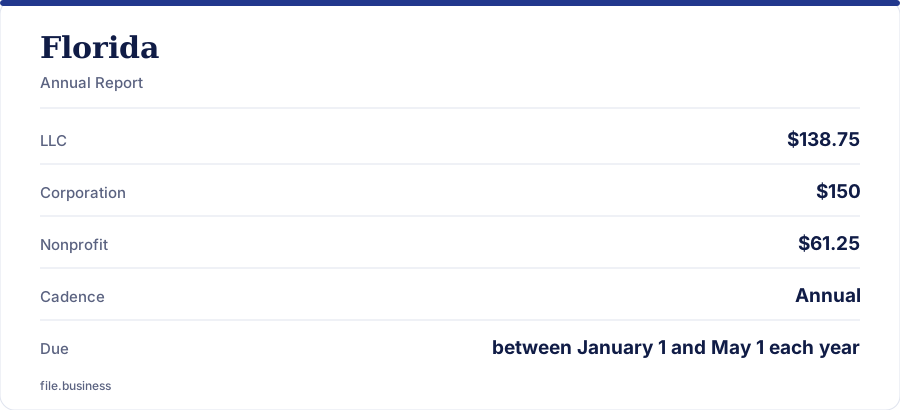

Florida's annual report is straightforward to complete and unforgiving to forget. Fla. Stat. § 605.0212 requires one from every LLC each year, and Fla. Stat. § 607.1622 requires the same from every corporation. The fee is $138.75 for an LLC and $150 for a for-profit corporation. The penalty for filing after May 1 is $400, and Florida does not waive it. Not for a first offense, not for a day, not for a hurricane, not for a business that filed every year for a decade and missed once.
That single design choice explains everything about how you should manage Florida filings. The entire job is making sure the date does not pass, because there is no negotiation on the other side of it.
Filings go through the Division of Corporations at sunbiz.org, which is one of the better state portals in the country. Processing runs two to five business days, and the record updates publicly. The whole exercise takes ten minutes for a company whose details have not changed. None of that convenience helps a company that opens the site on May 2.
The window opens on January 1
Florida accepts annual reports from January 1, which gives four full months of margin before the deadline. Almost nobody uses it. The pattern we see every year is a rush in the last ten days of April. That is exactly the moment when card declines, portal load, and staff holidays are most likely to cost someone a day. Filing in January converts a $400 risk into a diary entry. And it costs precisely the same $138.75.
What the report carries
The report confirms the entity's document number, its federal employer identification number, its principal and mailing addresses, and its registered agent and Florida street address. It also confirms the people responsible for the entity: managers or managing members for an LLC, and officers and directors for a corporation. It is the state's leadership record as much as a fee. That is why it is the right moment each year to reconcile what Florida publishes against who actually holds each role.
Florida Annual Report at a Glance
| Item | Value |
|---|---|
| Report name | Annual Report |
| Filing frequency | Annual |
| Deadline | May 1, window opens January 1 |
| LLC filing fee | $138.75 |
| Corporation fee | $150 |
| Late fee | $400 |
| Processing time | 2-5 business days |
| Filing agency | Florida Division of Corporations |
| Reinstatement window | 60 months |
Set the two numbers side by side. The report costs $138.75 and the penalty is $400. That is close to three times the fee, and the largest flat late fee in this series by a wide margin. Arkansas charges $25 for the same mistake. Colorado charges $50. Florida's figure is not calibrated to the administrative cost of a late filing. It is calibrated to make sure you file. Read the full year's cost on the Florida annual report cost page.
The $400 Penalty and What Follows It
Florida's arithmetic is blunt because the penalty is flat and repeats per missed year.
| Years missed | LLC fees at $138.75 | Corporation fees at $150 | Late fees at $400 | LLC total | Corporation total |
|---|---|---|---|---|---|
| One | $138.75 | $150 | $400 | $538.75 | $550 |
| Two | $277.50 | $300 | $800 | $1,077.50 | $1,100 |
| Three | $416.25 | $450 | $1,200 | $1,616.25 | $1,650 |
The first row is the one most companies actually experience: $538.75 for an LLC that was four days late, against $138.75 for one that filed in January. The second and third rows describe a dissolved entity working its way back, rather than a live company running a tab. Florida does not let a lapse sit for years.
Administrative dissolution in the same year
This is where Florida differs most sharply from its neighbors. Alabama takes about three years to dissolve a non-filer, and Connecticut takes three. Florida takes months. An entity that misses May 1 is administratively dissolved later the same year. That means the gap between a missed deadline and a closed record is a single season.
Once the record shows dissolved, the name is exposed. Banks re-verifying entity status freeze accounts. And no Florida certificate of status will issue for a closing, a lease, or a license. Owners who assume a missed report is a next-year problem are working from a timeline that does not apply here.
Five years to reinstate
Florida allows reinstatement for 60 months after administrative dissolution, one of the longer windows in this series. And it does not require a tax clearance step first. Reinstatement means filing every missed annual report, paying the accompanying fees and the $400 penalties, and paying the reinstatement fee the Division sets. A company reinstating after two missed years is therefore looking at the $1,077.50 above plus that fee. That compares with the $277.50 it would have paid by filing on time twice. Our Florida reinstatement guide and the reinstatement bundle cover what the Division expects and in what order.
File your Florida annual report
We pull your record from the state, prefill every field, and track next year’s deadline. Or keep reading and file it yourself; this guide covers both.
Three Florida Filings in Practice
Scenario one: a single-member LLC in Tampa
A wedding photographer runs a single-member Florida LLC. She files on January 6, the first working week the window is open, using the document number saved in her entity file. She confirms her registered agent, her principal address, and herself as managing member. She pays $138.75, and the record updates within three business days. Her total exposure to the $400 penalty for the rest of the year is zero. The habit that makes this work is small: the filing is the first item on her January list, tied to the same week she reconciles the previous year's books.
Scenario two: a Miami corporation refreshing its officers
An import corporation lists a president, a vice president, a secretary, and three directors on its Florida record. During the year the secretary left, a director was added, and the company moved warehouses. The annual report is where all of that reaches the state, at $150. The corporation files in February with a list taken from the board minutes, rather than from last year's filing. The record then matches the signature blocks on its supplier contracts.
The company had learned to do this after a freight forwarder's credit team pulled the Sunbiz record during an application. The team found an officer who had resigned eighteen months earlier, and asked for corporate resolutions before extending terms.
Scenario three: a Florida LLC registered in two other states
A logistics LLC formed in Florida qualifies in Alabama and California. Florida wants $138.75 by May 1, with $400 behind it. Alabama wants its Business Privilege Tax Return by April 15 at $50, with a $50 penalty and 1% per month. California wants a Statement of Information at $20, biennially for an LLC, in its anniversary window, plus $800 a year to the Franchise Tax Board whatever happens.
The year's filing fees total $208.75, and the recurring California tax adds $800. The single largest penalty risk, though, sits on the cheapest-looking filing of the three. Two of the deadlines fall two weeks apart in April. That is either helpful or fatal, depending on whether anyone wrote them down. We keep a per-jurisdiction compliance calendar for exactly this shape of business.
Five Mistakes That Cost Florida Filers $400
Mistake 1: Waiting for the reminder email
What happens. The owner relies on the state's email reminder as the prompt to file. Why it fails. The reminder goes to the email address recorded on the last report. That may belong to a former bookkeeper, a closed domain, or a spam folder. The obligation does not depend on it arriving. Consequence. The $400 attaches on May 2 with no warning anyone read. Prevention. Put January in your own calendar as the filing month. And check the current email on the record each year while you are in the form.
Mistake 2: Expecting an anniversary-based deadline
What happens. A filer who also manages Colorado, Arizona, or California entities waits for the month the company was formed. Why it fails. Florida uses one statewide date. May 1 applies to every entity regardless of when it registered, including one formed in April. Consequence. A company waiting for its anniversary is late by up to eleven months. And the penalty is the same $400, whether it is late by a day or by a season. Prevention. Record the fixed date. And keep anniversary states on separate lines, so the two conventions never blur.
Mistake 3: Confirming a registered agent who has resigned
What happens. The report is submitted with the agent and address prefilled from last year. Why it fails. Florida requires a registered agent at a Florida street address who accepts service during business hours. Prefill is a convenience, not a verification. Confirming a stale entry states that it is still true. Consequence. Service of process reaches an address nobody attends. And the first sign of a claim is a default judgment. Prevention. Read every field before submitting, and file the Florida agent change when the answer has changed.
Mistake 4: Assuming a quiet year means no filing
What happens. An LLC that traded nothing, or a company between projects, decides there is nothing to report. Why it fails. The report is a status filing, not a revenue filing. Florida charges $138.75 for an entity that earned nothing, and $400 more if that entity files late. A dormant company is not an exempt company. Consequence. The cheapest year of the business becomes the year that costs $538.75. And it ends in administrative dissolution. Prevention. Decide each January whether the entity still earns its place. If it does not, dissolve it deliberately rather than letting it lapse.
Mistake 5: Thinking registration covered the first report
What happens. A company formed in the autumn assumes its first annual report is due more than a year away. Why it fails. Florida has no separate initial report. The formation filing does not count as one. Every entity on the register files by May 1, including one that registered the previous November. Consequence. A first-year company can face $400 before it has completed a full trading year. Prevention. When the Florida formation is accepted, look the entity up on the Sunbiz business search, save the document number, and diary the coming May 1.
A January Habit
Every Florida problem we see would have been solved by filing in January. The window is open, and the fee is identical. Four months of margin absorbs anything that goes wrong: a declined card, a name mismatch, a missing document number, an agent who turns out to have resigned. Keep a single record with the exact entity name, the document number, the federal employer identification number, the agent's Florida street address, the managing members or officers, and the email the state should reach you at. Review it in the first week of the year.
Businesses running several entities can put every Florida filing on our annual report service and have January handled as one batch rather than five separate reminders.
How File.Business Handles Florida Annual Reports
We file Florida in January, not in April. We pull the current record from the Division, verify the registered agent and addresses, and reconcile the officer or managing member list against what you actually have. Then we submit through the state portal, pay the $138.75 or $150, and return the acceptance. Entities on our compliance plan carry Florida registered agent service and continuous status monitoring. So a drift toward dissolution is an alert, rather than a discovery.
The Florida annual report page covers the agency-side steps for anyone filing directly. And foreign qualification in Florida explains what registering from another state commits you to.
Florida annual report FAQ
When is the Florida annual report due?
By May 1 every year, with the filing window open from January 1. The date is fixed statewide, rather than tied to your formation anniversary. So an entity registered in December still files by the following May 1.
How much is the Florida annual report?
$138.75 for an LLC and $150 for a for-profit corporation. Filing after May 1 adds a $400 late fee. That is close to three times the LLC filing fee.
Can the Florida $400 late fee be waived?
No. Florida applies it to any for-profit entity that files after the deadline. It does not matter what the reason is, or how long the company has filed on time in the past. The only reliable protection is filing early in the window.
What happens if I miss the Florida deadline entirely?
The entity is administratively dissolved later the same year. That is far faster than most states. Once dissolved, the name is exposed. No certificate of status will issue. And banking and licensing verifications start to fail.
How long do I have to reinstate a Florida entity?
Sixty months from administrative dissolution. Reinstatement requires every missed annual report, the fees and $400 penalties that go with them, and the reinstatement fee the Division sets.
Does a Florida LLC with no income still file?
Yes. The annual report is a status filing, not a revenue filing. So a dormant entity owes the same $138.75, and faces the same $400 penalty. An entity that is no longer needed should be dissolved rather than left to lapse.
Can File.Business file my Florida annual report?
Yes. We file in January rather than April, validate the agent and officer detail, submit through the state portal, pay the fee, and confirm acceptance. Florida registered agent service and status monitoring are included on our compliance plan.
File your Florida annual report
We pull your record from the state, prefill every field, and track next year’s deadline. Or keep reading and file it yourself; this guide covers both.
Related Florida pages: Florida annual report filing if you want it handled, the Florida certificate of status when a bank or landlord asks, and ordering that certificate directly.
This guide is written from the official sources below. Fees, forms, and deadlines change. Confirm the current requirement with the agency before you file.
Disclosure. File.Business is a private filing service, not a government agency and not a law firm. We prepare and submit filings at your direction. Nothing on this page is legal or tax advice. Filing fees, deadlines, and statutory references are current as of the last-updated date shown above. They can change. Confirm current requirements with the relevant state agency before you file.