Oregon's Penalty Doubles the Filing
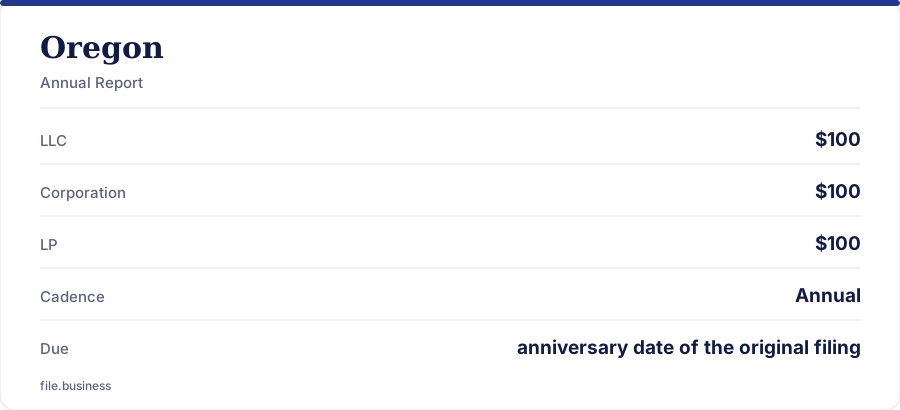

An Oregon annual report costs $100. Filing it late costs another $100. That one-to-one ratio is the most useful thing to know about the state's system. It turns a missed deadline into an exactly measurable loss: every year a report goes unfiled, the entity pays for two. There is no sliding scale, no per-month accrual, and no first-offense discount. One number, doubled.
The report goes to the Oregon Secretary of State through the Business Registry at sos.oregon.gov. ORS 63.787 requires it of a limited liability company and ORS 60.787 of a corporation, and it is due on the anniversary of the date the entity was registered. LLCs and corporations pay the same $100 and answer the same questions, which is unusual -- most states charge the two types differently.
The anniversary is yours alone
There is no Oregon-wide filing date. A business registered on January 6 files by January 6. One registered on September 22 files by September 22. Oregon does send a renewal notice ahead of the date, to the address it holds -- more than several states do. But that notice goes to the record address. And the record address is the thing most likely to be out of date in exactly the businesses most likely to miss the deadline.
The practical consequence for a group is arithmetic. Four Oregon entities registered in four different months produce four deadlines. At $100 each, that is a $400 annual line arriving in four separate pieces. That fragmentation is why Oregon delinquencies tend to be partial. It is common to find a group in which two entities are current and a third has been quietly delinquent for eighteen months.
Who files an Oregon report
Domestic LLCs, domestic corporations, nonprofit corporations, limited partnerships and every foreign entity holding Oregon authority must file. A Washington LLC that registered here to serve Portland customers files an Oregon report at the full $100 on its Oregon anniversary, separately from anything Washington requires of it. Getting authorized is covered in our Oregon foreign qualification guide. An assumed business name is a different registration, with a different rhythm -- renewable every two years at $50, and covered in our Oregon assumed business name guide.
Fees, Timing, and the Fields the Registry Asks For
Oregon Annual Report at a Glance
| Item | Value |
|---|---|
| Report name | Annual Report |
| Filing frequency | Annual |
| Deadline | The entity's anniversary date |
| LLC filing fee | $100 domestic / $275 foreign |
| Corporation fee | $100 domestic / $275 foreign |
| Late penalty | $100 |
| Processing time | 5-7 business days |
| Expedited option | $40 for 1 to 3 business days |
| Filing agency | Oregon Secretary of State |
What the report asks for
Oregon asks for the entity name as registered, the registry number, the principal place of business, the mailing address, the registered agent's name with the Oregon street address of the registered office, and the individuals with authority. That means members or managers for an LLC, and the president, secretary and directors for a corporation. It also asks the business to confirm its primary activity. No financial detail is requested.
Because the report collects the agent and address information alongside the people, it doubles as the state's routine mechanism for keeping the registry current. That is convenient, and it creates a trap. An owner who has nothing to change treats the report as a payment screen and clicks through. The fields that should have prompted a correction never get read.
What the report cannot do
It does not amend the articles. A change of entity name or a restatement takes Amended Articles at $100, covered in our Oregon amendment guide. A change of agent outside the report takes a Statement of Change of Registered Agent or Office at $5, covered in our guide to changing an Oregon registered agent; who may serve is set out in our Oregon registered agent guide. Expedited handling is $40 for 1 to 3 business days, against standard processing of 5 to 7. The whole recurring cost picture sits on our Oregon annual report cost page.
File your Oregon annual report
We pull your record from the state, prefill every field, and track next year’s deadline. Or keep reading and file it yourself; this guide covers both.
What a Lapsed Oregon Report Puts at Risk
The doubling is the headline, and it is worth taking literally rather than as a figure of speech. A business that files three years late does not pay a modest surcharge. It pays for six years of reports and receives three.
The penalty arithmetic, year by year
One missed year is $100 in back report plus $100 in penalty -- $200 total. Two missed years are $200 plus $200, or $400. Three missed years are $300 plus $300, or $600. By then the entity has been administratively dissolved, because Oregon moves on a delinquent registration at around 24 months. For a group of four Oregon entities that all slipped together, three missed years is $2,400 in state charges before any professional cost is counted, against $1,200 that would have kept every one of them current.
That is the argument for treating the Oregon report as a hard cost, not a small one. At $100 a year, it is already among the more expensive annual reports in the country for an LLC. The penalty structure means there is no cheap way to be casual about it.
Dissolution and the five-year route back
An administratively dissolved Oregon entity loses the ability to get a Certificate of Existence. The state issues that at $10, and it is what a bank asks for before it lends, or another state's registry asks for before it grants authority. Our Oregon certificate of existence guide covers what it proves. Oregon allows reinstatement for five years from dissolution, and does not require a tax clearance certificate -- which makes recovery faster here than in states where clearance adds a month or two.
The route back is the outstanding reports, the accumulated $100 penalties, and an Application for Reinstatement. Our reinstatement service is $297 plus state fees, and the sequence is in our Oregon reinstatement guide. Once five years pass, the entity cannot be restored. Closing deliberately costs $100 on Articles of Dissolution, covered in our Oregon dissolution guide.
Three Oregon Filings in Practice
Example 01: a Portland single-member LLC on its anniversary
A furniture maker registered a single-member LLC in Portland on March 18, 2022, and files six weeks early every year. Action taken: in early February, she opens the Business Registry, checks the principal address, confirms herself as the only person with authority, verifies the agent, and pays. Real cost: $100 to the Secretary of State, plus $149 for commercial agent service. Timeline: seven minutes, accepted within the standard 5 to 7 business day window. Outcome: four unbroken years, with no year where she paid $200 for a $100 filing.
She also holds an assumed business name for her retail brand and renews it every second year at $50, which she keeps in the same file so the two-year cycle never quietly expires. Her formation record sits in our Oregon LLC formation guide.
Example 02: a corporation refreshing its officers
A Eugene manufacturing corporation registered in 2016 replaced its president in mid-2025, and appointed a new director at the same meeting. The registry still showed the outgoing president, because in Oregon nothing forces the update between reports. Action taken: the November 2025 report named the new president and secretary, added the incoming director, and corrected a mailing address that had followed the company's old accountant. Real cost: $100, with no separate fee for the personnel changes -- the report is the instrument that records them.
Timeline: filed three weeks ahead of the anniversary, accepted in five business days. Outcome: the corporation applied for a working capital facility in February. The registry showed a president whose name matched the signature block on the application, and the $10 Certificate of Existence the bank required issued without a query.
Example 03: a foreign-qualified LLC in three states
A California LLC in specialty food distribution holds Oregon and Washington authority for regional accounts. The three obligations differ in price by an order of magnitude. Action taken: the owner built one calendar, with California's own recurring filing, the Oregon report at $100 on its March anniversary, and Washington tracked on its own date -- each line carrying the fee and the agency. Real cost: Oregon is the most expensive of the three recurring lines, and before the calendar existed, had been the one missed, at $200 rather than $100.
Timeline: about 25 minutes a year in total. Outcome: no lapse in three years, and a $100 saving in each of them that pays for the calendar several times over. The multi-state picture sits in annual report deadlines by state, and the continuous version in compliance monitoring.
Five Mistakes on an Oregon Report
Mistake 1: Expecting a grace period
What it is: filing two weeks after the anniversary on the assumption that a short delay costs nothing. Why it happens: several states run a soft window, and a $100 fee does not feel like the sort of thing that attracts a $100 penalty. Consequence: the cost of the year doubles for the sake of two weeks, with no partial credit for being nearly on time. Prevention: treat the anniversary as the last acceptable day, and aim four to six weeks earlier.
Mistake 2: Relying on the renewal notice arriving
What it is: waiting for Oregon's reminder rather than holding the date yourself. Why it happens: the notice does exist, and for businesses whose address never changes, it works. Consequence: the notice goes to the last address on the registry -- precisely the field that is stale in the businesses most at risk. So the reminder fails exactly where it is needed. Prevention: hold the anniversary date independently, and treat the state notice as a bonus, not the system.
Mistake 3: Letting the two-year name renewal slip
What it is: keeping the annual report current while an assumed business name expires on its own two-year cycle. Why it happens: an annual rhythm and a biennial one held in the same head eventually diverge, and the name renewal has no penalty to announce itself. Consequence: the trading name lapses and becomes available to somebody else, while the entity behind it remains perfectly current -- the more damaging loss for a consumer-facing business.
Prevention: record the name renewal date next to the report date, and note that one runs every year and the other every two.
Mistake 4: Clicking through the confirmation fields
What it is: treating the report as a payment screen and confirming addresses and officers without reading them. Why it happens: the form prefills from the registry, so it looks correct by default. Consequence: an entity that has moved, changed managers or lost an agent carries the error forward for another twelve months. The registry drifts a little further from reality each year. Prevention: read each prefilled field against a current internal record before confirming -- the only annual moment Oregon gives you to do it.
Mistake 5: Leaving a bad agent in place
What it is: filing while the registered agent has resigned, moved or stopped providing service. Why it happens: the warning goes to the agent -- the address that has stopped being monitored. Consequence: state notices and service of process arrive where nobody reads them. The entity is treated as validly served regardless, which is the ordinary route to a default judgment. Prevention: verify the agent before opening the report, and correct it with the $5 statement of change, which costs a twentieth of the report itself.
Building an Oregon Filing Routine
Practice 1: Set the reminder 45 days out
Because the penalty equals the fee, every day of slack you build in is worth real money rather than peace of mind alone. A reminder 45 days before the anniversary leaves room for a declined card, an officer who cannot be reached for a name, or a registry number nobody can find. It keeps the $40 expedite an emergency tool, not a habit.
Practice 2: Budget $100 per entity, per year
Oregon sits at the expensive end for an LLC annual report. A group with four entities is carrying $400 a year before anything else. Record it per entity, not as a single overhead line. Review it annually, and let the number inform whether every Oregon registration in the group still earns its place.
Practice 3: Read the registry before you confirm it
The report is the one moment each year when Oregon shows you what it believes about your business. Compare each prefilled line against your own records, and where the two disagree on something the report cannot change, file the correcting document first. Our Oregon operating agreement guide covers where manager authority should be documented. Entities across several registers stay current more reliably under a single compliance calendar.
How File.Business Handles Oregon Annual Reports
File.Business is a private filing service, not a law firm and not a government agency. For an Oregon report, we track the exact anniversary date, pull the current record from the Business Registry, and compare the address, agent and authority lines against what you tell us is true now. We flag anything that needs its own filing first, then file ahead of the anniversary. We pay the $100 fee and send you the acceptance.
Entities in several states run on one calendar from one dashboard. Start at the annual report filing service or read the state detail on the Oregon annual report page.
Oregon annual report FAQ
When is the Oregon annual report due?
On the anniversary of the date the entity was registered with the Oregon Secretary of State. There is no state-wide date, so a business registered on January 6 files by January 6 each year and one registered on September 22 files by September 22.
How much does the Oregon annual report cost?
$100 a year, and the fee is the same for an LLC and for a corporation. Payment is made in the Business Registry when the report is submitted. Expedited handling is available at $40 for 1 to 3 business days.
What is the penalty for filing an Oregon report late?
$100 -- exactly the cost of the report itself. So a late year costs $200 rather than $100. Two missed years come to $400, and three come to $600. There is no sliding scale, and no reduction for filing shortly after the deadline.
What happens if Oregon dissolves my entity?
Administrative dissolution follows at around 24 months of non-compliance, and the entity loses access to a Certificate of Existence. Oregon allows reinstatement for five years from dissolution and does not require a tax clearance certificate, so the route back is the outstanding reports, the accumulated penalties, and an Application for Reinstatement.
Does Oregon send a reminder before the annual report is due?
Oregon does send a renewal notice ahead of the anniversary, but it goes to the address held on the registry. For a business whose address has changed without the registry being updated, the reminder arrives somewhere it will not be read, which is why the date is worth holding independently.
Do foreign LLCs need to file an Oregon annual report?
Yes. An LLC holding Oregon authority files the annual report on its Oregon anniversary date and pays the same $100 as a domestic LLC. Filings made in the home state do not satisfy the Oregon requirement.
File your Oregon annual report
We pull your record from the state, prefill every field, and track next year’s deadline. Or keep reading and file it yourself; this guide covers both.
Doing this in Oregon specifically: Oregon annual report filing and the annual report page at the Oregon Secretary of State cover the detail for this state, including the current fee and the exact form the agency expects.
This guide is written from the official sources below. Fees, forms, and deadlines change. Confirm the current requirement with the agency before you file.
Disclosure. File.Business is a private filing service, not a government agency and not a law firm. We prepare and submit filings at your direction. Nothing on this page is legal or tax advice. Filing fees, deadlines, and statutory references are current as of the last-updated date shown above, and they can change. Confirm current requirements with the relevant state agency before you file.