
Kansas Ties the Deadline to Your Accounting Year
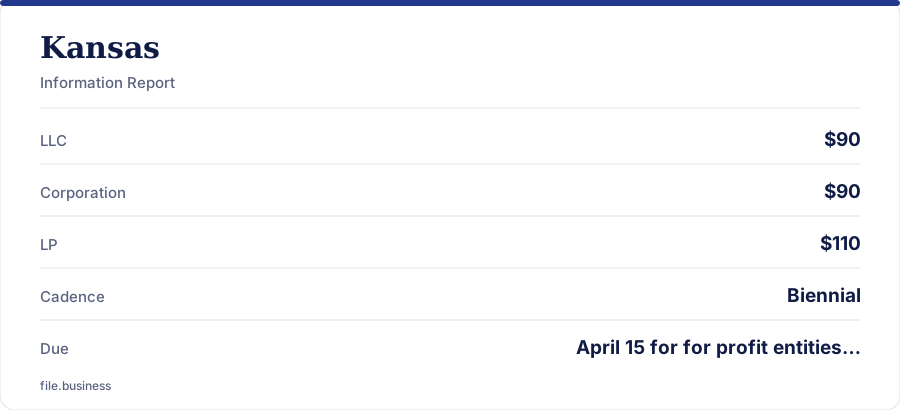

Almost every state sets its annual report deadline by one of two rules. Either it is a fixed calendar date for everybody, or it is the anniversary of formation. Kansas uses the first, on a two-year cycle. Effective January 1, 2024 Kansas replaced the annual report with a biennial Information Report, due April 15 for for-profit entities and June 15 for not-for-profit entities. So the date is fixed and only the year is derived from the register.
Every for-profit business files by April 15, whatever its accounting year. Which April 15 is set by formation-year parity: an entity formed in an even year owes its report in the next even year, and one formed in an odd year owes it in the next odd year. Changing the fiscal year no longer moves the filing deadline.
That design has a practical advantage worth naming. Kansas places the report two weeks after the point at which most businesses have closed and reviewed the year. So the officer list, the address, and the agent details are already in front of somebody. It also has a practical hazard. The filing year is not written anywhere on the formation certificate, and an owner searching for a Kansas filing date will find April 15 quoted everywhere without the parity rule that decides which April 15 applies.
What the Kansas report carries
The report goes to the Kansas Secretary of State at sos.ks.gov. It confirms the entity name and business entity identification number, the principal office, the registered agent and the agent's Kansas street address, and the members, managers, officers, or directors the entity type requires. It is the routine mechanism for correcting the register, so departures, appointments, and address moves belong in it. Anything the report cannot carry, such as the legal name, needs an amendment first. The line is drawn in our Kansas amendment guide.
A short clock behind a small penalty
Kansas charges $10 for lateness, which is among the smallest penalties in the country, and then runs interest on the balance. The number that matters is not the $10. Kansas administratively dissolves after 18 months of non-compliance. That matches Illinois for the shortest clock in this group, and runs half the length of Iowa's. A trivial penalty attached to an 18-month clock is the most misleading combination in state compliance, because the price signal and the timetable point in opposite directions.
Fee, Deadline and What the Portal Validates
Kansas Annual Report at a Glance
| Item | Value |
|---|---|
| Report name | Information Report |
| Filing frequency | biennial |
| Deadline | April 15 in the entity's biennial filing year |
| LLC filing fee | $90 online / $110 paper |
| Corporation fee | $90 online / $110 paper |
| Late penalty | $10 + interest |
| Processing time | 3-5 business days |
| Filing agency | Kansas Secretary of State |
LLCs and corporations pay the same $90 online, so entity type no longer changes the price. What does change the price is the twenty dollar paper surcharge, and what changes decisions is the interest line. It means a Kansas balance grows rather than sitting still, so an entity that has been delinquent for two years owes more than the arrears table suggests.
Processing and the practical cutoff
Standard processing runs 3 to 5 business days, which is quick by national standards. That gives a calendar-year filer real room, if they start in the last week of March. Kansas validates the entity name against the register down to the designator. The registered agent must also hold a physical Kansas street address that accepts service during business hours. The agent requirement is set out in the Kansas registered agent guide, and out-of-state entities will find the registration route in the Kansas foreign qualification guide.
File your Kansas annual report
We pull your record from the state, prefill every field, and track next year’s deadline. Or keep reading and file it yourself; this guide covers both.
The Compliance Risk Behind a Ten Dollar Penalty
Kansas prices lateness at almost nothing and prices the consequence at the entity. The gap between those two numbers is where the risk lives.
One, two and three missed reports in dollars
Because the report is biennial, arrears accumulate per missed report rather than per year. For an LLC, each missed report carries the $90 online fee and the $10 penalty. One missed report clears at $100, two at $200, and three at $300, before interest. A corporation pays the same $90 report and the same $10 penalty, so its arrears match an LLC's at every step. Add the $35 Application for Reinstatement once the entity has been dissolved, and a lapse of three missed reports settles at $335 in state charges for either entity type.
Interest accrues on top of both, and neither figure covers the cost of reconstructing three years of neglected records. Our reinstatement service handles the filing at a fixed $297 in service fees.
What forfeited status blocks
A delinquent Kansas entity cannot get a Certificate of Good Standing, which the Secretary of State issues for $15 on standard handling in 5 to 7 business days, or $25 expedited in 1 to 3 business days. Kansas certificates state the entity's fiscal year status, which is unusual. Counterparties in agriculture, energy services, and construction read that detail closely, because it tells them whether the business is current on its own accounting cycle, rather than merely on a calendar date.
A blocked certificate in Kansas therefore signals something slightly more specific than it would elsewhere. Counterparties commonly accept a certificate up to 90 days old, so the document is worth ordering before it is needed rather than during a transaction. The Kansas Certificate of Good Standing guide covers ordering and validity.
Eighteen months to dissolution, sixty to return
Administrative dissolution arrives at 18 months of non-compliance. For a calendar-year filer, that means missing two April deadlines is enough. The way back is an Application for Reinstatement at $35, without a tax clearance requirement, processed in 5 to 10 business days. Kansas keeps that route open for 60 months. That five-year remedy behind an eighteen-month trigger is generous. But the name is released at dissolution, and reinstatement does not recover it from whoever registered it next. Our Kansas reinstatement guide sets out the steps, and the Kansas dissolution guide covers closing on purpose.
Three Kansas Filings in Practice
Example 01: a Wichita single-member LLC
A private tutor runs a single-member LLC in Wichita formed in an even year, which sets her deadline at April 15 in each even year. Action taken: she files in the last week of March of her filing year, in the same session in which she assembles her tax material. She confirms her registered agent's Sedgwick County street address and lists herself as sole member.
Real cost: $90 to the Secretary of State. Timeline: seven minutes on the portal, accepted three business days later. Outcome: current for the next two years, with the report handled inside a task she was doing anyway.
Example 02: an Overland Park corporation on a June year end
An Overland Park distribution corporation was formed in an odd year, which places its Kansas report in each odd year rather than every year. Its bookkeeper had docketed the report annually from a general reference page. The company filed in an off year, when nothing was due, and, after the bookkeeper left, missed the odd-year deadline that mattered. The same report also had to record a treasurer appointed in March and a director who resigned in May.
Action taken: the filing year was recalculated from the formation year, the April filing listed the current officers and directors and corrected the principal office after a move within Johnson County.
Real cost: $90 for the corporate report, plus the $10 penalty and interest on the report that slipped, so $100 in all. Timeline: filed April 6, accepted April 10. Outcome: the register matches the board record, and the deadline is now stored as a rule tied to the formation year rather than as a date copied from a generic page.
Example 03: a foreign-qualified LLC filing in three states
A field services LLC formed in Kansas qualified in Oklahoma and Colorado as its crews took work across both borders. Three states, three entirely different clocks. Action taken: the owner recorded Kansas at $90, due April 15 but only in every second year. Oklahoma comes to $25, due on the entity's anniversary date, and Colorado to $25, due in the anniversary month. Real cost: $140 in a Kansas filing year and $50 in the off year, so $190 across the two-year cycle.
Timeline: about half an hour a year in total. Outcome: no lapse in any state, and one insight written down that saved the next year, which is that Kansas alone skips a year, so an off year with nothing due is not evidence that the entity is exempt. The comparison across states is in annual report deadlines by state.
Five Mistakes on the Kansas Annual Report
Mistake 1: Treating the state notice as the trigger
What it is: filing when a Kansas notice arrives rather than on a schedule you control. Why it happens: the notice generally does arrive, and a $10 penalty makes the occasional miss feel harmless. Consequence: the notice goes to the contact details on the register, so a stale address ends the reminders silently. Kansas also dissolves at 18 months, which arrives before the following biennial report would even come due. Prevention: work out your filing year from your formation year, put the April 15 date in your own calendar, and treat the state notice as a cross-check.
Mistake 2: Copying an annual cadence from a general reference page
What it is: treating the Kansas report as an annual filing due every April 15. Why it happens: Kansas was an annual-report state until January 1, 2024, and most summaries still describe it that way. Consequence: an entity files in a year when nothing is due, or lets the parity year in which the report actually falls go by. The interest runs from the real deadline, not the assumed one.
Prevention: store the rule, which is April 15 in the year whose parity matches your formation year, and confirm that parity once rather than guessing each spring.
Mistake 3: Confirming an agent or address that has lapsed
What it is: accepting the prefilled registered agent and principal office without verifying them. Why it happens: the portal displays last year's record, and confirming is faster than checking. Consequence: Kansas treats service delivered to the registered address as effective, whether or not anyone collects it. That is how a default judgment reaches a business that never saw the claim. Prevention: verify the agent's consent and Kansas street address each year before confirming, and file a change of registered agent when it is out of date.
Mistake 4: Assuming a dormant year is exempt
What it is: skipping the report because the entity had no activity, or expecting the fee to be waived for a business that closed its books at zero. Why it happens: the April 15 deadline sits on the tax calendar, which makes the filing feel like a tax return, and a nil tax return often costs nothing.
Consequence: the report is due whatever the numbers say, and the fee is unchanged. An entity that treats a quiet year as an exempt year is halfway to the 18-month dissolution threshold before anyone reviews it. Prevention: file in every year the report falls due for as long as the entity exists, and close it deliberately if it will not be used again.
Mistake 5: Looking for an initial report Kansas does not require
What it is: expecting a separate first filing within 90 days of formation. Why it happens: states such as Georgia and Louisiana do require one, and national checklists mention it without naming the states. Consequence: Kansas has no initial report. The first obligation falls in the next year whose parity matches the formation year, so an entity formed in November 2026 owes its first report on April 15, 2028, later than an owner expecting an annual filing will assume.
Prevention: on formation, record whether the formation year is odd or even and calculate the first filing year from it. Formation itself is covered in how to start a Kansas LLC.
Building a Kansas Filing Routine
Practice 1: Attach the filing to the year end close
Kansas placed the deadline three and a half months after a calendar year's books close for a reason. Put the report on the closing checklist for the years it falls due, rather than on a separate compliance calendar, and it gets done while the officer list and the addresses are already being reviewed.
Practice 2: Confirm which year your report falls in
A change of accounting year no longer moves the Kansas deadline, but the parity year still decides whether anything is due this April. Confirm the formation year once, record whether it is odd or even, and update every calendar that still holds an annual date.
Practice 3: Keep the Kansas record together
Hold the entity identification number, the fiscal year end, each filed report, the registered agent agreement and the current certificate in one place. Because the Kansas certificate reports fiscal year status, the accounting record and the register have to agree before a counterparty reads either. Our compliance monitoring keeps that alignment under watch, and the annual report filing service handles submission.
How File.Business Handles Kansas Annual Reports
File.Business files the Kansas Annual Report for entities on our compliance service. We calculate your filing year from your formation year, rather than assuming the report is due every April 15, and pull the current record from Business Services so the submission matches the register. We flag anything needing an amendment or an agent change first, file ahead of the deadline, pay the $90 online state fee, and confirm acceptance.
If you are unsure which year your report falls in we confirm the parity against the register, which is the failure that costs Kansas filers most often. Kansas registered agent service and good-standing monitoring are included. Scope and pricing are on the Kansas annual report page.
Kansas annual report FAQ
When is the Kansas annual report due?
April 15, but only in every second year. Kansas replaced the annual report with a biennial Information Report effective January 1, 2024, and the filing year follows formation-year parity: formed in an even year, file in even years; formed in an odd year, file in odd years. Not-for-profit entities file by June 15.
How much does the Kansas annual report cost?
The Kansas Information Report is $90 filed online and $110 on paper, for both LLCs and corporations. Not-for-profit entities pay $80. Kansas files BIENNIALLY, not annually, under K.S.A. 17-76,139 and 17-7503. Payment is made in the Kansas Business Services portal at the time of filing. Late filings add a $10 penalty plus interest, so a Kansas balance grows rather than sitting still.
Where do I file the Kansas annual report?
Online at sos.ks.gov, the Kansas Secretary of State Business Services portal. Standard processing runs 3 to 5 business days, which is quick by national standards and leaves a calendar-year filer real room if they begin in the last week of March.
What happens if I miss the Kansas deadline?
A $10 penalty plus interest attaches and the entity is flagged delinquent, which blocks the $15 Certificate of Good Standing. Three missed reports cost $300, the same for an LLC as for a corporation, before interest. Kansas administratively dissolves after 18 months, and reinstatement then costs $35 and stays available for 60 months.
Does changing my fiscal year change the Kansas deadline?
No, not since January 1, 2024. The biennial Information Report is due April 15 regardless of the accounting year, and only the filing year varies, set by formation-year parity. A change of fiscal year is no longer a Kansas filing-date event.
Do foreign LLCs need to file a Kansas annual report?
Yes. An LLC or corporation foreign-qualified in Kansas files the Information Report on the same biennial schedule as a domestic entity, at the same fee. The report filed in your formation state does not satisfy the Kansas requirement.
Can File.Business file my Kansas annual report?
Yes. We calculate your filing year from your formation year, validate every field against the Business Services record, file ahead of the deadline, pay the $90 online state fee and confirm acceptance. Kansas registered agent service and good-standing monitoring are included with the compliance service.
File your Kansas annual report
We pull your record from the state, prefill every field, and track next year’s deadline. Or keep reading and file it yourself; this guide covers both.
Doing this in Kansas specifically: Kansas annual report filing and the annual report page at the Kansas Secretary of State cover the detail for this state, including the current fee and the exact form the agency expects.
This guide is written from the official sources below. Fees, forms, and deadlines change. Confirm the current requirement with the agency before you file.
Disclosure. File.Business is a private filing service, not a government agency and not a law firm. We prepare and submit filings at your direction. Nothing on this page is legal or tax advice. Filing fees, deadlines, and statutory references are current as of the last-updated date shown above, and they can change. Confirm current requirements with the relevant state agency before you file.


