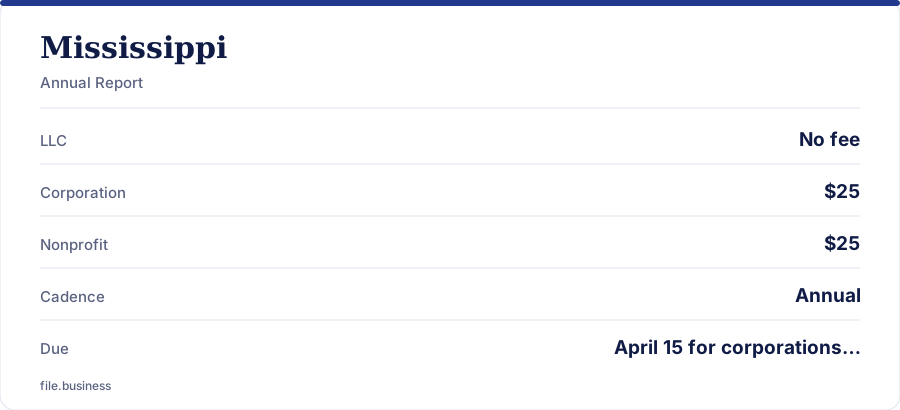
Mississippi prices its annual report by entity type rather than by anything else. A domestic limited liability company pays nothing, a corporation pays $25 whether domestic or foreign, and a foreign LLC pays $250. Those are the figures on the Secretary of State's own Services and Fees Schedule.
There is no late penalty at any of those prices. The Secretary of State keeps accepting the report after April 15, right up until it moves to dissolve the entity. That is precisely what makes Mississippi dangerous: for most filers there is neither an invoice to notice nor a penalty to sting, and the first consequence anybody sees is a refused certificate.
What the Mississippi Annual Report Covers

You file the annual report with the Business Services Division of the Mississippi Secretary of State, under Miss. Code § 79-29-215 for a limited liability company and Miss. Code § 79-4-16.22 for a corporation. It confirms the entity record for the coming year. It carries the legal name and business identification number. It carries the principal office address. It carries the registered agent and that agent's Mississippi street address. And it carries the officers, directors, managers, or members the entity type requires. The filing is short. What matters is that every field agrees with the record the Division already holds.
Mississippi has one feature worth knowing about before anyone runs due diligence on your company. The state prints registered agent verification status on the certificates it issues. A counterparty pulling a Mississippi certificate can see whether the agent on record has been verified. That turns what is normally an internal housekeeping matter into something a bank or an acquirer can read directly.
Who files in Mississippi
Domestic LLCs and corporations formed under Mississippi law file every year from formation onward. Entities formed elsewhere that hold a Mississippi foreign qualification file on the identical April 15 schedule, but not at the identical price: a foreign LLC pays $250 a year where a Mississippi LLC pays nothing, while a foreign corporation pays the same $25 as a domestic one. They use the Mississippi registration, rather than anything from the home state. Nonprofits file the Nonprofit Status Report at $25 by May 15. Unregistered sole proprietorships and general partnerships have nothing to file here.
Why April 15 creates the problem
Mississippi shares its deadline with the federal income tax date. Take an owner whose accountant is mid-season, and whose own attention is on a tax return. A registry filing that costs an LLC nothing at all is the easiest thing in the calendar to defer by a week, and nothing bills you when you do. That is why the practical advice for Mississippi is to file in February, rather than to file on time in April.
The Mississippi Filing at a Glance
| Item | Value |
|---|---|
| Report name | Annual Report |
| Filing frequency | Annual |
| Deadline | April 15 |
| Mississippi LLC filing fee | No fee |
| Foreign LLC filing fee | $250 |
| Corporation fee, domestic or foreign | $25 |
| Late penalty | None |
| Reinstatement, if dissolved | $50 (LLC or profit corporation); $100 foreign LLC |
| Processing time | 5-7 business days |
| Filing agency | Mississippi Secretary of State |
| Filing portal | sos.ms.gov |
Five to seven business days is a quick standard turnaround. A report filed in the first week of March is on the record well before anyone needs to look at it. That is the whole argument for filing early in a state where nothing bills you for filing late.
Fields that have to agree with the record
The Division validates against its own data. Legal name, character for character, including whether the designator is preceded by a comma. Business identification number. Principal office. Registered agent name and Mississippi street address, which cannot be a post office box. Where the entity type requires officers or managers, those names too. A mismatch produces a refusal rather than a prompt, so the record check comes first.
Keeping the agent verification clean
Agent verification is visible on Mississippi certificates. So an agent record that has drifted is not only a filing obstacle. It is a diligence signal. Has the agent resigned, moved, or since left the business? Resolve it with a change of registered agent before the report, rather than after. Confirm what the state currently shows on the Mississippi business search. And if the arrangement was always informal, a commercial Mississippi registered agent removes the recurring risk.
File your Mississippi annual report
We pull your record from the state, prefill every field, and track next year’s deadline. Or keep reading and file it yourself; this guide covers both.
Compliance Risk: The Penalty That Doubles the Fee
Mississippi's escalation is straightforward, which makes the arithmetic easy to see and hard to argue with.
How a Mississippi lapse develops
- April 16. Nothing happens, and nothing is charged. The Secretary of State keeps accepting the report.
- Through the year. The entity leaves good standing. Certificates stop issuing, and the agent verification line stops helping you.
- Second April 15. Two reports outstanding, still with no money owed and still with nothing to prompt you.
- Around 24 months. Administrative dissolution. Mississippi authority to transact business ends.
- At 36 months. The reinstatement window closes. After three years the entity cannot be restored at all.
| Years missed | Back fees, MS LLC | Back fees, corporation | Penalties |
|---|---|---|---|
| One year | $0 | $25 | None |
| Two years | $0 | $50 | None |
| Three years | $0 | $75 | None |
Read that table for what is missing from it. There is no penalty column worth anything, because Mississippi charges none, and a domestic LLC owes nothing at all however many years it skips. Three missed years cost a corporation $75 and an LLC nothing. The money only appears once the entity has been administratively dissolved and needs the $50 Application for Reinstatement, and by then the exposure is the 36 month clock rather than the fee.
The 36 month limit deserves a diary entry rather than a mental note. Mississippi allows reinstatement for three years after administrative dissolution. Once that period expires the entity is gone permanently. The formation date, the name, and any qualification another state granted on the strength of the Mississippi registration all have to be rebuilt from scratch.
Our reinstatement service operates inside that window. Has the business genuinely stopped? Then voluntary dissolution leaves a much cleaner record than an administrative one.
Three Mississippi Filings in Practice
Example 1: A Hattiesburg LLC files in February
A landscaping business operating as a single-member LLC files its annual report in the second week of February. That is before the spring season starts, and well before its accountant disappears into tax work. The record check confirms the registered agent address, and the report goes in at no charge, because Mississippi charges a domestic LLC nothing for it. Acceptance posts within a week. A commercial client asks for a certificate in May, as a condition of a maintenance contract. The certificate issues immediately, with the agent verification showing current.
Outcome: The certificate was available the week it was requested, with nothing on it to explain.
Example 2: A Jackson corporation lists new officers
A broadcasting company appointed a new general manager as president, and replaced a retiring director. Mississippi corporations carry officers and directors on the annual report. So the April filing is where the change becomes public. The company files on March 3 for $25, with both names corrected. In July a station acquisition puts the corporate record under a buyer's scrutiny. The officer list on the register matches the resolutions in the minute book, which removes an entire round of diligence questions.
Outcome: A $25 filing did the work that would otherwise have taken a corrective filing under deal pressure.
Example 3: A Gulfport business across the Gulf Coast
A marine services company formed in Mississippi works ports in Alabama and Louisiana, and holds qualifications in both. Mississippi wants its report on April 15. Alabama and Louisiana run their own schedules, on their own forms, with their own fees. The office manager files Mississippi first each year, in February. Mississippi is the state of formation, and a dissolved home entity cannot support either qualification. Three registrations, one sequence, and the free one treated as the most important.
Outcome: No qualification was ever exposed to a lapse in the state of formation. Our deadline table by state keeps the other two visible.
Five Errors Behind Mississippi Penalties
Each of these is inexpensive to prevent and disproportionately expensive to correct.
What happens: The report is deferred because the fee is small, or for an LLC absent altogether.
Why it happens: People size the risk by the fee, and $0 does not read as risk at all.
Consequence: No bill and no penalty ever arrive to correct the impression, and the first thing anyone notices is a good standing gap.
Prevention: Rank the filing by what failure costs rather than what it charges, and diary April 15 the day the entity is formed.
What happens: April 15 arrives, the income tax return absorbs everything, and the annual report slides.
Why it happens: Mississippi shares its deadline with the federal filing date, and one obligation crowds out the other.
Consequence: A delinquency that is entirely a scheduling failure rather than a cash flow one, and one nothing bills you for.
Prevention: File in February. Nothing about the report benefits from waiting for April.
What happens: A counterparty pulls a Mississippi certificate and sees agent verification that is not current.
Why it happens: Mississippi surfaces agent status on its certificates, a detail most owners never learn until someone else reads it.
Consequence: A diligence question about basic corporate housekeeping at the least convenient moment.
Prevention: Confirm the agent record annually, before the report rather than after a certificate request.
What happens: The submission is refused over a designator, a comma, or an ampersand that does not match the register.
Why it happens: The name on the invoice template is rarely the name on the formation document.
Consequence: A rejection cycle that can carry a mid-April filing past the deadline and into the penalty.
Prevention: Copy the legal name and identification number directly from the state record every year.
What happens: A dissolved Mississippi entity is left dormant past the 36 month reinstatement limit.
Why it happens: Dissolution arrives quietly and the deadline to fix it is not announced.
Consequence: Permanent loss of the entity, its formation date, its name, and any qualification built on it.
Prevention: Diary the 36 month date the moment dissolution appears on the register, and act well inside it.
A Mississippi Routine That Avoids April
Three habits carry a Mississippi entity through the year without ever paying the penalty.
How File.Business Files in Mississippi
We file Mississippi annual reports ahead of April 15, usually in February. First we reconcile the entity against the Business Services record, so the name, identification number, agent, and officer list validate first time. We pay whatever the entity type owes, which for a Mississippi LLC is nothing at all, confirm acceptance, and monitor good standing through the year. Mississippi registered agent service is included for the first year. That also keeps the agent verification line on your Mississippi certificate reading the way you want it to when someone else looks at it.
Mississippi annual report FAQ
Six questions Mississippi filers raise most often. For registrations in more than one state, see our annual report service.
When is the Mississippi annual report due?
April 15 every year, for domestic and foreign-qualified LLCs and corporations alike. The date is fixed rather than tied to the formation month. And it coincides with the federal income tax filing date.
How much does the Mississippi annual report cost?
Nothing for a Mississippi LLC, $25 for a corporation whether domestic or foreign, and $250 for a foreign LLC. Those are the figures on the Secretary of State's Services and Fees Schedule. None of them varies with revenue or headcount.
What is the late penalty in Mississippi?
There is none. Mississippi charges no late penalty on the annual report, and the Secretary of State keeps accepting a late report until it moves to administratively dissolve the entity. Clearing three missed years costs a domestic LLC nothing and a corporation $75, the ordinary fees with nothing added.
Why does agent verification appear on Mississippi certificates?
Mississippi includes the registered agent verification status on the certificates it issues. That gives a bank, buyer, or counterparty a direct view of whether the agent record is current. It is a useful due diligence signal, and a reason to keep the agent record clean.
How long do I have to reinstate a dissolved Mississippi entity?
Thirty-six months from administrative dissolution. Inside that window an Application for Reinstatement restores the entity with its original formation date. Once three years have passed the entity cannot be restored. A new company has to be created instead.
Do foreign-qualified companies file a Mississippi annual report?
Yes. Any LLC or corporation holding a Mississippi qualification files by April 15, on the same terms as a domestic entity. The report filed in the state of formation does not satisfy Mississippi. And a lapse here suspends the Mississippi qualification, while the home registration stays current.
File your Mississippi annual report
We pull your record from the state, prefill every field, and track next year’s deadline. Or keep reading and file it yourself; this guide covers both.
Working in Mississippi specifically: Mississippi annual report filing and our Mississippi annual report reference page carry the current fee and the exact submission the Business Services Division expects. Registering in from another state starts with foreign qualification in Mississippi.
This guide is written from the official sources below. Fees, forms, and deadlines change. Confirm the current requirement with the agency before you file.
Disclosure. File.Business is a private filing service, not a government agency and not a law firm. We prepare and submit filings at your direction, and nothing on this page is legal or tax advice. Filing fees, deadlines, and statutory references are current as of the last-updated date shown above and can change. Confirm current requirements with the relevant state agency before you file.