
Why Arizona Does Not Look Like Its Neighbors
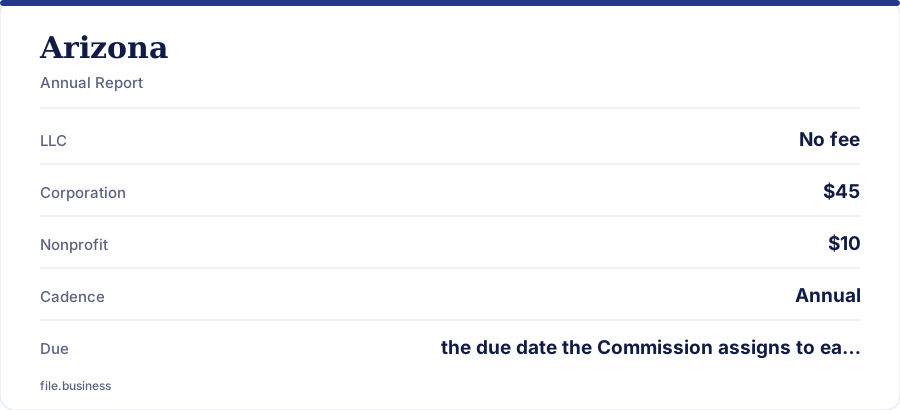

Three things make Arizona unusual, and each one is a place where filers who learned the rules in another state get it wrong. The agency is the Arizona Corporation Commission rather than a Secretary of State. The deadline is the entity's own anniversary month rather than a date printed on the calendar. And the annual report is a corporation obligation, imposed by Arizona Revised Statutes 10-1622 on each domestic corporation and each foreign corporation authorized to transact business in the state. The Commission's fee schedule shows $45 for a corporation and carries no LLC annual report line at all, because an Arizona LLC is not asked for an annual report.
That last point causes more confusion than the other two combined. It does not mean an Arizona LLC has nothing to maintain. The maintenance runs through the record rather than through a yearly fee. You need a statutory agent with a physical Arizona address, a current principal address, and accurate member or manager detail. The Commission publishes all of this, and a bank, insurer, or counterparty will read it. Filings go through azcc.gov, and the same portal shows the status the state currently holds for you.
Statutory agent, not registered agent
Arizona calls the role a statutory agent. The label matters when you are searching a portal or reading a form, because the phrase used in most other states returns nothing useful here. The substance is the same: a named person or company with a physical Arizona street address who accepts service of process during business hours.
A post office box does not qualify, and neither does an out-of-state office. Companies that treat Arizona statutory agent service as a formality discover the gap when a lawsuit is served on an address the business left two years ago.
What the corporate report actually carries
An Arizona corporation's annual report is a disclosure document, not a receipt. It confirms the principal office, the statutory agent, and the officers and directors the Commission publishes. That makes it the natural moment to reconcile the state record against the corporate minute book. A corporation that changes its board in March and files in November has an eight-month gap. During that gap, the public record names people who no longer serve.
Arizona Annual Report at a Glance
| Item | Value |
|---|---|
| Report name | Annual Report |
| Filing frequency | Annual |
| Deadline | Entity anniversary month |
| LLC filing fee | $0 (no report required) |
| Corporation fee | $45 |
| Late penalty | $9 per month on a corporate report |
| Processing time | 3-5 business days |
| Filing agency | Arizona Corporation Commission |
| Reinstatement window | 72 months |
Three to five business days is a fast turnaround by national standards. That tempts corporations into filing in the last week of their anniversary month. The margin is thinner than it looks, because the $9 per month penalty attaches by reference to the due date, not to the day the Commission gets around to reviewing a submission. Filing in the first week of the month costs the same $45 and removes the question entirely.
The Risk Ladder for a Delinquent Arizona Corporation
Arizona's penalty is small per month and relentless per year. At $9 a month, a single unfiled corporate report costs $108 in penalties over twelve months, which is more than twice the $45 the report itself would have cost. Leave a second year unfiled and the first year keeps accruing alongside it.
| Years missed | Report fees | Penalty accrual | Running total |
|---|---|---|---|
| One | $45 | $108 | $153 |
| Two | $90 | $324 | $414 |
| Three | $135 | $648 | $783 |
The penalty column stacks because each unfiled report keeps its own clock. After two years the oldest report has run twenty-four months at $9 and the newer one twelve, which is $216 plus $108. After three years the same logic produces $324, $216, and $108. Nothing about that arithmetic is aggressive on its own. The total simply becomes absurd next to a $45 filing.
Administrative dissolution six months in
Long before the money matters, the status does. Roughly six months into a delinquency, the Commission moves toward administrative dissolution. The corporate name stops being protected. Contracts signed after that date invite an argument about who exactly signed them. And a certificate of good standing becomes unobtainable at the moment a lender or a licensing board asks for one. Arizona does not need three years to make a lapse expensive. It needs two quarters.
A six-year window to come back
Arizona is generous where it counts. The Application for Reinstatement is available for 72 months after administrative dissolution, the longest window of any state in this series. There is also no tax clearance step blocking the route. What you pay instead is the arithmetic above: every missed report, every accrued monthly penalty, and the reinstatement fee the Commission sets. A corporation that comes back in year three pays the $783 rather than the $153 it would have owed by fixing the problem in month two. The Arizona reinstatement guide covers what the Commission expects with the application.
File your Arizona annual report
We pull your record from the state, prefill every field, and track next year’s deadline. Or keep reading and file it yourself; this guide covers both.
Three Arizona Situations in Practice
Scenario one: a single-member LLC in Tempe
A software consultant runs a single-member Arizona LLC. Her annual state fee is $0, and her annual state task is not zero. Each January she opens the Commission record. She confirms the statutory agent is still under contract, checks that the principal address matches where mail actually arrives, and confirms the member detail is current. It takes ten minutes and costs nothing. The value shows up when she applies for a line of credit and the bank's verification of the public record returns exactly what she put on the application.
Scenario two: a Phoenix corporation updating its board
A commercial HVAC corporation incorporated in April files each April. This year the report does real work: a director resigned in the autumn, the vice president was promoted to president, and the company moved from a leased suite to a building it bought. All three changes reach the state through the annual report, and the corporation pays $45.
Skipping the reconciliation would have cost nothing in April and a great deal in October, when a bonding company pulled the Commission record before underwriting a contract and found an officer list that did not match the signature page in front of it.
Scenario three: an Arizona corporation qualified in two more states
The same HVAC corporation qualifies in California and Florida to chase work across state lines. Now it holds three deadlines with three different shapes. Arizona wants $45 in April, its anniversary month. California wants a Statement of Information every year from a corporation, at $25, in its own anniversary month. Behind that sits a $250 penalty, plus an $800 Franchise Tax Board minimum that has nothing to do with the report. Florida wants $150 by May 1 flat, with a $400 penalty for being one day late.
Total state fees for the year: $220. Total penalty exposure for forgetting the cheapest-looking one: $400. Companies that treat multi-state filing as one task rather than three end up optimizing for the wrong state, which is why we keep a per-jurisdiction compliance calendar for entities on the annual report service.
Five Mistakes That Put Arizona Entities in Delinquent Status
Mistake 1: Waiting for the Commission to write first
What happens. The corporation treats the Commission's reminder as the start of the process. Why it fails. The reminder goes to the statutory agent and the address on the record, and those are exactly the fields that go stale first. A reminder sent to a resigned agent is still a reminder the state considers delivered. Consequence. The $9 per month penalty starts on the due date, not on the day anyone realizes. Prevention. Diary the anniversary month with a thirty-day warning and treat the Commission's notice as confirmation.
Mistake 2: Looking for a fixed calendar date
What happens. A filer who also handles Florida or Arkansas assumes Arizona has a single statewide date. Why it fails. Arizona ties the deadline to the entity's own anniversary month, so two companies in the same office can be six months apart. Consequence. Filing on the wrong assumption means being late by months without ever having been careless. Prevention. Take the anniversary from the Commission record rather than from memory, and write the month into the entity file where the next person will find it.
Mistake 3: Filing against a lapsed statutory agent
What happens. The report repeats the statutory agent and address that were entered at formation. Why it fails. Agents resign, service contracts end, and Arizona requires a physical in-state address that accepts service during business hours. Consequence. Service of process and Commission notices reach an address nobody monitors, which is how a default judgment arrives before the complaint does. Prevention. Verify the agent first, and file the Arizona statutory agent change before the annual report if anything has moved.
Mistake 4: Reading the LLC exemption as nothing to do
What happens. An owner learns that an Arizona LLC owes nothing and concludes the Arizona record maintains itself. Why it fails. The absence of a fee is a statement about money, not about obligations. The statutory agent requirement, the address requirement, and the accuracy of the published member detail all continue, and any corporation in the same portfolio still owes $45 a year.
Consequence. The record drifts until something breaks that depends on it, usually a bank verification or a license renewal. Prevention. Give the LLC the same annual review a corporation gets, even though no invoice arrives to prompt it.
Mistake 5: Assuming formation covered the first cycle
What happens. A newly incorporated Arizona company assumes its formation filing satisfied the first annual report. Why it fails. Registering an entity and reporting on it are separate transactions. Arizona has no combined filing, so the first corporate report is owed in the first anniversary month that follows incorporation. Consequence. A first-year corporation collects penalties before it has collected revenue. Prevention. On the day the Commission approves the Arizona incorporation, look the entity up, note the anniversary month, and set the reminder before the paperwork is filed away.
Running an Anniversary-Month Calendar
Anniversary deadlines defeat spreadsheets that assume everyone files in April. The fix is to store the month with the entity rather than with the task. Track the entity name exactly as chartered, the Commission file number, the anniversary month, the statutory agent and physical address, and the current officer list for a corporation. Review it in the month before the anniversary, not during it. That way a change of agent or address can be filed first, and the report matches the record when it arrives.
If you hold both an Arizona LLC and an Arizona corporation, keep the two on separate lines even though only one of them generates an invoice, because the one that does not is the one that gets forgotten.
How File.Business Handles Arizona Filings
We take the anniversary month from the Commission record, not from what a client remembers. We check the statutory agent and address before anything is prepared, reconcile the officer and director list for corporations, file inside the month, pay the $45, and return the acceptance. Arizona LLCs on our compliance plan get the same annual record review even though no fee is due, because the record is the asset. The Arizona annual report page covers the agency-side detail if you would rather do it yourself.
Arizona annual report FAQ
Do Arizona LLCs file an annual report?
No. Arizona is one of the few states that does not require an annual report from an LLC. The Corporation Commission's fee schedule has no LLC annual report line at all, so there is nothing to file and nothing to pay. The statutory agent, principal address, and member detail on the record still have to be kept current.
How much is the Arizona annual report for a corporation?
$45, filed in the corporation's anniversary month. A late corporate report accrues $9 per month, so a report left unfiled for a year costs $108 in penalties on top of the $45.
Which agency handles Arizona business filings?
The Arizona Corporation Commission, at azcc.gov. Arizona does not route entity filings through a Secretary of State, which is why searches framed around that office lead nowhere.
When exactly is my Arizona deadline?
Your entity's anniversary month, taken from the date the Commission approved the registration. Two companies formed in the same office in different months have different deadlines, so the month should be read off the Commission record rather than assumed.
What happens if an Arizona corporation stops filing?
Penalties accrue at $9 per month per unfiled report, and the Commission moves toward administrative dissolution roughly six months into the delinquency. Three unfiled years total about $783 in fees and penalties before any reinstatement fee.
How long do I have to reinstate an Arizona entity?
Up to 72 months after administrative dissolution, which is the longest reinstatement window in this series. All missed reports and accrued penalties have to be cleared as part of the application.
Can File.Business handle Arizona filings for me?
Yes. We confirm the anniversary month, validate the statutory agent and officer detail, file the corporate annual report and pay the $45, and run the same record review for Arizona LLCs even though no fee is due.
File your Arizona annual report
We pull your record from the state, prefill every field, and track next year’s deadline. Or keep reading and file it yourself; this guide covers both.
More on the Arizona record: Arizona annual report filing if you want it handled for you, Arizona LLC versus corporation if the absence of an LLC report is shaping your entity choice, and closing an Arizona entity if the plan is to wind down.
This guide is written from the official sources below. Fees, forms, and deadlines change. Confirm the current requirement with the agency before you file.
Disclosure. File.Business is a private filing service, not a government agency and not a law firm. We prepare and submit filings at your direction, and nothing on this page is legal or tax advice. Filing fees, deadlines, and statutory references are current as of the last-updated date shown above and can change. Confirm current requirements with the relevant state agency before you file.


