
The Smallest Filing With the Sharpest Edge
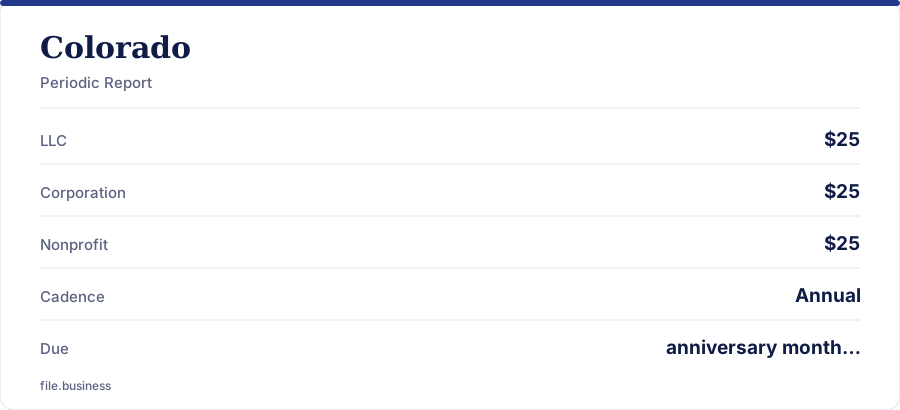

At $25, the Colorado Periodic Report that C.R.S. 7-90-501 requires of every reporting entity is the cheapest annual obligation in this series. The late fee is $50 - so the penalty for forgetting is double the price of remembering. No other state covered here punishes at that ratio. The reason it matters is behavioral, not financial: a $25 line item never earns a place on anyone's calendar, and the state has priced the consequence accordingly.
Everything happens at sos.state.co.us, and Colorado accepts these filings online only. There is no paper fallback to buy time with, and that cuts both ways. A filer with the entity ID in hand can finish in under ten minutes, at any hour. But a filer who has lost access to the record, or who never knew the entity ID, has no counter to walk up to and no envelope to post.
What the Periodic Report asks for
Less than most states. Colorado wants the entity name and ID, the principal office address, and the registered agent's name and Colorado street address, confirmed or corrected. It does not collect an officer roster, a member list, or financial detail. That brevity matters: a change of directors or officers never reaches the Colorado record through this filing at all. The state simply is not asking, so a company that assumes the report keeps its leadership record current has a gap it cannot see.
Anniversary month, plus two
The report is due in the month the entity registered, and Colorado allows roughly two further months before it moves the record out of good standing. That grace period is real, and it is also why Colorado lapses are so common. Nothing visible happens at the end of the anniversary month, so the deadline feels soft. And a soft deadline in a business with a busy quarter is a deadline that arrives after the grace has already run out.
Colorado Periodic Report at a Glance
| Item | Value |
|---|---|
| Report name | Periodic Report |
| Filing frequency | Annual |
| Deadline | Entity anniversary month |
| LLC filing fee | $25 |
| Corporation fee | $25 |
| Late fee | $50 |
| Processing time | 1-3 business days |
| Filing agency | Colorado Secretary of State |
| Curing delinquency | Statement Curing Delinquency, no deadline |
One to three business days is the fastest turnaround of any state in this series. That is why a Colorado problem can usually get fixed the same week it is found. This speed is also why there is no excuse for filing at the edge of the grace period - the constraint is never the state's processing, it is whether anyone looked at the record.
The Consequences of Letting the Window Close
Colorado's arithmetic is small, but its shape is instructive. Every year you miss costs $25 in report fees and $50 in late fees. The penalty always outweighs the filing that would have avoided it.
| Years missed | Report fees | Late fees | Running total |
|---|---|---|---|
| One | $25 | $50 | $75 |
| Two | $50 | $100 | $150 |
| Three | $75 | $150 | $225 |
Two hundred and twenty five dollars is not what a three-year Colorado lapse actually costs - it is only what the state charges. The rest of the cost sits in the two years the record showed the entity as delinquent, to every bank, insurer, landlord, and counterparty who looked.
Delinquent, in public
Colorado publishes entity status openly, and the search is free and instant. That is a genuine advantage when you are checking a supplier, and a genuine exposure when someone is checking you. A delinquent status means no Colorado certificate of good standing will issue. The effects land in ordinary commercial situations rather than in a courtroom: a lender pauses a draw request, a general contractor asks for proof before adding you to a project, a merchant processor holds a settlement. None of that shows up as a penalty in the state's ledger - and all of it costs more than $50.
Curing delinquency, with no clock running
Colorado's route back is the Statement Curing Delinquency, and there is no window on it. An entity that went delinquent in 2021 can still cure in 2026, by filing the missed reports and paying the fees and the late fees. Around 24 months of delinquency, Colorado can move to administrative dissolution, and the cure filing is what stands between the record and that outcome.
The absence of a deadline should not be read as an absence of consequence. The record stays visibly bad for the entire period, and the Colorado reinstatement path exists to be used early, rather than eventually.
File your Colorado annual report
We pull your record from the state, prefill every field, and track next year’s deadline. Or keep reading and file it yourself; this guide covers both.
Three Colorado Filings in Practice
Scenario one: a single-member LLC in Denver
A freelance video editor formed her single-member Colorado LLC in March, so March is her month. She files on the second of March, confirms the agent address and the principal office, pays $25, and the record updates within two business days. Her whole compliance year is one filing and one screen. What makes it reliable is that she files on the first business day of her month, rather than at the end of the grace period - so a card failure or a portal outage costs her days of margin rather than $50.
Scenario two: a Boulder corporation and its officer roster
A hardware corporation in Boulder replaced its chief financial officer and appointed two new directors during the year. Its Periodic Report is filed in September, at $25, and it confirms the principal office and the registered agent. What it does not do is publish the new officers - Colorado does not ask for them on this form. So the corporation keeps its roster current in two other places instead: the minute book, and the documents counterparties actually rely on, which are the incumbency certificates and banking resolutions it issues on request.
Companies that expect the state record to carry officer detail - as Arizona and California records do - discover the gap when a bank asks for evidence of signing authority, and the public record has nothing to offer.
Scenario three: three entities, three different cadences
A construction group holds a Colorado LLC, an Arizona corporation, and an Alaska LLC. Colorado wants $25 in the LLC's anniversary month. Arizona wants $45 in the corporation's anniversary month, with $9 per month behind it. Alaska wants $100, but only every second January. Three entities, three anniversaries - and one that skips a year entirely.
The group's controller keeps a single sheet with entity, jurisdiction, month, cadence, fee, and penalty, and reviews it each quarter. Without the cadence column, the Alaska filing is the one that vanishes - and Alaska is the state that moves to dissolution six months after the miss. A structured compliance calendar is the difference between three filings and two filings plus a reinstatement.
Five Mistakes That Make Colorado Entities Delinquent
Mistake 1: Relying on the email reminder
What happens. The owner signs up for a notification once, and treats it as the whole system. Why it fails. Notifications depend on an address that stays valid and a mailbox someone still reads. Staff turnover, a changed domain, or an aggressive spam filter breaks the chain silently. Consequence. The anniversary month and the grace period both pass, and $50 attaches to a $25 filing. Prevention. Put the anniversary month in your own calendar with a two-week lead, and use the state notification only as a second signal, not the only one.
Mistake 2: Hunting for a statewide due date
What happens. A filer looks for the Colorado equivalent of Florida's May 1, cannot find one, and so nothing gets docketed. Why it fails. Colorado sets the deadline per entity, from the month of registration. There is no single date to look up, and no shared reminder to ride on. Consequence. The company waits for a date that never arrives, while the grace period quietly expires. Prevention. Read the month off the state record once, write it into the entity file, and treat that month as the fixed date it effectively is.
Mistake 3: Confirming an agent you no longer have
What happens. The report is submitted with the agent and principal address prefilled from last year. Why it fails. The prefill is a convenience, not a verification. Colorado requires a physical Colorado street address for the agent, and confirming a stale entry is an affirmative statement that it is correct. Consequence. Service of process reaches an address the business already left, and the first sign of trouble is a judgment rather than a summons. Prevention. Read every prefilled field before submitting, and file a Colorado agent change whenever the answer is no.
Mistake 4: Treating a cheap filing as an optional one
What happens. A $25 obligation never makes it onto a list that contains five-figure items. Why it fails. The consequence has nothing to do with the fee. Delinquent status gets published, it blocks the certificate of good standing, and it runs toward administrative dissolution at around 24 months. Consequence. A trivial filing produces a real commercial problem, right in the middle of a financing or a bid. Prevention. Rank compliance work by what failure blocks, not by what it costs - which puts Colorado's $25 filing near the top, rather than off the page.
Mistake 5: Assuming registration covered the first report
What happens. A new Colorado entity assumes its formation filing started the clock and satisfied the first report. Why it fails. Colorado has no separate initial report - which owners often read as meaning nothing is owed early. The first Periodic Report is still due in the anniversary month that follows registration, on the ordinary schedule. Consequence. A first-year company goes delinquent before its first anniversary dinner. Prevention. When the Colorado registration is accepted, look the entity up on the Colorado business search, note the month, and mark it on the calendar before closing the tab.
A Calendar Built Around an Anniversary
Anniversary states reward a specific habit: store the month with the entity, not the task. A Colorado file should carry the exact registered name, the entity ID, the anniversary month, the agent's Colorado street address, and a login someone other than the founder can use. Review it the month before the anniversary, so an address change or an amendment can be filed first, and the report simply confirms a record that is already correct.
Groups holding entities in several states should record cadence alongside the month - the annual ones build habits, and the biennial ones build gaps. Our annual report service keeps that per-entity, which is the only way a portfolio stays clean.
How File.Business Handles Colorado Periodic Reports
We take the anniversary month from the Secretary of State record, not from memory. We verify the agent and principal address before the filing opens, submit inside the first week of the month, pay the $25, and send you the confirmation. Because Colorado publishes status openly, we monitor it continuously for entities on our compliance plan, and raise an alert if anything moves toward delinquency - along with Colorado registered agent service at a real Colorado street address. The Colorado periodic report page covers the agency-side steps for anyone filing directly.
Colorado Periodic Report FAQ
What is Colorado's annual report called?
The Periodic Report. It is filed with the Colorado Secretary of State once a year, in the entity's anniversary month, and Colorado accepts it online only.
How much is the Colorado Periodic Report?
$25 for both LLCs and corporations. Filing late adds $50 - so the penalty is twice the cost of the report itself.
When is my Colorado report due?
In the month your entity registered with the state, with roughly two further months before Colorado moves the record out of good standing. There is no single statewide date, so you have to read the month off your own entity record.
Does the Colorado report update my officers?
No. Colorado asks for the entity name and ID, the principal office address, and the registered agent details. It does not collect officer and director changes on this form, so you have to track those in your corporate records and evidence them separately.
What happens if a Colorado entity goes delinquent?
The delinquent status gets published on the public record. No certificate of good standing will issue, and the state can move toward administrative dissolution at around 24 months. Three missed years cost $225 in fees and late fees, before any commercial consequences even start.
Is there a deadline to cure a Colorado delinquency?
No. You can file a Statement Curing Delinquency at any time, together with the missed reports and fees. The record stays visibly delinquent until you do - which is the real cost of waiting.
Can File.Business file the Colorado report for me?
Yes. We confirm the anniversary month, verify the agent and address, file the Periodic Report, pay the $25, and monitor the published status afterward. Colorado registered agent service is included on our compliance plan.
File your Colorado annual report
We pull your record from the state, prefill every field, and track next year’s deadline. Or keep reading and file it yourself; this guide covers both.
More Colorado detail: Colorado periodic report filing if you want it handled, foreign qualification in Colorado if you are registering from another state, and closing a Colorado entity if the record should be retired rather than renewed.
This guide is written from the official sources below. Fees, forms, and deadlines change. Confirm the current requirement with the agency before you file.
Disclosure. File.Business is a private filing service. We are not a government agency and not a law firm. We prepare and submit filings at your direction, and nothing on this page is legal or tax advice. Filing fees, deadlines, and statutory references are current as of the last-updated date shown above, and they can change. Confirm current requirements with the relevant state agency before you file.


