
Wisconsin Files by Quarter, Not by Month
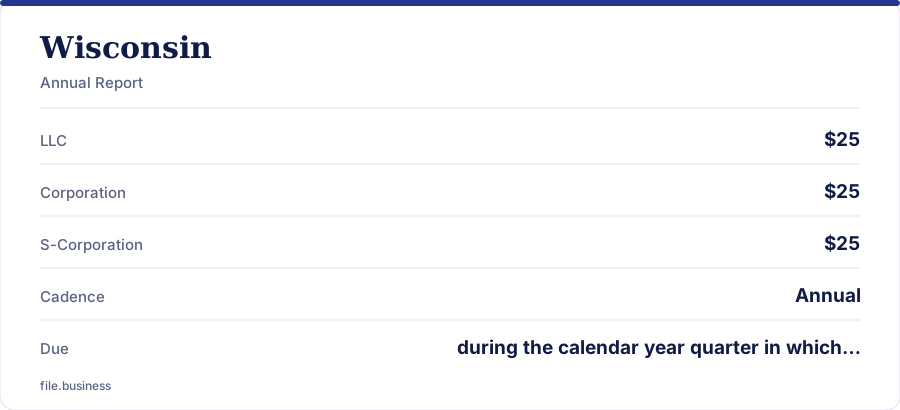

Wis. Stat. 183.0212 requires every limited liability company to file an Annual Report, and Wis. Stat. 180.1622 imposes the same duty on corporations. Wisconsin sets the deadline at the end of the calendar quarter in which the entity came into existence. An LLC organized on February 4 files by March 31. One organized on August 20 files by September 30. There are four deadlines in the state rather than twelve. An entity formed on the last day of a quarter has a matter of hours between its anniversary and its report date in its first year.
The rule is easy to apply once it is understood and easy to misread as an anniversary rule. A business formed in February that dockets February will file a month early in a year where that is harmless. After any change of bookkeeper, it will eventually file a quarter late in a year where it is not.
The Department of Financial Institutions, not a Secretary of State
Wisconsin keeps its corporate register at the Department of Financial Institutions, the same agency that regulates banks, credit unions and securities in the state. The Secretary of State has no role in business filings here, so an owner searching for one is looking in a place that does not hold the record. Everything runs through wdfi.org.
Who files a Wisconsin report
Domestic LLCs and corporations file, as does every out-of-state company registered through Wisconsin foreign qualification. A foreign entity's quarter is set by the date the DFI admitted it, not by its formation quarter at home, and the two rarely coincide. Charter changes are made through the process described in amending Wisconsin articles rather than inside the report.
Twenty-Five for an LLC, Forty for a Corporation
Wisconsin Annual Report at a Glance
| Item | Value |
|---|---|
| Report name | Annual Report |
| Filing frequency | annual |
| Deadline | End of anniversary quarter |
| Domestic filing fee, online | $25 (LLC and corporation alike) |
| Domestic filing fee, paper | $40 (LLC and corporation alike) |
| Late penalty | $5/month |
| Processing time | 5-10 business days |
| Reinstatement window | 36 months after dissolution |
| Filing agency | Wisconsin Department of Financial Institutions |
A domestic corporation and a domestic LLC pay exactly the same: $25 filed online, or $40 on paper. The $15 gap is the paper surcharge under DFI rule DCCS 10.01(6), not a corporate premium, so an owner holding both types in Wisconsin has one rate to remember and potentially two quarters to track. Acceptance normally posts within 5-10 business days. Comparative figures sit in our Wisconsin annual report cost page.
Filing through the DFI system
The DFI system retrieves the record by entity identifier and presents the name, principal office, registered agent and registered office, and the members, managers, officers or directors for confirmation. The registered agent must maintain a Wisconsin street address, and an agent who has resigned or relocated has to be replaced before the report will complete, through a change of registered agent in Wisconsin. Our Wisconsin registered agent guide covers the standing requirement.
File your Wisconsin annual report
We pull your record from the state, prefill every field, and track next year’s deadline. Or keep reading and file it yourself; this guide covers both.
A Penalty That Grows Every Month
How Wisconsin delinquency compounds
- $5 every month. The charge accrues rather than landing once, so the cost is a function of how long the report sits.
- Each year runs its own clock. Two unfiled reports accrue in parallel, at different stages.
- Certificate of status refused. The DFI will not certify an entity that is behind.
- Tax clearance in the way. Reinstatement needs clearance from the Department of Revenue before DFI will act.
- Dissolution near 36 months. Wisconsin allows a longer runway than most, and it does end.
- A 36 month door. Reinstatement closes three years after dissolution.
What the accrual actually adds up to
Because the penalty accrues monthly, the arithmetic depends on elapsed time rather than on a count of missed reports. Take an LLC and assume the accrual runs uninterrupted. One report left unfiled for twelve months carries $60 in accrued penalty on top of the $25 fee, so $85. Two unfiled reports, the older 24 months overdue and the newer 12, carry $120 and $60 respectively, so $180 in penalty plus $50 in fees, a total of $230. Three unfiled reports at 36, 24 and 12 months carry $180, $120 and $60, so $360 in penalty plus $75 in fees, a total of $435.
A corporation pays the same $25 online, so its three-year figure is the same $435; filing on paper at $40 instead lifts each of those fee lines, taking the three-year total to $480. Add the $50 Application for Reinstatement once the entity has been dissolved, and an entity filing online is looking at about $485 against the $75 that three ordinary filings would have cost. Wisconsin is the state in this series where waiting one more quarter has a visible price. That is a useful property: it makes the cost of delay legible instead of hiding it behind a flat fee. The reinstatement sequence is set out in our Wisconsin reinstatement guide.
Tax clearance and the longer runway
Wisconsin gives roughly 36 months before administrative dissolution, longer than the 24 months most states allow, and then a further 36 months to reinstate. The extra room is real. It is also the reason Wisconsin lapses run long: nothing forces a decision for three years while the monthly accrual quietly compounds. Reinstatement also requires tax clearance from the Department of Revenue. So an entity that has stopped filing state returns has two problems to solve rather than one. Where the business has genuinely ended, the deliberate path in Wisconsin dissolution stops both clocks.
Three Wisconsin Filings in Practice
Example 01: a Madison single-member LLC
A Madison translator organized her single-member LLC on May 9, which places her in the second quarter and gives her a June 30 deadline every year. Action taken: she files in the first half of June, confirms her registered agent and Wisconsin street address, and checks herself as sole member. Real cost: $25 a year. Timeline: six minutes, accepted inside a week. Outcome: no accrual has ever started, and when a university client required proof of standing before adding her to its supplier list, the Wisconsin certificate of status issued the same week.
Example 02: a Milwaukee corporation updating its officers
A Milwaukee food processing corporation incorporated in October. Its report is due each December 31. It appointed a new treasurer in July and lost a director in September. Action taken: the controller filed on December 3, entered the treasurer with a current business address, removed the departed director, and confirmed the president and secretary.
Real cost: $40, the paper rate the controller used; filing the same report online would have cost $25, the same as for an LLC. No separate charge for the officer changes. Timeline: accepted December 11. Outcome: the register matched the board minutes before the year-end audit, and the auditor's standing check produced no exception. Filing in early December also kept the report clear of the holiday period, when a rejection would have been hard to cure before December 31.
Example 03: a foreign-qualified LLC in three states
An Illinois commercial laundry LLC holds registrations in Wisconsin and Minnesota. Three rules, no overlap: Illinois runs on its own anniversary cycle, Minnesota takes a renewal by December 31, and Wisconsin keys to the quarter in which the DFI admitted the company. That is the third quarter, rather than the first quarter of its Illinois formation.
Action taken: the bookkeeper recorded the Wisconsin admission quarter explicitly, set a September 30 working date, and stopped inferring Wisconsin from the Illinois anniversary. Real cost in Wisconsin: $25 a year. Timeline: about twenty-five minutes across the three states. Outcome: no lapse anywhere, and the two December deadlines in Minnesota and elsewhere stopped absorbing attention that Wisconsin needed in September. The comparison is set out in annual report deadlines by state.
Five Mistakes on the Wisconsin Annual Report
Mistake 1: Treating the quarter rule as an anniversary rule
What it is: docketing the formation month rather than the end of the formation quarter. Why it happens: anniversary rules are the norm elsewhere. In some months the two dates are close enough that the error goes unnoticed for years. Consequence: a report filed in the month after the quarter closes is already accruing at $5 a month. Prevention: write the quarter end date, March 31, June 30, September 30 or December 31, on the entity file and file to that.
Mistake 2: Looking for a Wisconsin Secretary of State portal
What it is: searching for a Secretary of State business filing system. Why it happens: nearly every other state keeps the register there. Consequence: time lost inside a quarter that may be nearly over. Prevention: file with the Department of Financial Institutions, which holds the corporate register in this state.
Mistake 3: Assuming the penalty stops growing
What it is: treating $5 a month as a fixed late charge that has already been incurred. Why it happens: most states charge a flat penalty. So the mental model is a one-off. Consequence: a report left for three years carries $180 of accrual on its own. The figure the owner remembers bears no relation to the amount due. Prevention: file the current report even when older ones are outstanding, because each one stops accruing the day it is filed.
Mistake 4: Leaving tax clearance until the end
What it is: assembling back reports for a dissolved entity without touching the Department of Revenue account. Why it happens: the reinstatement form looks like the whole task. Consequence: the application cannot proceed without clearance, and weeks are added to a timeline that has usually been promised to a lender or a buyer. Prevention: open the tax clearance request at the same time as the back reports, not after them.
Mistake 5: Relying on the longer runway
What it is: allowing a Wisconsin lapse to run because the state does not dissolve as quickly as its neighbors. Why it happens: the absence of an immediate consequence reads as tolerance. Consequence: three years of monthly accrual on multiple reports, a dissolution, a tax clearance problem, and a 36 month window that then starts counting down. Prevention: treat the first missed quarter as the deadline that matters and clear it within the following quarter.
A Quarterly Rhythm for Wisconsin
Practice 1: File in the middle month of the quarter
Aim for February, May, August or November depending on the entity's quarter. Filing a month before the quarter closes leaves room for an agent correction without starting an accrual.
Practice 2: Align the report with other quarterly work
Wisconsin is one of the few states whose corporate deadline lines up naturally with quarterly tax and bookkeeping cycles. Attaching the report to work that already happens on that rhythm is the cheapest way to keep it reliable.
Practice 3: Record the quarter with the entity number
Keep the DFI entity identifier, the formation or admission quarter, the agent details and the current management list together. The wider view sits in annual report deadlines by state and the state view at our Wisconsin compliance hub.
How File.Business Handles Wisconsin Annual Reports
File.Business files Wisconsin Annual Reports for entities under our compliance service. We calculate the quarter-end deadline from the formation or admission date rather than the anniversary month, apply the right fee for the entity type, and pull the DFI record so identifiers match. We then surface any agent or management correction that has to come first, file through the DFI system, pay the fee, and confirm acceptance. Entities registered in Wisconsin and elsewhere run every state cycle from one dashboard, with Wisconsin registered agent service and good-standing monitoring included.
Wisconsin annual report FAQ
When is the Wisconsin annual report due?
At the end of the calendar quarter in which the entity was formed or admitted, so March 31, June 30, September 30 or December 31. An LLC organized on February 4 files by March 31, and one organized on August 20 files by September 30.
Which agency takes the Wisconsin annual report?
The Wisconsin Department of Financial Institutions, through its corporate registration system at wdfi.org. Wisconsin does not use a Secretary of State for business filings. Searching for one wastes time inside a quarter that may be nearly over.
How much does the Wisconsin annual report cost?
$25 filed online or $40 on paper. The rate is identical for a domestic LLC and a domestic corporation, the $15 difference is the paper surcharge under DFI rule DCCS 10.01(6), not an entity difference. A foreign entity pays $65 online or $80 on paper. An owner holding both entity types in Wisconsin pays the same fee twice, but potentially in two different quarters.
How does the $5 per month penalty work?
It accrues rather than landing as a single charge, and each unfiled report runs its own clock. Assuming the accrual runs uninterrupted, one LLC report twelve months overdue costs $85 in total, two overdue reports come to about $230, and three come to about $435.
What happens if a Wisconsin entity is administratively dissolved?
It loses the right to transact business and cannot get a certificate of status. Reinstatement means filing every missed report with its accrued penalty, getting tax clearance from the Department of Revenue, and submitting an Application for Reinstatement at $50 inside a 36 month window.
Does Wisconsin allow longer than other states before dissolving an entity?
Yes. Wisconsin allows roughly 36 months of non-compliance before administrative dissolution, where most states act at around 24 months. The extra runway is genuine, and it is also why lapses here run long while the monthly penalty compounds.
File your Wisconsin annual report
We pull your record from the state, prefill every field, and track next year’s deadline. Or keep reading and file it yourself; this guide covers both.
Doing this in Wisconsin specifically: Wisconsin annual report filing and the Wisconsin annual report page at the Department of Financial Institutions cover the detail for this state, including the current fee and the exact form the agency expects.
This guide is written from the official sources below. Fees, forms, and deadlines change. Confirm the current requirement with the agency before you file.
Disclosure. File.Business is a private filing service, not a government agency and not a law firm. We prepare and submit filings at your direction. Nothing on this page is legal or tax advice. Filing fees, deadlines, and statutory references are current as of the last-updated date shown above, and they can change. Confirm current requirements with the relevant state agency before you file.


