
A Two-Year Clock Inside a One-Year Habit
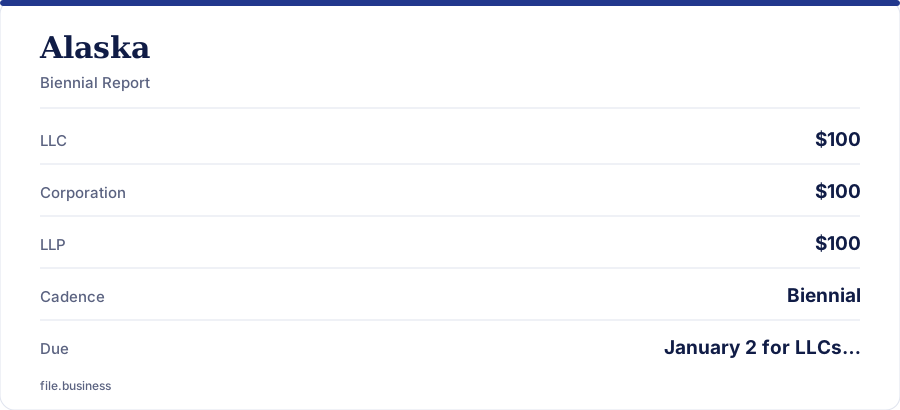

Alaska does not run an annual report. Alaska Statutes 10.50.750 gives LLCs a Biennial Report instead, and 10.06.805 puts corporations on the same two-year footing; that difference is the whole problem. Compliance habits form around things that repeat every year. A filing that comes back twenty-four months later lands in a calendar nobody built - in a January when the person who filed it last time may have left the company. That is why an Alaska lapse usually starts with a competent business owner who simply believed the filing had already happened.
The report goes to the Alaska Division of Corporations, Business and Professional Licensing, part of the Department of Commerce, Community and Economic Development. It is not a Secretary of State office, so searching for one wastes an afternoon. The Division maintains the entity record and takes filings at commerce.alaska.gov/cbp - the same place where you confirm the status the state currently shows for your company.
Which year is your year
Alaska sets your cycle by the year you registered, not by your entity type. An LLC or corporation that filed in an even-numbered year files every even year; one that registered in an odd-numbered year files every odd year. The entity's own record confirms the cycle the Division assigned. Checking that record once is worth more than any assumption - a company that guesses wrong does not find out until the late fee posts. Foreign-qualified entities are on the same footing as domestic ones: completing foreign qualification in Alaska puts a company into the Alaska cycle regardless of what its home state requires.
The initial report nobody expects
Alaska is one of the states that wants an initial report from a newly registered entity. It is due within six months of registration, separate from the biennial cycle that follows. New owners routinely miss it because they assume the formation package covered everything the state wanted. It did not. The initial report and the biennial report are different filings with different triggers - satisfying one does nothing for the other.
Alaska Biennial Report at a Glance
| Item | Value |
|---|---|
| Report name | Biennial Report |
| Filing frequency | Biennial, every two years |
| Deadline | Before January 2, in even or odd years depending on the year you registered |
| Domestic LLC filing fee | $100 |
| Domestic corporation fee | $100 |
| Foreign LLC or corporation fee | $200 |
| Late fee | $37.50 |
| Processing time | 5-10 business days |
| Filing agency | Alaska Division of Corporations |
| Initial report | Required within six months of registration |
A January 2 deadline has a practical wrinkle worth planning around. It sits at the end of a holiday stretch, when finance staff are away and card authorizations sometimes fail. Filing in early December costs the same $100, and it avoids the only week of the year when nobody is at a desk to fix a rejected payment. Turnaround runs five to ten business days once a clean report is in. You can confirm the posted status through the Alaska entity search rather than waiting for mail.
The Penalty Path After a Missed January 2
Alaska's late fee is modest, but its timeline is not. The $37.50 penalty is the smallest among the states in this series. The six-month runway to involuntary dissolution is the shortest. Put those two facts together, and the risk profile becomes clear: Alaska does not punish you with money - it punishes you with speed.
| Cycles missed | Elapsed time | Report fees | Late fees | Running total |
|---|---|---|---|---|
| One | 2 years | $100 | $37.50 | $137.50 |
| Two | 4 years | $200 | $75 | $275 |
| Three | 6 years | $300 | $112.50 | $412.50 |
The table is arithmetic, not a forecast - a company almost never reaches the second missed cycle as a live entity. Six months past the deadline, the Division moves toward involuntary dissolution. The four-year and six-year rows describe what a dissolved company has to clear on the way back. They are not a bill that quietly accumulates while business carries on.
Six months to involuntary dissolution
Once the record shows the entity as dissolved, three things stop working at once. The name is no longer held for you. Banks that re-verify entity status on renewal freeze accounts. Any contract counterparty who pulls the record sees a company the state says does not exist - a difficult conversation in the middle of a season that in Alaska may only be twelve weeks long. A certificate of compliance becomes unobtainable exactly when a permit renewal or a charter contract demands one.
Reinstating inside the two-year window
Alaska allows a Reinstatement Application within 24 months of involuntary dissolution. The filing itself is not the hard part. The real condition is this: every missed biennial report has to be filed, and every late fee paid, before the Division will restore the record. So an entity dissolved after one missed cycle pays the $87.50 above, plus the reinstatement fee the Division sets.
Miss the 24-month window, and the route back is not reinstatement at all - it is forming a new entity, with a new registration date, a new EIN relationship to sort out, and no claim to the old company's history. The Alaska reinstatement page walks through the sequence.
File your Alaska annual report
We pull your record from the state, prefill every field, and track next year’s deadline. Or keep reading and file it yourself; this guide covers both.
Three Alaska Filings in Practice
Scenario one: a one-owner charter business in Homer
A halibut charter operator runs a single-member Alaska LLC. Her cycle falls in even years, so her report is due January 2, 2026. She files it on December 8, 2025, while the boat is out of the water and the season is over. She pays $100 and has confirmation in nine business days. Cost for two years of state compliance: $100. The reason it works is not diligence - it is timing. She attached the filing to an event that already happens every other winter, rather than to a date she has to remember.
Scenario two: a Fairbanks corporation updating its officers
A construction corporation in Fairbanks lists a president, a secretary, and three directors on its Alaska record. Between cycles, the secretary retired, one director resigned, and a shareholder crossed the ownership threshold that Alaska asks about on the report. The biennial report is where all of that reaches the state - Alaska's report carries officer, director, and significant-shareholder detail, not just an address. The corporation pays the same $100. The real work is the hour spent reconciling the state record against the corporate minute book, so the two agree.
When the company later applied for a bonded public works contract, the awarding authority pulled the state record. It found the same names already given in the bid package.
Scenario three: three states, three different clocks
A seafood distributor formed in Alaska qualifies in Arkansas and Delaware. Alaska takes $100 every second January. Arkansas takes an Annual Franchise Tax Report of $150 by May 1 every year. Delaware takes $400 from the LLC by June 1 every year. Over a two-year span, the company pays $100 once and $900 in the other two states. Its exposure is lopsided in the same direction: the Delaware penalty for missing June 1 is $200 plus 1.5% per month, while Alaska's is just $37.50.
Companies that build a compliance routine around their home state usually under-serve the more expensive ones. A single compliance calendar that lists all three deadlines, with the penalty next to each, fixes the priority problem in an afternoon.
Five Mistakes Alaska Filers Make
Mistake 1: Treating the state's reminder as the trigger
What happens. The owner waits for a notice from the Division before thinking about the report. Why it fails. Reminders go to the address and agent on record, and over a two-year gap that address is more likely to be stale than current. A notice sent to a previous agent is still a notice that was legally sent - and never read.
Consequence. The late fee and the six-month dissolution clock both start, whether or not anyone saw the mail. Prevention. Mark January 2 of your filing year on the calendar the day you file the previous report, and treat any notice as a second signal, not the first.
Mistake 2: Filing on an annual assumption
What happens. A filer who also operates in annual-report states assumes Alaska works the same way - or assumes the opposite, and skips a year that was actually due. Why it fails. Alaska is biennial, and the cycle year is fixed to the entity, not to the calendar preference of whoever is filing.
Consequence. Either a wasted filing, or - far more often - a missed one, discovered only when the status changes. Prevention. Look up the entity on the Division's record, note the cycle year in writing, and store it with the entity file, not in someone's memory.
Mistake 3: Carrying a stale agent across two years
What happens. The report is filed with the registered agent and mailing address that were accurate when the company registered. Why it fails. Two years is long enough for an agent to resign, a service to lapse, or an office to move - and Alaska's physical-address requirement means a mail drop does not qualify.
Consequence. Service of process and state notices go to a place nobody checks, and the next thing the owner learns is that a default has already been entered. Prevention. Verify the agent before filing, and file the Alaska agent change first if it is out of date.
Mistake 4: Reading $100 as a trivial obligation
What happens. The fee is small enough that the filing never earns a place on the operations calendar. Why it fails. In Alaska, the fee is not the exposure. The six-month path to involuntary dissolution is - and it runs on its own schedule, regardless of how small the invoice was. Consequence. A $100 filing becomes a dissolved entity, a $37.50 late fee, a reinstatement application, and a season spent explaining the record to customers and lenders. Prevention. Rank the filing by what failure costs, not by what it costs to do.
Mistake 5: Skipping the initial report
What happens. A newly registered company files nothing until its first biennial report comes due. Why it fails. Alaska expects an initial report within six months of registration. That is a separate obligation, and the biennial report does not backfill it. Consequence. A company that thought it was compliant from day one is already behind on the record - a poor position from which to open a bank account or bid on work.
Prevention. When the registration is accepted, calendar two dates at once: the initial report at six months, and the first biennial report in the assigned cycle year.
Building a Rhythm That Survives Two Years
The single most effective Alaska habit is to file the next report's reminder the moment the current one is accepted. Two years is long enough for a bookkeeper to change, an office to move, and the login credentials for the Division's portal to be lost. So the entity record should live in a document, not in an account someone controls personally. Keep the legal name exactly as chartered, the entity number, the agent's physical Alaska address, the cycle year, and the officer list all in one place, and update it the week anything changes.
Companies with filings in several states can hand the whole calendar to our annual report service. It tracks each jurisdiction on its own cadence, instead of flattening them into one.
How File.Business Handles Alaska Biennial Reports
We confirm the cycle year from the Division's record before preparing anything, so the report gets filed in the year the state actually expects it. We check the agent and address, prepare the officer and shareholder detail Alaska asks for, submit ahead of January 2, pay the $100, and send the acceptance back to you.
Entities on our compliance plan also carry Alaska registered agent service with same-day document scanning - which matters more in a state where the next notice may be two years out. If you would rather file it yourself, the Alaska report page sets out the agency-side steps.
Alaska biennial report FAQ
Does Alaska have an annual report?
No. Alaska uses a Biennial Report, filed every two years rather than annually, due before January 2. Which year is yours depends on when you registered, not on your entity type: register in an even-numbered year and you file in even years; register in an odd-numbered year and you file in odd years. LLCs and corporations follow the same rule.
How much is the Alaska biennial report?
The filing fee is $100 for a domestic LLC or corporation, and $200 for a foreign LLC or corporation. A late filing adds $37.50, so a delinquent domestic report comes to $137.50.
Which agency handles Alaska business filings?
The Alaska Division of Corporations, Business and Professional Licensing, within the Department of Commerce, Community and Economic Development. Alaska has no Secretary of State office for entity filings - the portal is at commerce.alaska.gov/cbp.
What happens if I miss the January 2 deadline?
A $37.50 late fee applies, and the Division moves toward involuntary dissolution roughly six months after the deadline. That six-month runway is the shortest in this series, so an Alaska lapse turns into a dissolved entity faster than a lapse in most other states.
How long do I have to reinstate an Alaska entity?
Alaska allows a Reinstatement Application within 24 months of involuntary dissolution, but every missed report and late fee must be cleared first. After the window closes, the only route back is registering a new entity.
Do new Alaska entities file anything before the biennial report?
Yes. Alaska requires an initial report within six months of registration. This is a separate filing from the biennial report, and completing the formation paperwork does not satisfy it.
Can File.Business file the Alaska biennial report for me?
Yes. We confirm the cycle year, validate the agent and officer detail, file with the Division, pay the $100 fee, and send you the acceptance. Alaska registered agent service and status monitoring are both included on our compliance plan.
File your Alaska annual report
We pull your record from the state, prefill every field, and track next year’s deadline. Or keep reading and file it yourself; this guide covers both.
Also for Alaska: Alaska biennial report filing if you want it handled, Alaska certificate of compliance when a lender asks for proof, and closing an Alaska entity if the answer is to wind it down instead.
This guide is written from the official sources below. Fees, forms, and deadlines change. Confirm the current requirement with the agency before you file.
Disclosure. File.Business is a private filing service. We are not a government agency and not a law firm. We prepare and submit filings at your direction, and nothing on this page is legal or tax advice. Filing fees, deadlines, and statutory references are current as of the last-updated date shown above, and they can change. Confirm current requirements with the relevant state agency before you file.


