
Montana costs almost nothing to stay compliant in. Nothing at all for the annual report while the fee waiver holds, thirty-five dollars if you file after April 15, thirty-five dollars to form the company in the first place. A decade of perfect compliance comes to less than most states charge for one filing. The interesting question in Montana is therefore not what a lapse costs in money. It barely costs anything. The real question is why so many Montana entities lapse anyway. The answer sits in who owns them, and in what the state prints on its certificates.
What the Montana Annual Report Does
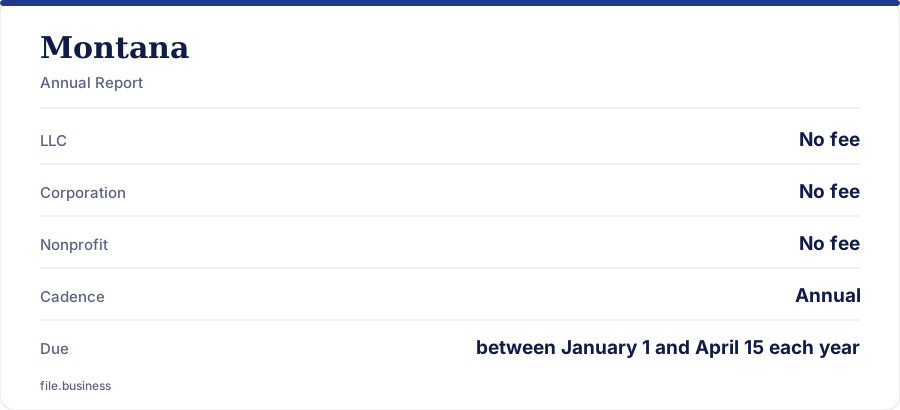

Mont. Code Ann. § 35-8-208 requires the annual report from a limited liability company and § 35-14-1621 requires it from a corporation. It is filed with the Business Services Division of the Montana Secretary of State and confirms the entity record for the year: legal name, entity number, principal office and mailing address, registered agent and that agent's Montana street address, and the managers, members, officers, or directors the entity type calls for. It is filed online through the state business portal, and the whole exercise takes a few minutes when the record is already accurate.
Montana adds something most states leave out. The certificates it issues carry the entity's annual report compliance status. So a bank, a title company, or a counterparty ordering a Montana certificate sees directly whether the report is current. In a state where the late fee is $35, that visibility is the real enforcement mechanism. It is the reason the filing matters far more than its price suggests.
Why absentee ownership drives Montana lapses
A large share of Montana entities are administered from somewhere else. Owners who formed in Montana for structural reasons often have no local office, no local accountant, and nothing in their working week that mentions Montana at all. There is no landlord, no state payroll filing, and no local bank relationship to act as an incidental reminder. The April 15 deadline then depends entirely on a calendar entry that someone had to create deliberately. That is exactly the kind of entry that does not survive a change of bookkeeper.
Who files in Montana
Domestic LLCs and corporations formed under Montana law file every year. Entities formed elsewhere holding a Montana foreign qualification file on the same April 15 date. Nonprofits and professional entities file their own variants. The obligation attaches to the Montana registration, so nothing filed in another state discharges it.
The Montana Filing at a Glance
| Item | Value |
|---|---|
| Report name | Annual Report |
| Filing frequency | Annual |
| Deadline | April 15 |
| LLC filing fee | Waived by April 15 |
| Corporation fee | Waived by April 15 |
| Fee after April 15 | $35 |
| Processing time | 5-7 business days |
| Filing agency | Montana Secretary of State |
| Filing portal | biz.sosmt.gov |
Five to seven business days is a solid standard turnaround, and Montana pairs it with a low base fee for certificates. If you know a certificate will be needed in May, filing the report in February rather than on April 14 is the difference between a document that reads clean and one that arrives while the record is still catching up.
What Montana validates
The submission is checked against the register. Entity name exactly as recorded, including the designator. Entity number. Principal office address. Registered agent name and Montana street address, which must be a physical location rather than a post office box. Where officers or managers are required, those names too. Confirm all of it on the Montana business search before you begin, particularly if the entity is administered from out of state and nobody has looked at the record in a year.
The agent is the usual blocker
For remotely held Montana entities the registered agent is often the only Montana presence there is. That makes it both the most important record and the one most likely to have drifted. An agent who resigned, closed, or moved has to be replaced through a change of agent filing that clears before the report can go through. A commercial Montana registered agent is the standard fix, because it is the one part of the arrangement that should never depend on where the owner happens to live.
File your Montana annual report
We pull your record from the state, prefill every field, and track next year’s deadline. Or keep reading and file it yourself; this guide covers both.
Compliance Risk: What a Montana Lapse Really Costs
The money is trivial and the arithmetic is short. What matters is what sits underneath it.
The Montana escalation path
- April 16. The $35 late fee attaches for the year. The compliance status on the record changes.
- Any certificate ordered from now on. Montana prints annual report compliance status, so the lapse is legible to whoever asked for the certificate.
- Second missed April. Two years of fees and penalties outstanding, and a pattern rather than an oversight on the record.
- Around 24 months. Administrative dissolution, ending the authority to transact business in Montana.
- Within 60 months. Reinstatement remains available for five years after dissolution, though the name is not held during that period.
| Years missed | Late report fee per year | Total to clear |
|---|---|---|
| One year | $35 | $35 |
| Two years | $35 | $70 |
| Three years | $35 | $105 |
One missed year costs $35, which is precisely what it cost to form the company. Three missed years cost $105, three times the formation fee. That is still less than a single annual report in several neighboring states. Nobody has ever been financially damaged by a Montana late penalty. That is the trap: the number is too small to prompt action. So the lapse is left alone until it reaches the point where the state acts.
The consequences worth taking seriously are the visible ones. A certificate that reports the entity as not current in its annual reports is read by lenders as a signal about how the business is administered generally, and it is not a signal that improves the terms on offer. Beyond that, an administratively dissolved Montana entity has no authority to transact, which reaches every contract, bank account, and title held in its name.
Our reinstatement service handles the application inside the five year window, and where an entity has served its purpose, closing it deliberately is a better ending than letting it drift into dissolution.
Three Montana Filings in Practice
Example 1: A Bozeman guide files before the season
A fly fishing guide operating as a single-member LLC files in the third week of February, before the season starts and while the desk work still fits in a morning. The record check confirms the registered agent and the principal office, the report goes in, and it clears with nothing to pay. Acceptance posts within a week. When an outfitter partner asks for a certificate in June before adding him to a joint permit, the certificate shows annual reports current, which is exactly what the partner was checking for.
Outcome: The cheapest filing in the business produced the document that unlocked the season's partnership.
Example 2: A Billings corporation updates its board
An agricultural equipment dealer brought in a new vice president and lost a long serving director over the winter. Montana corporations list officers and directors on the annual report. So the April filing carries both changes onto the register at no charge. The dealer's floor plan lender reviews the corporate record annually as part of its facility review. It finds the officer list matching the guarantee documents on file. Had the report repeated last year's names, the mismatch would have become a condition to satisfy before the facility renewed.
Outcome: A waived filing kept a lending facility clean at renewal.
Example 3: A Missoula brand in three states
An outdoor apparel brand formed in Montana opened warehousing in Idaho and a retail outlet in Wyoming, qualifying in both. Montana wants its report on April 15. Idaho runs an anniversary month cycle. Wyoming runs its own annual date tied to the registration month. Nothing lines up. The Montana filing is also by far the cheapest of the three. That is why it was the one that kept slipping.
The office manager fixed it by putting all three on one sheet with the fee next to each date, which made the point that the Montana entry was protecting the two more expensive ones.
Outcome: The home state stopped being the one that slipped. Our deadline table by state holds the same information.
Five Errors That Catch Montana Entities
These are the recurring ones, and four of the five are about attention rather than money.
What happens: An owner with no Montana operations has nothing in the working week that mentions Montana, and April passes unnoticed.
Why it happens: Many Montana entities are held for structural reasons and have no local office, accountant, or bank.
Consequence: A lapse that continues for years because nothing local ever surfaces it.
Prevention: Give the entity one deliberate owner and one recurring calendar entry that survives staff changes.
What happens: The $35 charge is noted and then left, because it is not worth an afternoon.
Why it happens: Montana's penalty is genuinely negligible, so the financial signal to act is absent.
Consequence: Years of non-compliance accumulate quietly and end in administrative dissolution.
Prevention: Judge the filing by what a dissolved entity costs, not by what the penalty costs.
What happens: A certificate is ordered for a lender and arrives showing annual reports out of compliance.
Why it happens: Most states do not surface report status on certificates, so nobody expects Montana to.
Consequence: A document intended to demonstrate good administration doing precisely the opposite.
Prevention: File before you need any certificate, and allow the record time to reflect it.
What happens: The report will not submit because the registered agent has resigned, closed, or moved.
Why it happens: For a remotely held entity the agent is the only Montana presence, and it is rarely reviewed.
Consequence: A change filing has to clear first, and any service of process in the meantime may never reach you.
Prevention: Use a commercial agent whose address does not change when your circumstances do.
What happens: A dissolved entity is left for later because Montana allows sixty months to reinstate.
Why it happens: The window is long enough to feel like a safety net.
Consequence: The name is unprotected during dissolution, and the entity may be unreinstatable under its own name.
Prevention: Decide within weeks whether to reinstate or close. Both are cheap in Montana. Drifting is not.
A Montana Routine for Owners Who Live Elsewhere
The routine has to work without any local prompt, because for most Montana entities there is not one.
How File.Business Files in Montana
We file Montana annual reports through the state business portal ahead of April 15, after reconciling the entity name, number, principal office, agent, and officer list against the Business Services record. We file the report, return the acceptance, and monitor good standing between filings. For a Montana entity that means watching a record most owners never see. First year Montana registered agent service is included. Because compliance status appears on Montana certificates, we can also order a Montana certificate once the record is current, so you know exactly what a counterparty will read.
Montana annual report FAQ
The questions Montana filers ask, including the ones that come from owners who have never been to the state. See also our annual report service.
When is the Montana annual report due?
April 15 every year. Montana uses one fixed date for every entity rather than an anniversary cycle, so domestic and foreign-qualified companies share the same deadline regardless of when they registered.
How much is the Montana annual report?
The Secretary of State currently waives the fee for an LLC or a corporation that files by April 15, and charges $35 for a report filed after that date. Montana runs one of the least expensive compliance regimes in the country, and forming an entity there costs $35.
Does Montana show annual report status on certificates?
Yes. Montana includes the entity's annual report compliance status on the certificates it issues, so a lender, buyer, or counterparty ordering one can see directly whether the report is current. In practice that visibility does more enforcement work than the late fee.
Why do so many Montana entities fall behind?
A large share are administered from outside the state. With no Montana office, accountant, or bank relationship, nothing in the ordinary working week surfaces the April 15 date, so the filing depends entirely on a calendar entry someone created deliberately.
How long can a dissolved Montana entity be reinstated?
Sixty months, or five years, from administrative dissolution. The window is generous, but Montana does not hold the entity name during dissolution, so a company that waits may be unable to reinstate under its original name.
Do foreign-qualified companies file a Montana annual report?
Yes. Any LLC or corporation holding a Montana qualification files by April 15 on the same terms as a domestic Montana entity, and a lapse suspends the Montana qualification even when the home state registration is entirely current.
File your Montana annual report
We pull your record from the state, prefill every field, and track next year’s deadline. Or keep reading and file it yourself; this guide covers both.
Working in Montana specifically: Montana annual report filing and our Montana annual report reference page carry the current fee and the exact submission the Business Services Division expects. Registering in from another state starts with foreign qualification in Montana.
This guide is written from the official sources below. Fees, forms, and deadlines change. Confirm the current requirement with the agency before you file.
Disclosure. File.Business is a private filing service, not a government agency and not a law firm. We prepare and submit filings at your direction. Nothing on this page is legal or tax advice. Filing fees, deadlines, and statutory references are current as of the last-updated date shown above, and they can change. Confirm current requirements with the relevant state agency before you file.


