
Two Dates, Either Side of the New Year
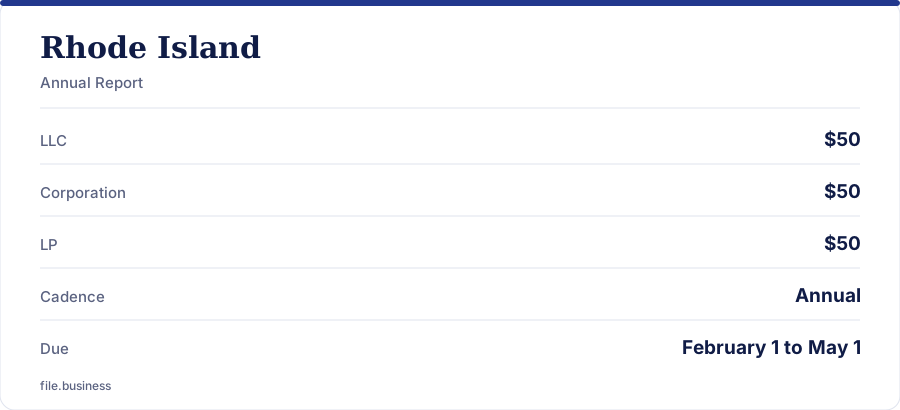

Rhode Island splits its annual report across the turn of the year. R.I. Gen. Laws 7-16-66 has a limited liability company file between February 1 and May 1, and R.I. Gen. Laws 7-1.2-1501 puts a business corporation in the same window. Both go to the Rhode Island Department of State through the business services portal at sos.ri.gov. Both cost $50, and both ask much the same questions. What differs is when. The four months between the two dates fall precisely across the holiday period and the year end -- the least attentive stretch of the calendar for most small businesses.
A group holding one of each files twice within five months, then not at all for seven. That rhythm is hard to hold in memory. It produces a particular failure: the November filing gets done, the March one is assumed to have been part of the same exercise, and nobody looks again until the following autumn.
Resident agent, not registered agent
Rhode Island calls the person or company appointed to accept service of process a resident agent. The form for replacing one is a Statement of Change of Resident Agent at $20. Every search screen and fee schedule in the state uses the same wording. A business hunting for a Rhode Island registered agent change form will find the right thing eventually. But learn the terminology first, since it also governs how the requirement is described on the report itself.
Our Rhode Island resident agent guide covers who qualifies, and our guide to changing a Rhode Island resident agent covers the mechanics.
Who files a Rhode Island report
Domestic LLCs, domestic business corporations, nonprofit corporations, and every foreign entity holding Rhode Island registration must file. A Massachusetts LLC that registered here to serve Providence customers files a Rhode Island report in the February to May window at the full $50, separately from anything Massachusetts requires. Registering in the first place is covered in our Rhode Island foreign qualification guide. Fictitious business names are handled by the city or town, not the Department of State, at fees typically between $20 and $30. That is unusual, and it is covered in our Rhode Island fictitious business name guide.
Fees, Timing, and the Content of the Report
Rhode Island Annual Report at a Glance
| Item | Value |
|---|---|
| Report name | Annual Report |
| Filing frequency | Annual |
| LLC deadline | February 1 to May 1 |
| Corporation deadline | February 1 to May 1 |
| LLC filing fee | $50 |
| Corporation fee | $50 |
| Late penalty | $25 per outstanding year |
| Processing time | 5-10 business days |
| Expedited option | $50 for 24-hour handling |
| Filing agency | Rhode Island Department of State |
What the report asks for
Rhode Island asks for the entity name as registered, the identification number the Department of State assigned, the principal office address, the resident agent's name with the Rhode Island street address of the resident office, a brief statement of the character of the business, and the people who run it. That means managers or members for an LLC, and officers and directors for a corporation. No financial information is requested.
Expedited handling is available at $50 for 24-hour turnaround, against standard processing of 5 to 10 business days. That price is worth noting: it equals the report fee itself. Buying speed in Rhode Island doubles the cost of the filing. That makes it a reasonable emergency measure, and a poor annual habit.
What the report cannot change
It does not amend the articles. A name change or a restatement takes Articles of Amendment at $50, covered in our Rhode Island amendment guide. It also has no effect on a fictitious business name held at town level. That lives on an entirely separate register, maintained by a different office in a different building. The whole recurring cost picture, including the town-level element, sits on our Rhode Island annual report cost page.
File your Rhode Island annual report
We pull your record from the state, prefill every field, and track next year’s deadline. Or keep reading and file it yourself; this guide covers both.
The Consequences of Missing a Rhode Island Report
Rhode Island charges $25 for each year a report is outstanding, which is half the filing fee and modest by national standards. The state charge is not what makes a Rhode Island lapse expensive. The tax clearance requirement behind reinstatement is.
The penalty arithmetic over three years
One missed year costs $50 in back report plus $25 in penalty -- $75 total. Two missed years cost $100 plus $50, or $150. Three missed years cost $150 plus $75, or $225. At every step the total is small enough that an owner feels relieved on finding it. That relief is the problem: by the third year, the entity is no longer on the active register at all.
Rhode Island revokes a persistently delinquent entity at around 24 months -- which lands between the second and third missed report. From that point, the $225 is the smallest line on the bill.
Tax clearance is the long pole in reinstatement
Rhode Island allows reinstatement within 36 months of revocation, and requires tax clearance before it will restore an entity. Every state tax account has to be brought current first. That includes the minimum annual charge that applies to entities whether or not they traded, and years in which the business did nothing at all.
Producing returns for dormant years is normally the largest cost in the exercise. Clearance itself takes weeks rather than days, which matters when the 36-month window is already running. Our reinstatement service is $297 plus state fees, and the full sequence is in our Rhode Island reinstatement guide.
While the entity is revoked, it cannot get the $22 Certificate of Good Standing described in our Rhode Island certificate of good standing guide. That is the document a bank, a landlord or another state's filing office asks for before it acts. Closing deliberately instead costs $50 on Articles of Dissolution, covered in our Rhode Island dissolution guide.
Three Rhode Island Filings in Practice
Example 01: a Providence single-member LLC on the November date
A ceramicist formed a single-member LLC in Providence in 2020, and files in the first week of October every year, four weeks ahead of the deadline. Action taken: she opens the portal, confirms the principal office and the character of the business, checks that her resident agent is still listed, then pays.
Real cost: $50 to the Department of State, plus $149 for commercial agent service, and $25 every few years to renew the fictitious name she trades under with the city. Timeline: six minutes, accepted inside the standard window. Outcome: six unbroken years, with no need to pay $50 for 24-hour handling in any of them. Her formation record sits in our Rhode Island LLC formation guide.
Example 02: a corporation updating its officers in March
A Warwick marine services corporation elected a new treasurer in September 2025, and accepted a director's resignation in December. Neither reached the register at the time, because the corporate report was not due until March. Action taken: the March 2026 report removed the outgoing director, recorded the new treasurer with a business address, and updated the character of business line after the company added a repair yard to what had been a brokerage.
Real cost: $50, with no separate charge for the changes. Timeline: filed February 12, accepted in nine business days. Outcome: the corporation renewed its yard lease in May. The landlord's search returned a current officer list, and the $22 certificate it asked for issued the same week. Where officer authority should be documented internally is covered in our Rhode Island operating agreement guide.
Example 03: a foreign-qualified LLC in three states
A Connecticut LLC in commercial glazing holds Rhode Island and Massachusetts registrations, taken out for regional contracts. The three dates land in three different quarters. Action taken: the owner built one calendar, with the Connecticut home-state filing on its own date, the Rhode Island report at $50 in the February to May window, and Massachusetts tracked separately. Each entry carries the fee, the deadline and the agency name.
Real cost: the Rhode Island line is $50 a year, the middle of the three, and the one that had slipped in 2023 at a cost of $75 to clear. Timeline: about 20 minutes a year in total. Outcome: no lapse in three years since. The multi-state view is in annual report deadlines by state, and continuous cover in compliance monitoring.
Five Mistakes on a Rhode Island Report
Mistake 1: Mixing up the November and March dates
What it is: filing an LLC report in March or a corporate report in November, or assuming a group's entities all share one date. Why it happens: the two dates sit four months apart across a year boundary, and most coverage prints one date per state. Consequence: either months of unnecessary earliness, which costs nothing, or months of delinquency at $25 a year, with a 24-month revocation clock running behind it. Prevention: record the entity type beside each date, and hold both where the group contains both.
Mistake 2: Searching for a registered agent form
What it is: looking for a Rhode Island registered agent change, and concluding the state does not have a straightforward process. Why it happens: nearly every other state uses the registered agent wording. Consequence: an agent change is deferred. Service of process keeps going to somebody who no longer acts, and the entity remains validly served without anybody reading the mail. Prevention: search for resident agent, and use the $20 Statement of Change of Resident Agent.
Mistake 3: Expecting the state to hold the trading name
What it is: assuming the annual report protects a fictitious business name. Why it happens: in most states, the name registration and the entity register are administered by the same office. Consequence: the name registration lapses at city or town level while the entity itself stays perfectly current. The business loses the name it actually trades under, not the one on its articles. Prevention: hold the town registration as a separate dated obligation, and confirm which of Rhode Island's cities and towns holds it.
Mistake 4: Underestimating the tax clearance step
What it is: treating reinstatement as a form and a fee, and planning around it as though it takes days. Why it happens: the state charges are small, so the process reads as administrative. Consequence: clearance takes weeks. Dormant years need returns before it can be issued, and the 36-month reinstatement window keeps running while the accounting is prepared. Prevention: start the tax side first, before the reinstatement paperwork. Count the window from revocation, not from the day you noticed.
Mistake 5: Relying on 24-hour handling to rescue the date
What it is: leaving the report to the last days, on the theory that $50 buys a same-week turnaround. Why it happens: the expedite tier is genuinely fast, so it looks like insurance. Consequence: the fee doubles every year it is used. It also does nothing for a report already past its deadline, because speed of processing is not the same as being on time. Prevention: file four weeks early, and keep the expedite fee for genuine emergencies.
Building a Rhode Island Filing Routine
Practice 1: Hold November and March together
The two dates are the whole difficulty of the Rhode Island system. Write them into one entity calendar with the entity type against each. Treat the November filing as a prompt to confirm the March one is scheduled, not as evidence that the group is current. Two dates in one list is a routine. Two dates spread across a year end is an eventual miss.
Practice 2: File a month before either date
Early October for an LLC, and late January for a corporation, both fall outside the periods when a small business is least reachable. Filing then leaves room for a declined card, an officer whose address is wrong, or an identification number nobody can find. It also keeps the $50 expedite in reserve, not in the budget.
Practice 3: Keep the state and town records in one file
Rhode Island is the only state in this group where the trading name lives with a city or town, not the state. Hold both registrations in the same entity file with their own dates, so the annual report and the local name renewal are visible in the same place. Entities held across several states stay current more reliably under a single compliance calendar.
How File.Business Handles Rhode Island Annual Reports
File.Business is a private filing service, not a law firm and not a government agency. For a Rhode Island report, we pull the current record from the Department of State, and compare the principal office, resident agent and officer lines against what you tell us is true now. We flag anything that needs its own filing first, then file inside the February to May window. We pay the $50 fee and send you the acceptance.
Entities in several states run on one calendar from one dashboard. Start at the annual report filing service or read the state detail on the Rhode Island annual report page.
Rhode Island annual report FAQ
When is the Rhode Island annual report due?
Rhode Island runs one window for everyone: between February 1 and May 1 each year, for limited liability companies and business corporations alike. Foreign entities registered in Rhode Island file on the same window as domestic ones. A group holding both types therefore has one date to manage, not two.
How much does the Rhode Island annual report cost?
$50 -- the fee is the same for an LLC and for a corporation. Expedited handling is available at $50 for 24-hour turnaround. That doubles the cost of the filing, so keep it for emergencies.
What is the penalty for filing a Rhode Island report late?
$25 for each year the report stays outstanding, on top of the $50 report fee. One missed year comes to $75, two to $150, and three to $225. Revocation follows at around 24 months of non-compliance.
Why does Rhode Island say resident agent instead of registered agent?
It is the term Rhode Island law uses for the person or company appointed to accept service of process. Other states call this role a registered agent. The form for replacing one is the Statement of Change of Resident Agent at $20.
How do I reinstate a revoked Rhode Island entity?
By filing every outstanding annual report with its $25 penalty, getting tax clearance, and submitting an Application for Reinstatement within 36 months of revocation. Clearance is the slow part: every state tax account has to be brought current first, including periods when the business had no activity.
Does the Rhode Island annual report cover my trading name?
No. Fictitious business names in Rhode Island are registered with the city or town rather than with the Department of State, at fees generally between $20 and $30. That registration runs on its own clock and lapses independently of the annual report.
File your Rhode Island annual report
We pull your record from the state, prefill every field, and track next year’s deadline. Or keep reading and file it yourself; this guide covers both.
Doing this in Rhode Island specifically: Rhode Island annual report filing and the Rhode Island annual report agency page cover the detail for this state, including the current fee and the exact form the agency expects.
This guide is written from the official sources below. Fees, forms, and deadlines change. Confirm the current requirement with the agency before you file.
Disclosure. File.Business is a private filing service, not a government agency and not a law firm. We prepare and submit filings at your direction. Nothing on this page is legal or tax advice. Filing fees, deadlines, and statutory references are current as of the last-updated date shown above, and they can change. Confirm current requirements with the relevant state agency before you file.


