
The Free Filing That Still Ends Companies
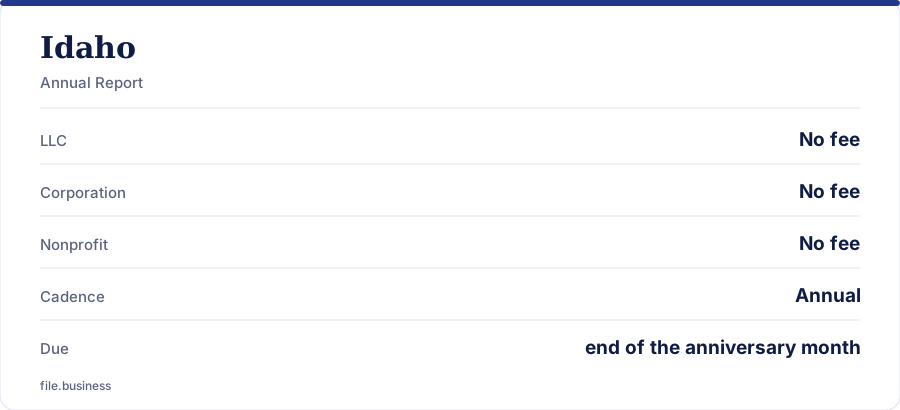

Idaho charges nothing at all to file the Annual Report, whether the filer is a limited liability company or a corporation. Idaho Code 30-21-214(b)(7) prices the annual report at “No fee.” That single design choice explains most of what goes wrong here. A filing with no invoice attached leaves no trace in an accounting system. There is no card charge to reconcile, no receipt to file, and no line in the bookkeeping that reappears next year to prompt the question of what it was for. The obligation exists entirely in the owner's memory, and memory is the least reliable compliance control there is.
The report goes to the Idaho Secretary of State through SOSBiz at sos.idaho.gov. It confirms the entity name and file number, the principal office, the registered agent and the agent's Idaho street address, and the governors, managers, members or officers appropriate to the entity type. Idaho does not ask for financial data. The whole submission is a confirmation that the register is still accurate, and it takes minutes when the underlying facts have not moved.
The deadline moves with the entity
Idaho uses an anniversary system rather than a statewide date. The report is due by the last day of the month in which the entity was originally formed or registered, every year. An LLC organized on September 12 files by September 30 each year. A corporation registered on February 2 files by the last day of February.
That means no two businesses in a portfolio necessarily share a deadline. The date is not written on any calendar the state publishes. It is written on your formation certificate. That is why the first step in an Idaho routine is finding that document and reading the date off it.
Who has to file in Idaho
Every domestic LLC and corporation on the Idaho register files, and so does every entity that has foreign-qualified to do business in the state. Nonprofits and professional entities are inside the same system. The report is required whether or not the business traded during the year, whether or not it made money, and whether or not it has employees.
A dormant Idaho LLC holding a single piece of land files exactly the same report as an operating one, at exactly the same price of nothing. Details of the qualification path are in the Idaho foreign qualification guide, and formation itself in how to start an Idaho LLC.
Fee, Deadline and What SOSBiz Checks
Idaho Annual Report at a Glance
| Item | Value |
|---|---|
| Report name | Annual Report |
| Filing frequency | annual |
| Deadline | End of the anniversary month |
| LLC filing fee | $0 (free) |
| Corporation fee | $0 (free) |
| Late penalty | None |
| Reinstatement, if dissolved | $30 |
| Processing time | 5-7 business days |
| Filing agency | Idaho Secretary of State |
Read the fee rows together. Nobody pays anything to file, and nobody pays anything to be late either. Idaho Code 30-21-214(b) prices the annual report at “No fee” for every entity type and sets no late charge. That is exactly why the filing is dangerous: there is no invoice, no penalty notice, and no bookkeeping trace, so the only thing standing between an entity and administrative dissolution is somebody remembering.
The fields that get a filing rejected
SOSBiz validates the submission against the register. The entity name has to match the formation document exactly, including the designator and any punctuation. The registered agent must be an Idaho resident or an entity authorized to do business in Idaho, with a physical street address in the state that accepts service during business hours.
A mailbox service address fails. If the entity needs to change something the report cannot change, such as its legal name, the amendment goes first. Our Idaho amendment guide covers that boundary, and the Idaho registered agent guide covers the agent requirement in detail.
Standard processing runs 5 to 7 business days. Against a month-end deadline, that puts the practical cutoff around the middle of the anniversary month, a rejection on the 28th cannot be fixed before the 31st.
File your Idaho annual report
We pull your record from the state, prefill every field, and track next year’s deadline. Or keep reading and file it yourself; this guide covers both.
The Real Consequence of Skipping an Idaho Report
Because the filing is free for everyone, the cost of a lapse is never the arrears. It is the loss of good standing and, at 24 months, the loss of the entity itself.
One, two and three missed years in dollars
The arrears are the easiest arithmetic in this series, because there are none. The report costs $0 for every entity type and Idaho charges no late fee, so one missed year clears at $0, two at $0 and three at $0. The only state charge in the sequence is the $30 Reinstatement Application, and only once the entity has actually been administratively dissolved. A three-year lapse therefore settles at $30 in state charges for an LLC and $30 for a corporation. Our reinstatement service handles the filing work at a fixed $297 in service fees on top of that.
Losing good standing in a state with no fee
Before dissolution, the entity shows as delinquent, and Idaho will not issue a Certificate of Good Standing while a report is outstanding. That certificate costs $10 on standard handling with a 5 to 7 business day turnaround, or $40 for expedited handling in 1 to 2 business days. Lenders, SBA underwriters, general contractors prequalifying a subcontractor, and other states' filing offices all ask for this document. Idaho construction and agricultural supply work in particular tends to demand one at short notice.
A business that has paid the state nothing all year can find a $10 certificate out of reach on the week it needs it most. The Idaho Certificate of Good Standing guide covers the ordering process.
Dissolution and an unusually open door back
Idaho administratively dissolves after 24 months of non-compliance. Unlike most states, it then sets no statutory deadline for coming back. The Reinstatement Application remains available, costs $30, requires no tax clearance, and is processed in 10 to 15 business days. That looks genuinely forgiving on paper, but it is misleading in practice, because the register releases the name when the entity is dissolved.
Reinstatement restores the company. It does not restore a name that somebody else has taken in the meantime. In a state where trade names are cheap to register, that gap is real. The Idaho reinstatement guide covers the application, and the Idaho dissolution guide covers winding up deliberately.
Three Idaho Filings in Practice
Example 01: a Boise single-member LLC
A structural drafting consultant organized a single-member LLC in Boise on March 14, giving her a March 31 deadline every year. Action taken: she files in the second week of March, confirms her registered agent's Ada County street address, confirms herself as the sole governor, and submits. Real cost: nothing. Idaho charges an LLC no fee for the annual report, so the entire transaction is time.
Timeline: six minutes in SOSBiz, accepted five business days later. Outcome: current for the year at zero cost, and the dissolution clock never starts.
Example 02: a Coeur d'Alene corporation updating its officers
A millwork corporation in Coeur d'Alene incorporated in June and runs a June 30 deadline. Its long-serving secretary retired in November, and a shareholder's daughter took the role. The change was recorded only in the minute book. The annual report is where Idaho collects it. Action taken: the June filing listed the incoming secretary, removed the retiring officer, and corrected the principal office to the new shop address on the north side of town.
Real cost: nothing. Idaho charges no fee for a corporate annual report and no separate charge for the officer change. Timeline: filed June 11, accepted June 18. Outcome: the register now matches the resolutions in the minute book, which is the comparison a bank makes when it re-papers signature authority on a line of credit.
Example 03: a foreign-qualified LLC filing in three states
A wildfire mitigation contractor formed in Idaho qualified in Washington and Utah as its crews began crossing state lines. Every one of the three uses an anniversary rule, and each defines it slightly differently. Action taken: the owner recorded Idaho's anniversary month end at $0, Washington's anniversary month end at $70, and Utah's anniversary month at $20. The owner then set a single reminder two weeks ahead of the earliest of the three.
Real cost: $80 a year in state fees across three registers, of which Idaho is nothing. Timeline: about 25 minutes a year. Outcome: no lapse anywhere, and the free filing stopped being the one at risk precisely because it was tracked alongside two that cost money. The comparison is set out in annual report deadlines by state.
Five Mistakes on the Idaho Annual Report
Mistake 1: Treating the state reminder as the system
What it is: filing only when a notice arrives from the Secretary of State. Why it happens: the reminder generally does arrive, so nothing goes wrong for several years in a row. Consequence: the notice goes to the contact details held on the register. The moment those go stale, the reminder stops, and because Idaho charges no late penalty there is no bill to raise the alarm either. The first sign of a problem is usually a refused certificate of existence.
Prevention: read the anniversary month off the formation certificate, put it in your own calendar as a recurring event, and treat state notices as backup.
Mistake 2: Borrowing a fixed date from another state
What it is: assuming an Idaho report is due on a set spring date because a neighboring state works that way. Why it happens: fixed-date states are common and easy to remember. An owner who files elsewhere first carries that habit across. Consequence: an entity formed in October gets filed in April, six months late, with the register showing delinquency for half a year and the dissolution clock already running.
Prevention: for every state you are registered in, write down the rule rather than the date, and mark clearly which ones move with the entity's own anniversary.
Mistake 3: Confirming an agent or address that has moved on
What it is: accepting the prefilled agent and principal office without checking them. Why it happens: SOSBiz shows the existing record, and confirming takes one click. Consequence: state notices and service of process go to an address nobody watches, and Idaho treats the entity as properly served either way. For seasonal and construction businesses that change premises between projects, this is the ordinary route to a default judgment.
Prevention: verify the agent still consents and still holds an Idaho street address before confirming, and file a change of registered agent where it is out of date.
Mistake 4: Reading a zero fee as a zero obligation
What it is: concluding that a filing the state does not charge for is a filing the state does not require. Why it happens: fees are how most owners recognize obligations, and there is no invoice here to recognize. Consequence: nothing at all happens for a while, because there is no fee and no penalty to raise the alarm. The entity is then administratively dissolved at 24 months and loses the exclusive right to its name. Prevention: treat $0 as a price rather than as an exemption, and docket the anniversary month the day the entity is formed.
Mistake 5: Waiting for an initial report Idaho never asks for
What it is: expecting a separate first-year filing before the ordinary annual cycle begins. Why it happens: several states do require an initial report within 90 days of formation, and generic formation packets mention one. Consequence: Idaho has no initial report, so the first obligation is the ordinary annual report in the first anniversary month. An entity formed in one month with an anniversary shortly afterwards can owe its first report far sooner than the owner expects.
Prevention: on the day formation is approved, calculate the first anniversary month end and put it in the calendar as the first deadline.
Building an Idaho Filing Routine
Practice 1: File in the first half of the anniversary month
Processing runs 5 to 7 business days and a rejection restarts it. Filing in the first half of the month leaves room for one full correction cycle inside the deadline. For an LLC there is no cash cost to filing early, so there is nothing to gain by waiting.
Practice 2: Check the record before you confirm it
Verify four things each year: the agent still consents and holds an Idaho street address, the principal office matches reality, the governor or officer list matches who actually signs, and the entity name matches the formation document exactly. Anything that fails is an amendment or an agent change rather than something the annual report can absorb.
Practice 3: Keep the Idaho record in one place
Hold the file number, the formation certificate showing the anniversary month, each filed report and the current certificate together. Because there is no payment trail for an LLC filing, the folder is the only evidence the filing happened. Our compliance monitoring keeps the status under watch between filings and the annual report filing service handles submission.
How File.Business Handles Idaho Annual Reports
File.Business files the Idaho Annual Report for entities on our compliance service. We take the anniversary month from the register rather than from memory, and we pull the current record so the submission matches SOSBiz exactly. We flag anything needing an amendment or an agent change before it causes a rejection. We file inside the anniversary month and confirm acceptance.
Because an Idaho annual report carries no state fee for any entity type, the value here is entirely in the tracking. That is precisely the part that fails when nobody is paying attention to a free obligation. Idaho registered agent service and good-standing monitoring are included. Scope and pricing are on the Idaho annual report page.
Idaho annual report FAQ
When is the Idaho annual report due?
The Idaho Annual Report is due by the last day of the month in which the entity was formed or registered, every year. An LLC organized in September files by September 30. A corporation registered in February files by the last day of February. There is no statewide date, so the deadline has to be read off the formation certificate.
How much does the Idaho annual report cost?
Nothing, for any entity type. Idaho Code 30-21-214(b)(7) prices the annual report at “No fee,” for LLCs and corporations alike, and Idaho charges no late fee either. The $30 people see quoted is the Reinstatement Application, which is only owed once the entity has been administratively dissolved.
Where do I file the Idaho annual report?
Online through SOSBiz at sos.idaho.gov, the Idaho Secretary of State filing portal. Standard processing runs 5 to 7 business days, so filing in the first half of the anniversary month leaves room to correct a rejection before month end.
What happens if I miss the Idaho deadline?
No penalty attaches, because Idaho charges none. The entity is flagged delinquent, and that blocks the $10 Certificate of Good Standing that lenders and general contractors ask for. Back reports cost nothing to bring current, however many years are missed. Idaho administratively dissolves after about 24 months, and the Reinstatement Application then costs $30.
How long does Idaho allow for reinstatement?
Idaho sets no statutory deadline for reinstatement, which makes it more forgiving than states that close the window after 24 or 60 months. The limitation is practical rather than procedural: once the entity is dissolved, its name is released on the register. Reinstatement does not recover a name another business has since taken.
Do foreign LLCs need to file an Idaho annual report?
Yes. An LLC or corporation foreign-qualified in Idaho files the annual report on the same anniversary-month schedule as a domestic entity, at the same fee. The report filed in your formation state does not satisfy the Idaho requirement.
Can File.Business file my Idaho annual report?
Yes. We take the anniversary month from the register and validate every field against the SOSBiz record. We file inside the anniversary month and confirm acceptance. Idaho registered agent service and good-standing monitoring are included with the compliance service.
File your Idaho annual report
We pull your record from the state, prefill every field, and track next year’s deadline. Or keep reading and file it yourself; this guide covers both.
Doing this in Idaho specifically: Idaho annual report filing and the annual report page at the Idaho Secretary of State cover the detail for this state, including the current fee and the exact form the agency expects.
This guide is written from the official sources below. Fees, forms, and deadlines change. Confirm the current requirement with the agency before you file.
Disclosure. File.Business is a private filing service, not a government agency and not a law firm. We prepare and submit filings at your direction, and nothing on this page is legal or tax advice. Filing fees, deadlines, and statutory references are current as of the last-updated date shown above and can change. Confirm current requirements with the relevant state agency before you file.


