Two Washington Agencies, Two Different Renewals

A Washington business carries two recurring state obligations. People constantly mistake one for the other. The Annual Report goes to the Washington Secretary of State under RCW 23.95.255. It keeps the entity itself on the corporate register. The business license, and the tax registration that travels with it, belongs to the Business Licensing Service at the Department of Revenue. Renewing one does nothing for the other.
What ties them together is the Unified Business Identifier. That is the number Washington agencies share when they look a business up. Both renewals reference the same UBI. So a renewal notice from one agency reads convincingly like confirmation that everything is current. An owner who paid a license renewal in March will say with complete sincerity that Washington has been handled for the year. Meanwhile the annual report sits unfiled.
Who files a Washington annual report
Domestic LLCs and corporations file. So does every out-of-state company registered through Washington foreign qualification. Non-profit corporations file on their own schedule with the same office. The report is due in the entity's anniversary month. That holds whether or not the business traded, invoiced, or held a license during the year.
What the report confirms
The form confirms the entity name and UBI. It confirms the principal office. It confirms the registered agent, with a physical Washington address and consent to serve. It confirms the governors of an LLC, or the officers and directors of a corporation. And it carries a brief statement of the nature of the business. It confirms a record. It does not amend one. Charter changes travel through the process in amending Washington articles.
Sixty Dollars and the Anniversary Month
Washington Annual Report at a Glance
| Item | Value |
|---|---|
| Report name | Annual Report |
| Filing frequency | annual |
| Deadline | Last day of anniversary month |
| LLC filing fee | $70 |
| Corporation fee | $70 |
| Late penalty | $25 |
| Processing time | 5-10 business days |
| Reinstatement fee | $140 |
| Filing agency | Washington Secretary of State |
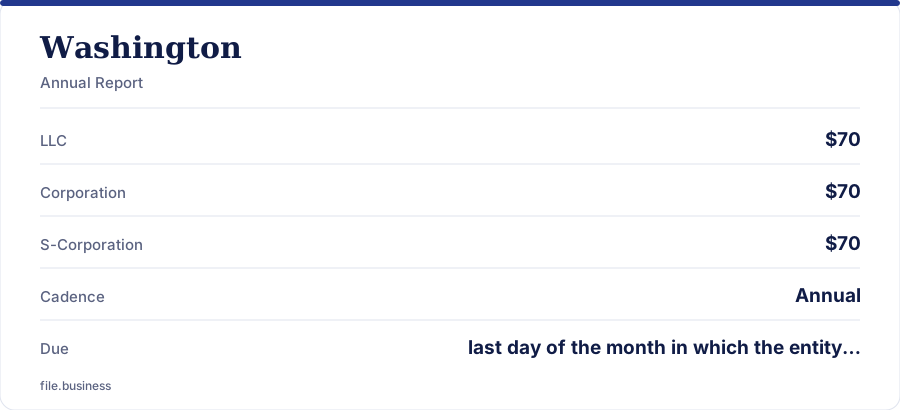
Sixty dollars is the same for both entity types. Washington gives the entire anniversary month to pay it. Acceptance normally posts within 5-10 business days. The full cost picture, including formation, sits in our Washington annual report cost page.
Filing through the Corporations and Charities system
Filings run through the Corporations and Charities Filing System at sos.wa.gov, where the UBI retrieves the record. Washington requires the registered agent to hold a physical street address in the state. The agent must also have consented to the appointment. So an agent who has resigned or moved must be replaced before the report will complete, through a change of registered agent in Washington. Our Washington registered agent guide explains the consent requirement.
File your Washington annual report
We pull your record from the state, prefill every field, and track next year’s deadline. Or keep reading and file it yourself; this guide covers both.
The Penalty Is Modest, the Cure Is Not
What a delinquent Washington entity loses
- $25 per missed report. Small enough to ignore, which is the point at which the real exposure begins.
- $140 to reinstate. More than two full years of ordinary filing fees, charged once the entity has been dissolved.
- Certificates blocked. A certificate of existence will not issue against a delinquent record.
- License renewals complicated. A dissolved entity creates problems at the Department of Revenue that the annual report would have prevented.
- Dissolution near 24 months. The Secretary of State dissolves entities that stay silent.
- A 36 month door. Reinstatement closes three years after dissolution.
One, two and three missed reports
The annual arithmetic is $60 for the report plus $25 in penalty. So one missed year is $95. Two missed years cost $190. Three cost $285. None of those numbers is large enough to force action on its own. That is precisely why Washington entities drift.
Reinstatement is where Washington separates itself. The Application for Reinstatement is $140. So an entity dissolved after three unfiled years pays $395 in state charges, against the $180 that three routine filings would have cost. Put differently, the cure costs more than two years of ordinary compliance on its own, before the back reports are counted. The steps are set out in our Washington reinstatement guide.
The license that keeps running
A dissolved entity does not stop having a licensing and tax profile at the Department of Revenue. Business and occupation tax obligations, license endorsements and city endorsements attached to the UBI continue to sit there. Untangling them after a dissolution is materially harder than filing a $60 report would have been. An owner who has genuinely finished with the business should close both sides deliberately, starting with Washington dissolution. Do not let the corporate register lapse while a license quietly renews.
Three Washington Filings in Practice
Example 01: a Seattle single-member LLC
A Seattle user-experience consultant formed a single-member LLC in an April. So her annual report is due by April 30. Action taken: she files in the first week of April. She confirms the commercial agent she uses to keep her home address off the register. She checks her own name as sole governor. And she separately diaries the Department of Revenue license renewal, so the two never blur.
Real cost: $60 a year to the Secretary of State. Timeline: seven minutes, accepted within a week. Outcome: unbroken standing. And a Washington certificate of existence that issued on request when a design agency added her to its approved vendor list.
Example 02: a Tacoma corporation updating its officers
A Tacoma marine services corporation replaced its president in September and added a director in November. Its anniversary month is January. So nothing reached the public record until the report was filed. Action taken: the controller entered the incoming president and the new director with current business addresses. The controller also removed the outgoing officer and confirmed the secretary and treasurer already on file.
Real cost: $60, with no separate charge for the governance updates. Timeline: filed January 8, accepted January 15. Outcome: the corporation's insurer verified signing authority that spring. The register and the corporate records agreed, and the policy renewal went through without a supplementary resolution.
Example 03: a foreign-qualified LLC in three states
An Oregon construction supply LLC holds registrations in Washington and Idaho. Three states, three timetables. Oregon runs on its formation anniversary. Idaho runs on its own anniversary month. And Washington runs on the anniversary of the date it admitted the company, which is August rather than the February formation month at home.
Action taken: the office manager built one calendar from each state's own trigger. A separate line went in for the Washington business license renewal, so the two Washington obligations were never confused. Real cost in Washington: $70 a year. Timeline: about thirty minutes across all three states. Outcome: no lapse in any jurisdiction. The multi-state picture is in annual report deadlines by state.
Five Mistakes on the Washington Annual Report
Mistake 1: Treating the license renewal as the annual report
What it is: paying the Business Licensing Service and considering Washington complete for the year. Why it happens: both renewals reference the same UBI, so the confirmation reads like a general clearance. Consequence: the corporate register goes stale while the license stays current. Dissolution then arrives against a business that has been paying Washington every year. Prevention: keep two calendar lines. One for the Secretary of State report and one for the Department of Revenue license, each naming its own agency.
Mistake 2: Naming an agent who never consented
What it is: listing a friend, an accountant, or a lapsed provider as registered agent, without a current consent. Why it happens: the appointment was made once at formation and never revisited. Consequence: the filing stalls on a defective appointment. In the meantime, service of process has no lawful destination. Prevention: confirm the agent holds a physical Washington address and has consented, before the report is opened.
Mistake 3: Using a post office box for the agent address
What it is: entering a mailbox address in the registered agent field. Why it happens: it is the address the business actually uses for post. Consequence: rejection, and a second submission that may land after the anniversary month has closed. Prevention: use a physical street address in Washington for the agent. Keep the mailing address in the field intended for it.
Mistake 4: Assuming a dormant entity is exempt
What it is: leaving an inactive Washington LLC unfiled because it traded nothing. Why it happens: no revenue reads as no obligation. Consequence: $85 a year accrues against a shell. The eventual choice is a $140 reinstatement, or an entity that cannot be cleanly closed. Prevention: keep a dormant entity current at $60 a year, or dissolve it deliberately while it is still in good standing.
Mistake 5: Underestimating what reinstatement costs
What it is: allowing a lapse to run, on the assumption that catching up later will cost roughly what the reports would have. Why it happens: the $25 penalty sets the expectation. Consequence: a $140 reinstatement lands on top of the back reports and penalties. That takes a three-year lapse to $395. Prevention: file the current report even when prior years are outstanding. Resolve the arrears before dissolution rather than after it.
A Washington Routine That Separates the Two Obligations
Practice 1: Name the agency on every reminder
Write Secretary of State or Department of Revenue into the calendar entry itself. One change prevents the most common Washington failure. Refuse to let either reminder say only Washington.
Practice 2: File in the first week of the anniversary month
Washington gives the whole month, so use the first week of it. Three weeks of slack covers an agent correction or a declined card without touching the deadline.
Practice 3: Keep the UBI and both dates together
Record the UBI, the anniversary month, the license renewal date, the agent details and the governor list in one place. The wider cycle is set out in annual report deadlines by state. And the state view is at our Washington compliance hub.
How File.Business Handles Washington Annual Reports
File.Business files Washington Annual Reports for entities under our compliance service. We track the anniversary month. We pull the Secretary of State record so the entity name and UBI match. We confirm the registered agent appointment and consent before anything is submitted. We surface any correction that has to come first.
We file through the Corporations and Charities Filing System, pay the $60, and confirm acceptance. Entities registered in Washington and elsewhere run every state cycle from one dashboard. Washington registered agent service and good-standing monitoring are included.
Washington annual report FAQ
Who takes the Washington annual report?
The Washington Secretary of State, through the Corporations and Charities Filing System. The Business Licensing Service at the Department of Revenue handles business licenses and their renewals separately. Renewing a license does nothing for the annual report.
When is the Washington annual report due?
By the last day of the entity's anniversary month, every year. Washington allows the entire month. A foreign-qualified company uses the anniversary of its Washington registration, rather than its formation date at home.
How much does the Washington annual report cost?
$70 for LLCs and $70 for corporations. The late penalty is $25, so one missed year costs $95, two cost $190 and three cost $285.
Why is Washington reinstatement so expensive?
The Application for Reinstatement is $140. That is more than two full years of ordinary annual report fees. An entity dissolved after three unfiled years pays about $395 in total state charges, against the $180 that three routine filings would have cost.
Does Washington require the registered agent to consent?
Yes. The agent must hold a physical street address in Washington. A post office box will not satisfy the requirement. And the agent must have consented to the appointment. A defective appointment stops the annual report from completing.
Does paying the Washington business license renewal cover the annual report?
No. Both obligations reference the same Unified Business Identifier, which is why they are confused. But they belong to different agencies. A business can be fully licensed at the Department of Revenue and still be administratively dissolved by the Secretary of State.
File your Washington annual report
We pull your record from the state, prefill every field, and track next year’s deadline. Or keep reading and file it yourself; this guide covers both.
Doing this in Washington specifically: Washington annual report filing and the annual report page at the Washington Secretary of State cover the detail for this state, including the current fee and the exact form the agency expects.
This guide is written from the official sources below. Fees, forms, and deadlines change. Confirm the current requirement with the agency before you file.
Disclosure. File.Business is a private filing service, not a government agency and not a law firm. We prepare and submit filings at your direction, and nothing on this page is legal or tax advice. Filing fees, deadlines, and statutory references are current as of the last-updated date shown above and can change. Confirm current requirements with the relevant state agency before you file.