Why a North Carolina LLC Pays Eight Times What a Corporation Pays
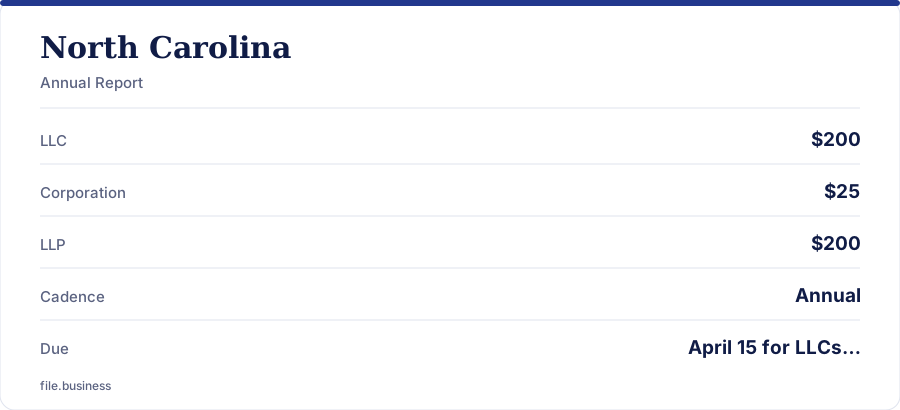

North Carolina charges a limited liability company $200 a year for its annual report, and a business corporation only $25. That ratio runs opposite to almost every other state, where corporations carry the heavier recurring cost and LLCs are the cheap option. In North Carolina the LLC is the expensive vehicle to maintain. An owner who chose the structure on the usual assumption about running costs ends up paying an extra $175 a year for the surprise.
Both filings go to the North Carolina Secretary of State through the business registration portal at sosnc.gov. The obligation itself sits in two different chapters: N.C. Gen. Stat. § 57D-2-24 requires the annual report from limited liability companies, and N.C. Gen. Stat. § 55-16-22 requires it from business corporations. Both are due on April 15. The form is the same length for both. The only thing that changes is the number at the end.
What the $200 buys, and what it does not
The fee is a maintenance charge on the register, not a tax, and it is not credited against anything. It does not cover the registered agent, which is a separate arrangement. It does not cover a Certificate of Existence, which North Carolina issues at $15 and which is inexpensive by national standards. It does not cover an amendment. What it buys is the entity's continued presence on the active register for another twelve months, plus the right to say so in front of a bank.
For a single-entity business, the $200 is an annoyance. For a group holding six North Carolina LLCs, it is $1,200 a year. At that point the entity count becomes a live cost question, not an administrative one. Owners consolidating property or operating entities in this state usually do the arithmetic once, then never form a spare LLC casually again.
Who files a North Carolina report
Domestic LLCs, domestic business corporations, limited liability partnerships, and every foreign LLC or corporation holding a North Carolina Certificate of Authority must file. A Virginia LLC that qualified here to take on regional work files a North Carolina report at the full $200, and pays it separately from anything Virginia requires. Getting qualified is covered in our North Carolina foreign qualification guide. Assumed business names are registered at county level, not with the Secretary of State, and follow their own rules, set out in our North Carolina assumed business name guide.
Deadlines, Fees, and the Form Itself
North Carolina Annual Report at a Glance
| Item | Value |
|---|---|
| Report name | Annual Report |
| Filing frequency | Annual |
| Deadline | April 15 |
| LLC filing fee | $200 |
| Corporation fee | $25 |
| Late penalty | $25 per outstanding year |
| Processing time | 5-10 business days |
| Filing portal | sosnc.gov |
| Filing agency | North Carolina Secretary of State |
The April 15 collision
North Carolina put its annual report on the busiest date in the American financial calendar. April 15 is when individual federal returns are due, when extension requests are filed, when first-quarter estimates are paid, and when every accountant in the state is unreachable. A filing worth $200 competes for attention that day with filings worth far more. It loses more often than its price would suggest.
The practical answer is to stop treating April 15 as the target. File the report as soon as the year opens. A business that files in late February removes itself from the collision entirely. Holding the money back for six weeks gains nothing. The whole cost picture is set out on our North Carolina annual report cost page.
What the form asks, and what it cannot change
North Carolina asks for the entity name as registered, the Secretary of State identification number, the street and mailing address of the principal office, a brief description of the nature of the business, the registered agent's name with the registered office street address, and the names, titles and business addresses of the company officials. That means managers or members for an LLC, and officers for a corporation.
The report will not amend the articles. A name change or a restatement takes Articles of Amendment at $50, covered in our North Carolina amendment guide. A change of agent takes a Statement of Change of Registered Agent, which North Carolina prices at $5 -- the cheapest correction available anywhere in this process. There is no financial reason to leave a bad agent on the record for even one cycle. Our guide to changing a North Carolina registered agent covers the mechanics, and our North Carolina registered agent guide covers who qualifies.
File your North Carolina annual report
We pull your record from the state, prefill every field, and track next year’s deadline. Or keep reading and file it yourself; this guide covers both.
The Cost of a Late North Carolina Report
North Carolina adds $25 for each year a report is outstanding. That is modest set against the LLC fee itself, which means the penalty is never the reason an owner cannot afford to get current. The back fees are, because they accumulate at $200 a year for an LLC whether or not the business traded.
The penalty arithmetic, for an LLC and for a corporation
For an LLC, one missed year costs $200 in back report plus $25 in penalty -- $225 total. Two missed years cost $400 plus $50, or $450. Three missed years cost $600 plus $75, or $675. By then the entity has been administratively dissolved, because North Carolina moves on delinquent entities at around 24 months. For a corporation, the same three steps cost only $50, $100 and $150 -- the difference between an irritation and a decision about whether the entity is worth keeping.
That asymmetry produces a specific and avoidable outcome. An owner holding a dormant North Carolina LLC alongside an active corporation will often let the LLC lapse, because $675 feels disproportionate for a shell. What they may not appreciate: the lapse also removes the name from protection, and leaves any contract signed in that name in an awkward position.
Reinstatement inside the five-year window
North Carolina allows an administratively dissolved entity to be reinstated for five years from the date of dissolution, and it does not require a tax clearance certificate to do it. That combination is genuinely favorable. In many states the tax clearance step is the longest part of the process, and can add two months. Here the route back is the outstanding reports, the accumulated $25 penalties, and an Application for Reinstatement.
Our reinstatement service is $297 plus state fees. The sequence is set out in our North Carolina reinstatement guide. Once the five years pass, the entity cannot be restored at all. Closing deliberately instead costs $30 on Articles of Dissolution, covered in our North Carolina dissolution guide. While an entity is dissolved, it cannot get the $15 Certificate of Existence described in our North Carolina certificate of existence guide.
Three North Carolina Filings in Practice
Example 01: a Durham single-member LLC budgeting for $200
A software contractor formed a single-member LLC in Durham in 2020, and files every year in the last week of February, deliberately ahead of the April date. Action taken: she opens the portal, confirms the principal office, the business description and her own name as the sole company official, then pays.
Real cost: $200 to the Secretary of State. She sets aside roughly $17 a month for it, rather than finding the sum in one go in April, plus $149 for commercial agent service. Timeline: eight minutes, accepted within the standard window. Outcome: six unbroken years on the active register, with no year where the report competed with her own tax return for attention. The formation record sits in our North Carolina LLC formation guide.
Example 02: a Charlotte corporation updating its officer roster
A Charlotte marketing corporation replaced its chief financial officer in October 2025, then appointed a second vice president in January 2026. Neither change reached the register at the time. That is normal, because in North Carolina nothing forces the update until the report falls due. Action taken: the April 2026 report removed the departed officer, added both new appointments with titles and business addresses, and corrected the mailing address after the company gave up its street-level suite.
Real cost: $25, with no separate fee for the officer changes. Timeline: filed April 3, accepted in six business days. Outcome: a state agency ran a vendor check in June, and the officer list on the register matched the corporate resolutions in the bid pack. The $175 the corporation saves against an LLC on this filing every year remained the quiet argument for the structure it chose.
Example 03: a foreign-qualified LLC across three states
A Georgia LLC in commercial landscaping holds North Carolina and South Carolina certificates of authority, taken out for regional contracts. The three obligations differ in date, price, and even in whether they exist. Action taken: the owner built one calendar covering Georgia's own annual registration, North Carolina's $200 report on April 15, and South Carolina, where an LLC has no annual report at all. Real cost: North Carolina is by some distance the largest recurring line of the three. That surprised the owner enough to trigger a review of whether the North Carolina entity was still needed.
Timeline: about 25 minutes a year. Outcome: the entity was kept, the calendar held, and the review itself was the value. The multi-state picture is in annual report deadlines by state, and continuous cover in compliance monitoring.
Five Mistakes on a North Carolina Report
Mistake 1: Budgeting the corporate fee for an LLC
What it is: setting aside $25 for a North Carolina LLC report, because that is the figure most often quoted in general guidance. Why it happens: $25 is the corporate fee, and national summaries frequently print a single number per state. Consequence: a $175 shortfall shows up at the deadline. In a group holding several LLCs, that shortfall multiplies by the entity count. Prevention: budget $200 per LLC per year and $25 per corporation. Check the figure against the entity type, not the state.
Mistake 2: Letting the report compete with tax day
What it is: planning to file on April 15, along with everything else that falls due that day. Why it happens: a shared date feels efficient. Consequence: the smallest item on the list is the one that slips. It slips into a delinquency that costs $25 immediately and starts a 24-month clock. Prevention: set the internal deadline to March 1, and treat April 15 as the state's backstop, not your date.
Mistake 3: Assuming the accountant filed it
What it is: believing the annual report was handled, because tax work was done for the same entity around the same date. Why it happens: the two land on the same day. To a client watching a tax preparer work, the report is not obviously a separate state registration matter.
Consequence: nobody files. Both parties believe the other did -- the single most common way a North Carolina report is missed entirely. Prevention: confirm in writing who files the Secretary of State report, and keep it on the entity calendar, not the tax calendar.
Mistake 4: Leaving a bad agent on the record
What it is: filing the report against a registered agent who has moved, resigned or stopped providing service. Why it happens: agent problems surface only when something is sent to the agent -- the same person who would have received the warning. Consequence: state notices and service of process go unread, even though the entity remains validly served. That is how a default judgment reaches a business that never saw the claim.
Prevention: verify the agent before opening the report. Correct it with the $5 statement of change -- the cheapest filing in the entire North Carolina schedule.
Mistake 5: Treating the reinstatement window as open ended
What it is: assuming an administratively dissolved North Carolina entity can be revived whenever the money is available. Why it happens: several states allow reinstatement indefinitely, and the absence of a tax clearance requirement here makes the process feel informal. Consequence: the five-year window closes and the entity can no longer be restored. The name, the formation date and the credit history attached to it are gone. Prevention: decide within the first year whether to reinstate or to dissolve deliberately, then act on that decision rather than deferring it.
Building a North Carolina Filing Routine
Practice 1: Move your internal date to March
The single most effective change any North Carolina filer can make is to stop sharing a deadline with the federal tax calendar. File in the first week of March. The report itself is identical in March and in April. The difference is that in March you have the attention of everyone whose sign-off you might need.
Practice 2: Treat $200 as a standing cost, per entity
An LLC report here is not a nuisance fee. It is a recurring line item large enough to belong in the budget. Record it per entity, review it annually, and let it inform how many North Carolina entities the business actually needs. An entity that exists only to hold a name costs $200 a year to do that.
Practice 3: Reconcile officials before you open the form
The company officials block is the part of the report that other institutions read. Compare it against your own minutes or written consents before you start, and resolve any difference in your own records first. Our North Carolina operating agreement guide covers where manager authority should be documented. Entities held across several registers stay current more reliably under a single compliance calendar.
How File.Business Handles North Carolina Annual Reports
File.Business is a private filing service, not a law firm and not a government agency. For a North Carolina report, we pull the current record from the Secretary of State and compare the principal office, agent and company official lines against what you tell us is true now. We flag anything that needs its own filing first, then file through the state portal ahead of April 15. We pay the $200 LLC fee or the $25 corporation fee, and send you the acceptance.
Entities in several states run on one calendar from one dashboard. Start at the annual report filing service or read the state detail on the North Carolina annual report page.
North Carolina annual report FAQ
When is the North Carolina annual report due?
April 15 each year -- the same date as the federal individual income tax return. You can file the report any time before that date. Filing in February or March avoids competing with the busiest day in the accounting calendar.
Why does a North Carolina LLC pay $200 when a corporation pays $25?
Because North Carolina prices the two entity types differently, and in the opposite direction from most states. The LLC annual report fee is $200; the business corporation fee is $25. The form and the deadline are the same for both. Only the fee changes.
What is the penalty for filing a North Carolina report late?
$25 for each year the report stays outstanding, on top of the report fee itself. For an LLC, that means $225 for one missed year, $450 for two, and $675 for three. Continued non-compliance leads to administrative dissolution at around 24 months.
How long do I have to reinstate a dissolved North Carolina entity?
Five years from the date of administrative dissolution. North Carolina does not require a tax clearance certificate for reinstatement, which makes the process faster here than in states that do. After five years the entity cannot be restored and a new one has to be formed.
Where do I file the North Carolina annual report?
Online with the North Carolina Secretary of State through the business registration portal at sosnc.gov. You locate the entity by name or identification number, confirm the record, correct anything that has drifted, and pay by card. Most filers finish in under ten minutes when their records are current.
Do foreign LLCs need to file a North Carolina annual report?
Yes. An LLC holding a North Carolina Certificate of Authority files the annual report by April 15 and pays the same $200 as a domestic LLC. The report filed in the home state does not satisfy the North Carolina requirement.
File your North Carolina annual report
We pull your record from the state, prefill every field, and track next year’s deadline. Or keep reading and file it yourself; this guide covers both.
Doing this in North Carolina specifically: North Carolina annual report filing and the annual report page at the North Carolina Secretary of State cover the detail for this state, including the current fee and the exact form the agency expects.
This guide is written from the official sources below. Fees, forms, and deadlines change. Confirm the current requirement with the agency before you file.
Disclosure. File.Business is a private filing service, not a government agency and not a law firm. We prepare and submit filings at your direction. Nothing on this page is legal or tax advice. Filing fees, deadlines, and statutory references are current as of the last-updated date shown above, and they can change. Confirm current requirements with the relevant state agency before you file.