
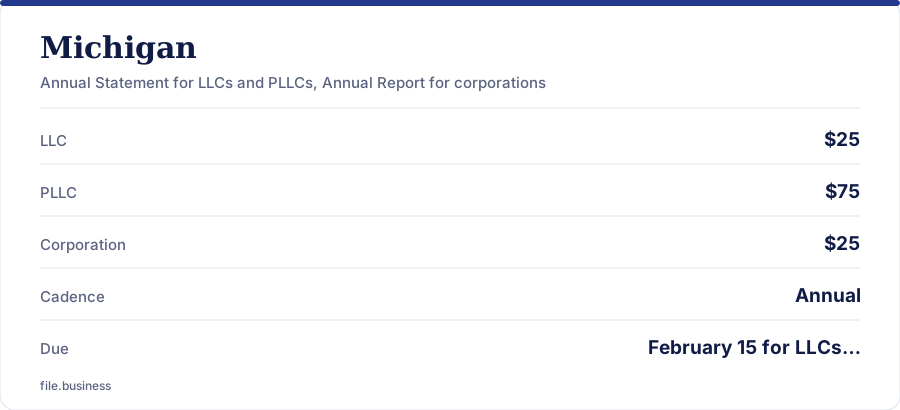
Start with the fact that costs Michigan filers the most time: the Secretary of State does not hold the business register. Michigan puts entity filings under the Department of Licensing and Regulatory Affairs, known everywhere as LARA. The Secretary of State only handles driver and vehicle matters. So if you search for a Michigan annual report at the Secretary of State, you get license renewal pages and nothing about your company. For an LLC the filing is called an annual statement, it is due on February 15, and it costs $25. For a corporation it is called an annual report, it is due on May 15, and it also costs $25.
What the Michigan Annual Statement Is

The annual statement confirms the entity information LARA publishes: legal name, identification number, registered office, resident agent and that agent's Michigan address, and the managers, members, or officers who run the company. MCL § 450.4207 is the section that requires a limited liability company to file it, and MCL § 450.1911 imposes the matching annual report duty on corporations. You submit it through the Corporations Online Filing System, the portal LARA runs at cofs.lara.state.mi.us. This is the filing on which a Michigan entity's good standing turns.
At $25, the fee is among the lowest annual charges in the country. That is precisely why Michigan lapses are common: a $25 obligation does not command attention the way a $300 one does. The penalty structure is where Michigan gets expensive. It is built to punish delay rather than lateness: Michigan does not run a monthly meter on LLCs. What accrues is the unfiled statements themselves, at $25 each, and after two years the company stops being in good standing by operation of law.
Why February 15 is an awkward date
Michigan sets the earliest annual deadline in the region. February 15 falls in the middle of year end close, W-2 and 1099 distribution, and the run up to income tax season. Bookkeepers who batch compliance work for spring find that Michigan has already come and gone. Companies that operate in Michigan alongside Ohio or Indiana are especially exposed, because the neighboring deadlines fall months later and set the wrong expectation.
Who files a Michigan annual statement
Domestic Michigan LLCs and corporations both file every year, on different dates: LLCs and PLLCs by February 15, profit and professional corporations by May 15, nonprofit corporations by October 1. Entities formed in another state that hold a Michigan foreign qualification file on the same schedule as their domestic counterparts. The report filed at home does nothing for the Michigan registration. A PLLC files the same statement at $75 rather than $25. Businesses with no Michigan registration on the LARA record have no filing to make.
The Michigan Filing at a Glance
| Item | Value |
|---|---|
| Report name | Annual Statement (LLC, PLLC) / Annual Report (corporation) |
| Filing frequency | Annual |
| Deadline | February 15 for LLCs and PLLCs, May 15 for profit and professional corporations, October 1 for nonprofits |
| LLC filing fee | $25 |
| PLLC filing fee | $75 |
| Corporation fee | $25 |
| Late penalty | Corporations $10 per month or part month, capped at $50. No monthly penalty on the LLC statement. |
| Processing time | 5-10 business days |
| Filing agency | Michigan Department of Licensing and Regulatory Affairs (LARA) |
| Filing portal | cofs.lara.state.mi.us |
Filings submitted through the Corporations Online Filing System post in roughly five to ten business days. LARA delivers certificates as PDFs for standard requests, which is faster than the paper process several neighboring states still run.
Fields LARA validates
The statement is checked against the record LARA already holds. The legal name has to match exactly, including the designator and its punctuation. The customer identification number has to match too. The registered office address, the resident agent name, and the agent's Michigan street address all have to agree with the register. A post office box will not satisfy the agent address requirement. Mismatches are refused rather than corrected.
Changes that need their own filing first
A resident agent who has resigned or moved needs a change of agent filing accepted before the statement will validate. A legal name change is its own amendment. Both are quick in January and both are fatal to a February 14 filing attempt. Pull the record from the Michigan business entity search in the first week of January and you will know which, if any, apply.
File your Michigan annual report
We pull your record from the state, prefill every field, and track next year’s deadline. Or keep reading and file it yourself; this guide covers both.
Compliance Risk: What Michigan Delay Costs Per Month
Michigan is cheaper to neglect than most states, and that is exactly why it gets neglected. There is no runaway meter. What there is instead is a quiet two-year line after which the company is no longer in good standing, and every bank, lender and counterparty that pulls the record can see it.
The Michigan escalation clock
- February 16. The LLC statement is late. Nothing is charged that day, but the year is now a delinquent year that has to be paid for later.
- May 16. A corporation that missed its own deadline starts paying $10 for each month or part of a month it stays delinquent, to a maximum of $50.
- Month twelve. The record shows the company as not in good standing. Certificates of good standing are refused, which is what blocks loans, leases and foreign qualifications in other states.
- Two years unfiled. An LLC is no longer in good standing by operation of law. A corporation is automatically dissolved sixty days after the two-year period expires, and a foreign corporation’s certificate of authority becomes revocable after one year.
- Restoring. An LLC files a Certificate of Restoration of Good Standing at $50 with the statements and fees for every unfiled year. Michigan sets no cut-off date for doing so, but it does not hold the company name for you either.
| Delinquent years | Back statements | Restoration certificate | Total to clear (LLC) |
|---|---|---|---|
| One year | $25 | $50 | $75 |
| Two years | $50 | $50 | $100 |
| Three years | $75 | $50 | $125 |
Add $25 if you restore after February 15, because the current year’s statement comes due as well. A PLLC pays $125 for each delinquent year instead of $25. The money is not the point in Michigan: three years of neglect on an LLC costs about what one rush certificate costs. The cost is the standing. For most of those three years the company could not produce a certificate of good standing, and that is the document a lender, a landlord or another state’s registry asks for.
Having no statutory cut-off is real relief compared with states that close the door after three years. It should not be read as permission to wait. Michigan does not reserve the name of a company that has lost good standing, so a business that intends to restore in year four may find its name registered to someone else. If the company is already out of good standing, our reinstatement service files the restoration and the back statements together. If it is genuinely finished, closing it properly ends the obligation for good.
Three Michigan Filings in Practice
Example 1: A Grand Rapids LLC beats the date
A commercial photographer running a single-member LLC files on January 12, a month early, because February is the busiest part of her year end. She checks the LARA record first, confirms the resident agent address is still hers, and pays $25. Acceptance posts on January 21. The total cost of Michigan compliance for the year is $25 and roughly fifteen minutes. The February 15 date never becomes a problem, because she stopped treating it as the target.
Outcome: The cheapest possible outcome, which in Michigan is entirely a function of filing before the clock starts.
Example 2: A Detroit corporation refreshes its officer record
A tooling company promoted its plant manager to president in November and appointed a new secretary at the same board meeting. Michigan corporations list officers and directors on the annual statement. So the February filing carries both changes onto the public record. The company files on February 3 for $25. In April, a tier one customer runs supplier verification and checks the LARA record. It finds the president named on the purchase agreement listed as president on the register too. No follow-up questions, no delayed onboarding.
Outcome: One $25 filing kept the register aligned with the signature authority the customer was checking.
Example 3: An Ann Arbor company across the Midwest
A logistics business formed in Michigan runs terminals in Ohio and Indiana. Michigan wants its statement by February 15 every year. Ohio does not require a general annual report for LLCs at all. Indiana runs a biennial business entity report keyed to the formation month. The operations manager nearly missed Michigan twice. The Ohio registration needs nothing, and the Indiana one only surfaces every other year, so nothing in the routine reminded anyone that February existed.
The fix was a single calendar with the Michigan date as a fixed February entry rather than a compliance review that happens when a state writes to you.
Outcome: The state with the smallest fee turned out to need the most deliberate tracking. Our deadline table by state shows why.
Five Errors That Derail Michigan Filings
The first one on this list costs more hours than the other four combined.
What happens: An owner searches Michigan Secretary of State for an annual report and finds nothing relevant, because that office does not hold the business register.
Why it happens: Forty-odd states do put the corporate register under the Secretary of State, so the assumption is reasonable everywhere except here.
Consequence: Wasted hours, and sometimes a missed February 15 while the search continues in the wrong place.
Prevention: Go to LARA and the Corporations Online Filing System. Michigan business filings live nowhere else.
What happens: A late filer sees that Michigan charges no monthly penalty on the LLC statement and treats the deadline as advisory.
Why it happens: Most states punish lateness with money, so a state that does not seems to be saying the filing is optional.
ConsequenceMichigan charges standing instead of money. Two unfiled years and the company is no longer in good standing by operation of law, which is what stops a loan, a lease or a foreign qualification in the next state.
Prevention: File the moment you notice. Each month of hesitation has a price attached to it.
What happens: Compliance work is batched for March or April and Michigan has already lapsed.
Why it happens: February 15 is earlier than almost every other state, so it falls outside the usual cycle.
Consequence: A penalty that starts in February and accrues through the whole compliance season.
Prevention: Put Michigan in the January workflow with the year end close, not in the spring batch.
What happens: The statement is refused because the agent on the record has resigned, moved, or listed a post office box.
Why it happens: Michigan requires a physical street address for the agent, and informal arrangements drift.
Consequence: A change filing has to clear first, which in mid-February means the penalty starts anyway.
Prevention: Keep a stable Michigan resident agent whose address does not change with your office.
What happens: A dissolved company waits, reasoning that reinstatement is available for sixty months.
Why it happens: Michigan's window is unusually long, which reads as safety.
Consequence: The name is not reserved during dissolution, and penalties keep accruing against the reinstatement bill.
Prevention: Treat the window as a limit, not a plan. Reinstate early or close the entity and stop the clock.
A Michigan Routine Built Around January
Everything about Michigan compliance gets easier if the work happens a month before the state expects it.
How File.Business Files in Michigan
We file Michigan annual statements through LARA's Corporations Online Filing System well ahead of February 15. First we reconcile the entity against the register, so that the name, identification number, agent, and officer list all validate on the first submission. We pay the $25, return the acceptance, and watch good standing in between.
Michigan resident agent service is included for the first year. Where an entity is already late we file immediately rather than waiting for a convenient date, because in Michigan the calendar itself is the cost. If you need proof of status afterwards, we can order the Michigan certificate of good standing at the same time.
Michigan annual statement FAQ
What Michigan filers ask most, including the agency question that trips up almost everyone. Our annual report service covers every state on one calendar.
Which agency handles Michigan annual reports?
The Michigan Department of Licensing and Regulatory Affairs, known as LARA. The Michigan Secretary of State does not hold the business register. It handles driver and vehicle matters. Filings go through LARA's Corporations Online Filing System.
When is the Michigan annual statement due?
February 15 for an LLC or PLLC. A corporation files an annual report by May 15 instead, and a nonprofit corporation by October 1. February 15 is the earliest annual entity deadline in the Great Lakes states, which is why it is so often missed by businesses that batch compliance work for the spring.
How much does the Michigan annual statement cost?
$25 for an LLC and $25 for a corporation, $75 for a PLLC and $20 for a nonprofit corporation. The fee is flat and does not vary with revenue or size, which makes it one of the least expensive annual filings in the country.
What is the penalty for filing a Michigan annual statement late?
There is no monthly penalty on the LLC statement. You pay $25 for each year you missed, plus $50 for the Certificate of Restoration of Good Standing once the company has fallen out of good standing. A corporation that files its annual report late pays $10 for each month or part of a month, capped at $50.
How long can a dissolved Michigan entity be reinstated?
Michigan publishes no cut-off for restoring an LLC to good standing; you file the Certificate of Restoration with every unfiled statement whenever you get to it. That is more generous than most states, but Michigan does not reserve the company name in the meantime, so waiting risks losing the name to another filer.
Do foreign-qualified companies file a Michigan annual statement?
Yes. A foreign LLC files by February 15 and a foreign corporation by May 15, on the same terms as their domestic counterparts. The annual filing made in the state of formation has no effect on the Michigan registration.
File your Michigan annual report
We pull your record from the state, prefill every field, and track next year’s deadline. Or keep reading and file it yourself; this guide covers both.
Working in Michigan specifically: Michigan annual report filing and our Michigan annual report reference page carry the current fee and the exact statement LARA expects. Registering into Michigan from another state starts with foreign qualification in Michigan.
This guide is written from the official sources below. Fees, forms, and deadlines change. Confirm the current requirement with the agency before you file.
Disclosure. File.Business is a private filing service, not a government agency and not a law firm. We prepare and submit filings at your direction, and nothing on this page is legal or tax advice. Filing fees, deadlines, and statutory references are current as of the last-updated date shown above and can change. Confirm current requirements with the relevant state agency before you file.


