Louisiana Asks for a Report Before the First Year
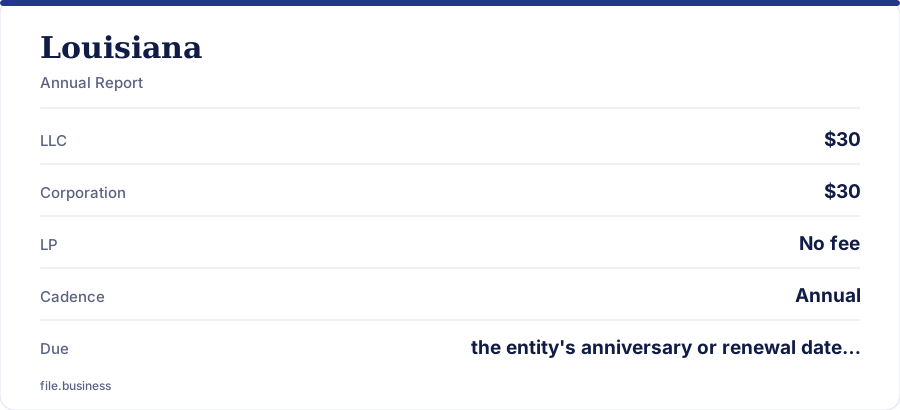

Louisiana runs an ordinary anniversary-month annual report, plus one requirement almost no other state pairs with it. A domestic entity files an initial report alongside its formation document. An out-of-state entity files an initial report or list of officers within 90 days of qualification. The annual cycle then begins immediately.
That single difference explains most Louisiana compliance failures. National formation checklists describe a world in which nothing is due until the first anniversary. A Louisiana business working from one of those checklists is behind before it has issued an invoice.
The filing goes to the Louisiana Secretary of State, Commercial Division, through geauxBIZ at geauxbiz.com. It confirms the entity name and charter number. It confirms the registered office and registered agent with a Louisiana street address. It confirms the principal business establishment, and the members, managers, officers or directors that the entity type requires.
Louisiana asks nothing about revenue. La. R.S. § 12:1308.1 puts the annual report on a limited liability company and § 12:1-1621 puts it on a corporation, and the filing is the routine mechanism for keeping the register accurate. It is also the filing that keeps the entity's name protected.
The anniversary month rule
Louisiana sets the deadline by the month in which the entity was formed or qualified, not by a statewide date. An LLC organized on August 8 files each August. A corporation qualified on March 2 files each March.
The initial report is filed at formation, so the first ordinary annual report falls due in that same month one year later. Most owners find that rhythm easy once they have noticed it.
Getting to that point requires one distinction. The initial report and the first annual report are two different filings. That is where the confusion usually sits.
Thirty-six months of patience, then tax clearance
Louisiana is patient on the way down and demanding on the way back. Administrative dissolution does not arrive until 36 months of non-compliance. That is longer than Illinois, Kansas, Hawaii, Kentucky, Indiana or Maine allow.
Reinstatement is then available for 36 more months. But the Secretary of State will not restore an entity without tax clearance from the Department of Revenue. So every dormant year has to be filed and settled before the register moves.
The generous timetable and the clearance requirement work in opposite directions. The state gives you three years to notice a problem. Then it makes the fix depend on three years of tax filings you have not done.
Fee, Deadline and What geauxBIZ Validates
Louisiana Annual Report at a Glance
| Item | Value |
|---|---|
| Report name | Annual Report |
| Filing frequency | annual |
| Deadline | Anniversary month |
| LLC filing fee | $30 |
| Corporation fee | $30 |
| Late penalty | $30 + interest |
| Processing time | 5-10 business days |
| Filing agency | Louisiana Secretary of State |
Thirty dollars covers every entity type. The penalty matches the fee exactly, so a late filing costs double.
The interest line is the one that changes behavior. A Louisiana balance keeps growing while an entity sits delinquent. An owner who calculates the cost of a lapse from the arrears table alone will underestimate it.
Processing and the practical cutoff
Standard processing runs 5 to 10 business days. Against a month-long window, the practical cutoff is around the middle of the anniversary month. A rejection in the final week cannot be corrected in time.
geauxBIZ validates the entity name against the register, down to the designator and punctuation. It checks the charter number against the name. And it requires a registered agent with a physical Louisiana street address able to accept service.
The Louisiana registered agent guide sets out the agent requirement. Some changes the report cannot carry, such as the legal name. Those belong in an amendment filed first.
File your Louisiana annual report
We pull your record from the state, prefill every field, and track next year’s deadline. Or keep reading and file it yourself; this guide covers both.
The Consequence Ladder in Louisiana
Louisiana escalates slowly in months and steadily in money. The sting is at the end. There the Department of Revenue, rather than the Secretary of State, decides how long the recovery takes.
One, two and three missed years in dollars
Each missed year carries the $30 report and the $30 penalty. So one missed year clears at $60, two at $120 and three at $180, before interest.
Add the $75 Application for Reinstatement once the entity has been dissolved. A three-year lapse then settles at $255 in state charges, again before interest and before any accounting work.
The tax clearance requirement is what turns that number into a real bill. Three dormant years usually means three sets of state returns to prepare and file. Clearance cannot be requested until they are done. Our reinstatement service covers the filing side at a fixed $297 in service fees.
Losing good standing in a state that otherwise moves fast
A delinquent Louisiana entity cannot get a Certificate of Good Standing. The certificate costs $20 on standard handling, with 5 to 7 business day turnaround. It costs $30 with expedited service, which Louisiana turns around in 24 hours. Counterparties commonly accept one up to 90 days old.
Louisiana is one of the faster states in the country for a business that is current. That makes the contrast sharp. The same office that will produce a certificate overnight for a compliant entity will produce nothing at all for a delinquent one, at any price.
Oil services, marine and construction contracts in the Gulf region routinely require a certificate at short notice. That is exactly when a lapse surfaces. The Louisiana Certificate of Good Standing guide covers ordering, and the apostille route for international counterparties.
Dissolution and the clearance bottleneck
After 36 months of non-compliance Louisiana administratively dissolves the entity. The Application for Reinstatement at $75 remains available for 36 months after that, processed in 10 to 15 business days once it is accepted.
The processing time is not the constraint. Tax clearance is. That is why a Louisiana reinstatement is usually measured in months rather than weeks. Our Louisiana reinstatement guide sets out the sequence. The Louisiana dissolution guide covers a deliberate wind-up, which avoids the clearance scramble entirely.
Three Louisiana Filings in Practice
Example 01: a New Orleans single-member LLC
A pastry chef formed a single-member LLC in New Orleans in April. She filed the initial report together with the Articles of Organization at formation, which set her annual cycle to April.
Action taken: each year she files in the first week of April. She confirms her registered agent's Orleans Parish street address, lists herself as sole member, and pays.
Real cost: $30 to the Commercial Division. Timeline: six minutes on geauxBIZ, accepted seven business days later.
Outcome: current for the year. The initial report was filed at formation rather than discovered later, so her entity has never carried a delinquency. That is the difference between her and most Louisiana businesses in their first two years.
Example 02: a Baton Rouge corporation updating its officers
A Baton Rouge industrial coatings corporation qualified in Louisiana in October and files each October. During the year it appointed a new vice president, lost a director and moved its principal business establishment to a larger yard.
None of it had reached the register. Louisiana collects those changes on the annual report rather than through a standalone officer filing. Action taken: the October report listed the current officers and directors, removed the departed director and corrected the establishment address.
Real cost: $30, with no separate charge for the governance changes. Timeline: filed October 9, accepted October 17.
Outcome: the register matches the corporate record. That mattered, because a prime contractor prequalifying the company in November checked the officer list on the state record against the signature block on the bid.
Example 03: a foreign-qualified LLC filing in three states
A specialty welding LLC formed in Louisiana qualified in Texas and Mississippi as its crews followed pipeline work west and east. Three states, three rules, and one of them free.
Action taken: the owner recorded Louisiana at $30 due in the anniversary month, Mississippi at $25 due April 15, and Texas at $0 due May 15. Then he set one reminder covering the two spring dates and a second for the Louisiana month.
Real cost: $55 a year in state fees across three registers. Texas charges nothing for a filing it nonetheless requires.
Timeline: about 30 minutes a year. Outcome: no lapse anywhere, and the trap identified in writing. The Texas obligation has no fee, so it has no invoice and no receipt, and it is the one most likely to be forgotten.
The comparison is in annual report deadlines by state, and the Louisiana registration route in the Louisiana foreign qualification guide.
Five Mistakes on the Louisiana Annual Report
Mistake 1: Relying on a notice from the Commercial Division
What it is: waiting for a state reminder rather than working from your own calendar. Why it happens: the notice usually arrives, and while it does the system looks reliable.
Consequence: the reminder goes to the address held on the register. A stale address ends it silently, and interest begins running on a balance nobody knows exists. Prevention: record the anniversary month yourself, with an alert on the first of it. Treat any state notice as confirmation rather than as the trigger.
Mistake 2: Mistaking the anniversary month for a fixed statewide date
What it is: assuming Louisiana has a single annual deadline, like Kentucky's June 30 or Georgia's April 1. Why it happens: fixed-date states are more common in the region, and summary pages often quote one date for every state.
Consequence: an entity formed in September gets filed in the spring, six months late. The penalty and interest attach, and the delinquency stays visible on the register throughout. Prevention: take the anniversary month from the charter record. Store the rule, not a date copied from elsewhere.
Mistake 3: Leaving the registered office behind after a move
What it is: confirming last year's registered agent and registered office because the fields are prefilled. Why it happens: geauxBIZ presents the existing record, and confirming is quicker than verifying.
Consequence: Louisiana treats service delivered to the registered office as effective, whether or not anyone is there to receive it. So an agent agreement that lapsed after a move becomes a default judgment against a business that never saw the claim.
Prevention: verify the agent's consent and Louisiana street address before confirming. File a change of registered agent when it is out of date.
Mistake 4: Reading a thirty dollar filing as optional
What it is: deciding a $30 report with a $30 penalty is small enough to leave until later. Why it happens: the numbers are trivial, and Louisiana waits three years before it dissolves anything. So nothing appears to happen for a long time.
Consequence: interest runs the whole time. The entity carries a visible delinquency. And the eventual fix requires Department of Revenue clearance covering every dormant year, which costs far more in accounting than the state ever charged in fees.
Prevention: price the filing at the cost of the clearance, not at the cost of the form.
Mistake 5: Missing the initial report Louisiana does require
What it is: treating formation or qualification approval as the end of the paperwork. Why it happens: almost no other state pairs an initial report with the formation filing, so the requirement is absent from checklists written for a national audience.
Consequence: a domestic entity files Articles of Organization without the accompanying initial report. Or a foreign entity lets 90 days pass after qualification. Either is non-compliant from its first week, and the annual cycle starts against an already imperfect record.
Prevention: file the initial report with the formation document. Or docket the 90-day date on the day qualification is approved. Formation is covered in how to start a Louisiana LLC.
Building a Louisiana Filing Routine
Practice 1: File in the first half of the anniversary month
Processing runs 5 to 10 business days, and a rejection restarts it. Filing in the first half of the month leaves room for one correction cycle inside the deadline. It also keeps the $30 penalty, and the interest that follows it, out of the picture entirely.
Practice 2: Keep the Revenue account current, not just the register
Louisiana reinstatement depends on tax clearance. So the state tax account is part of the compliance picture rather than a separate matter.
File state returns on time, including nil returns for dormant years. That is what keeps a future reinstatement to a fee and two weeks, rather than to an accounting project.
Practice 3: Keep the Louisiana record together
Hold the charter number, the initial report, each filed annual report, the registered agent agreement and the current certificate in one place. Louisiana issues certificates in 24 hours for compliant entities, so a clean file turns an urgent counterparty request into a same-week answer.
Our compliance monitoring watches the status between filings. The annual report filing service handles the submission.
How File.Business Handles Louisiana Annual Reports
File.Business files the Louisiana Annual Report for entities on our compliance service. We take the anniversary month from the charter record. We pull the current data from the Commercial Division, so the submission matches geauxBIZ exactly.
We flag anything needing an amendment or a registered office change first. Then we file inside the anniversary month, pay the $30 state fee, and confirm acceptance.
For new entities we handle the initial report alongside formation or qualification. That is the requirement most Louisiana businesses discover only after they have missed it. Louisiana registered agent service and good-standing monitoring are included. Scope and pricing are on the Louisiana annual report page.
Louisiana annual report FAQ
When is the Louisiana annual report due?
In the entity's anniversary month, every year. That is the month in which it was formed or qualified. An LLC organized on August 8 files each August. Louisiana has no single statewide date, so take the deadline from the charter record rather than from a summary page.
How much does the Louisiana annual report cost?
The Louisiana Annual Report fee is $30 for LLCs and $30 for corporations. You pay in geauxBIZ when the report is submitted. Filing late adds a $30 penalty plus interest, so the balance keeps growing while the entity sits delinquent.
Does Louisiana require an initial report?
Yes, and this is the requirement most Louisiana filers miss. A domestic entity files an initial report with its formation document. An out-of-state entity files an initial report or list of officers within 90 days of qualification. The annual cycle begins immediately afterwards, so there is no year of grace.
What happens if I miss the Louisiana deadline?
A $30 penalty plus interest attaches, and the entity is flagged delinquent. That blocks the $20 Certificate of Good Standing. Three missed years cost $180 before interest.
Louisiana administratively dissolves after 36 months. The Application for Reinstatement then costs $75 and requires Department of Revenue tax clearance.
How long does Louisiana reinstatement take?
The Application for Reinstatement itself is processed in 10 to 15 business days. But the tax clearance requirement sets the real timetable.
Every dormant year has to be reported and settled with the Department of Revenue before the Secretary of State will restore the entity. That usually turns a Louisiana reinstatement into a matter of months rather than weeks.
Do foreign LLCs need to file a Louisiana annual report?
Yes. An LLC or corporation qualified in Louisiana files the annual report in its qualification anniversary month, at the same $30 fee. It must also file the initial report or list of officers within 90 days of qualification. The report filed in your formation state does not satisfy the Louisiana requirement.
Can File.Business file my Louisiana annual report?
Yes. We take the anniversary month from the charter record and validate every field against the Commercial Division data. We file through geauxBIZ inside the anniversary month, pay the $30 state fee and confirm acceptance.
We also handle the initial report at formation or qualification. Louisiana registered agent service and good-standing monitoring are included.
File your Louisiana annual report
We pull your record from the state, prefill every field, and track next year’s deadline. Or keep reading and file it yourself; this guide covers both.
Doing this in Louisiana specifically: Louisiana annual report filing and the annual report page at the Louisiana Secretary of State cover the detail for this state, including the current fee and the exact form the agency expects.
This guide is written from the official sources below. Fees, forms, and deadlines change. Confirm the current requirement with the agency before you file.
Disclosure. File.Business is a private filing service, not a government agency and not a law firm. We prepare and submit filings at your direction, and nothing on this page is legal or tax advice. Filing fees, deadlines, and statutory references are current as of the last-updated date shown above and can change. Confirm current requirements with the relevant state agency before you file.