
New Jersey Reports Go to the Division of Revenue

The first thing that trips people up about a New Jersey report is where it goes. Most states put the business register under a Secretary of State. New Jersey does not. The register, the annual report and the entity record all sit with the New Jersey Division of Revenue. The filing runs through the state business portal at business.nj.gov. Searching for a New Jersey secretary of state filing page is the single most common reason an owner spends twenty minutes on the wrong website before finding the right one.
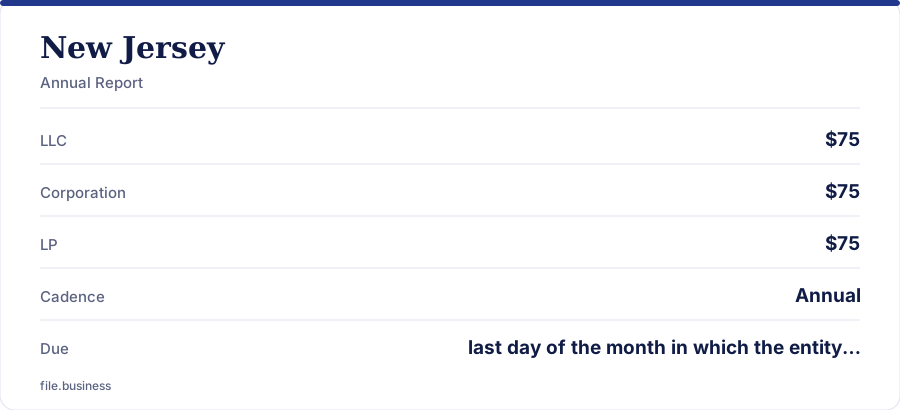
The report itself is $75 a year. It takes a few minutes once you have the entity number in front of you. That fee is identical for an LLC and for a corporation. The duty comes from two statutes running in parallel: N.J.S.A. 42:2C-26 requires the annual report from every domestic and foreign limited liability company, while N.J.S.A. 14A:4-5 imposes the same obligation on corporations. That is unusual: most states charge the two entity types differently. New Jersey treats them the same and asks the same short set of questions of both.
Why the anniversary month drives everything
There is no statewide filing date in New Jersey. Your report is due on the last day of the month in which the entity was originally formed or, for a foreign entity, the month it registered to do business here. An LLC organized on March 3 files by March 31 every year. A corporation authorized on November 28 files by November 30. That design spreads the workload for the Division of Revenue. It removes the thing that makes deadlines stick in an owner's memory: everybody talking about the same date at the same time.
The consequence shows up in groups that hold several entities. A holding company formed in January, an operating LLC formed in June and a property entity registered in October carry three separate deadlines, none of which lines up with a tax date. Owners who track their filings by tax season rather than by formation date are the ones who fall behind. The anniversary is worth copying out of the formation certificate into whatever calendar you actually read.
Who has to file a New Jersey report
Every for-profit entity on the register files: domestic LLCs, domestic business corporations, limited partnerships, limited liability partnerships, and every foreign entity holding a New Jersey certificate of authority. A Delaware corporation with New Jersey operations files a New Jersey report in its own name and pays the same $75. Its Delaware franchise filing does nothing for that obligation.
Registering to do business here in the first place is covered in our New Jersey foreign qualification guide. Sole proprietors and general partnerships that never registered with the state have no report to file. An alternate name registration, though, runs on its own five-year cycle; it is covered in our New Jersey alternate name guide.
The $75 Report, Line by Line
New Jersey Annual Report at a Glance
| Item | Value |
|---|---|
| Report name | Annual Report |
| Filing frequency | Annual |
| Deadline | Last day of the anniversary month |
| LLC filing fee | $75 |
| Corporation fee | $75 |
| Late penalty | None; revocation after two years |
| Processing time | 5-10 business days |
| Filing portal | business.nj.gov |
| Filing agency | New Jersey Division of Revenue |
What the New Jersey form asks for
The report is a confirmation exercise rather than a disclosure exercise. New Jersey asks for five things: the entity name exactly as registered; the ten-digit entity identification number; the main business address; the registered agent's name and the registered office street address; and the current officers or directors for a corporation, or the managers or members for an LLC. There is no revenue figure, no balance sheet and no ownership percentage. Anything that reads like an accounting question belongs to a different filing.
Two of those lines carry more weight than the rest. The registered agent line is the address at which the state and any process server will reach the entity. It has to be a physical New Jersey street address that is attended during business hours. Our New Jersey registered agent guide covers what qualifies and what does not. The officer and member line is the one a bank or an acquirer will later compare against your own resolutions. A stale name there causes more friction in a transaction than a stale address does.
Filing through the New Jersey business portal
You locate the entity by name or entity number and confirm the record the Division already holds. Then correct the address and officer lines where they have drifted, and pay the $75 by card or e-check. Confirmation on a clean submission is quick. The state's own processing window on filings generally runs 5-10 business days.
What the report cannot do is change the certificate of formation. A name change or a restatement needs a Certificate of Amendment at $100, covered in our New Jersey amendment guide. A change of agent needs the Certificate of Change of Registered Agent or Office at $25, covered in our guide to changing a New Jersey registered agent. Total lifetime costs sit on our New Jersey annual report cost page.
File your New Jersey annual report
We pull your record from the state, prefill every field, and track next year’s deadline. Or keep reading and file it yourself; this guide covers both.
What a Missed New Jersey Report Actually Costs
New Jersey does not run a late fee. There is no charge per month, no doubling penalty and no interest on an unpaid report. That makes the arithmetic unusually clean and unusually deceptive, because the absence of a bill in year one is exactly why year two arrives without anybody noticing.
The penalty arithmetic on one, two and three missed years
Miss one year and you owe $75. The entity is flagged as delinquent on the public record, which is visible to anyone who searches it. But nothing else happens, and no invoice arrives. Miss two years and you owe $150 in back reports. This is where the clock matters: two consecutive years without a report is the point at which the Division of Revenue revokes the charter. Miss three years and the back reports come to $225. By then the entity is already revoked, and the cost stops being about report fees at all.
A revoked entity has to file every outstanding report and then an Application for Reinstatement. New Jersey sets no deadline on that application, which is genuinely generous compared with states that close the window after two or three years. But it does require tax clearance before it will restore the charter.
Every corporation business tax, sales and use, and employer withholding account has to be brought current first, including years in which the business did nothing at all. Producing returns for dormant years is usually the largest line in the whole exercise. Our reinstatement service is $297 plus state fees. The full sequence is set out in our New Jersey reinstatement guide.
What revocation blocks while it lasts
While the charter is revoked, the entity cannot get a Standing Certificate. That is the document New Jersey issues in place of a certificate of good standing, and it costs $50 on standard handling. That certificate is what a lender asks for before closing, what a landlord asks for before signing, and what another state's filing office asks for before granting a certificate of authority. Our Standing Certificate guide covers when it is needed.
A revoked entity also loses the practical ability to bring a claim in New Jersey courts until it is restored. That turns a $75 oversight into a live commercial problem at the worst possible moment. Closing deliberately instead of lapsing costs $100 on a Certificate of Cancellation and is covered in our New Jersey dissolution guide.
Three New Jersey Filings in Practice
Example 01: a Hoboken single-member LLC
A design consultant formed a single-member LLC in Hoboken in April 2022. She has filed every April since. Action taken: in the last week of March she opened the portal, confirmed her registered agent address, corrected nothing because nothing had changed, and paid. Real cost: $75 to the Division of Revenue, plus the $149 renewal on her commercial registered agent.
Timeline: seven minutes, confirmation the same day. Outcome: unbroken good standing since formation. That mattered in 2025 when a corporate client's procurement team asked for a Standing Certificate before renewing a contract, and she was able to order one the same afternoon. Her formation history sits in our New Jersey LLC formation guide.
Example 02: a corporation refreshing its officer roster
A Newark logistics corporation with a September anniversary changed treasurer in February and lost a director in June. Nobody updated the register, because in New Jersey nothing forces the update until the report falls due. Action taken: the September report was used to remove the departed director and list the new treasurer by name and title. It also corrected a principal address that had moved one floor within the same building. Real cost: $75, with no separate fee for the officer changes, because the report is the mechanism for making them.
Timeline: filed September 22, accepted within the standard window. Outcome: when the company refinanced its equipment line in November, the lender's search returned an officer list that matched the corporate resolutions it had been given. No explanatory letter was needed. Governance documents for LLCs get the same treatment in our New Jersey operating agreement guide.
Example 03: a foreign-qualified LLC across three states
A New York LLC in specialty contracting holds New Jersey and Pennsylvania registrations won on multi-site work. The three obligations look nothing alike. Action taken: the recurring filings were mapped onto one calendar. It lists the New York biennial statement at $9 in the formation anniversary month every second year, the New Jersey report at $75 on the last day of its own anniversary month, and the Pennsylvania annual report at $7 by September 30.
Real cost: $82 in a year with no New York filing and $91 in a year with one. Timeline: about 25 minutes a year in total. Outcome: no lapse in any state across four years. The mechanics of holding several registers at once are covered in and handled automatically under compliance monitoring.
Five Mistakes on a New Jersey Report
Mistake 1: Looking for a secretary of state
What it is: searching for a New Jersey secretary of state annual report page and filing nothing because none of the results look official. Why it happens: 47 states put the business register under a Secretary of State. So the assumption is nearly always right, and it is wrong here. Consequence: the deadline passes while the owner is still looking. The delinquency begins. Prevention: bookmark business.nj.gov and record the New Jersey Division of Revenue as the filing agency in your entity file.
Mistake 2: Treating the anniversary as a day rather than a month
What it is: calendaring the exact formation date, then filing two weeks later on the assumption there is a grace period. Why it happens: the word anniversary suggests a single day. Consequence: nothing happens in year one, because the true deadline is the last day of that month. But the habit of filing after the notional date eventually crosses a month boundary and produces a real miss. Prevention: calendar the last working day of the anniversary month. File in the first half of that month.
Mistake 3: Assuming no late fee means no consequence
What it is: reading that New Jersey charges nothing for filing late and concluding the report can wait indefinitely. Why it happens: in most states the penalty arrives as money. So no money reads as no penalty. Consequence: two consecutive missed years, charter revocation, and a reinstatement that requires tax clearance and routinely runs into four figures once dormant-year returns are prepared. Prevention: treat the two-year revocation point, not a fee, as the deadline that matters.
Mistake 4: Using the report to change the entity name
What it is: editing the business name inside the annual report screen because the field appears there. Why it happens: the report displays the registered name. So the screen looks editable. Consequence: a rejection, or worse, an accepted report that never changed anything, discovered months later when a bank compares the certificate of formation against a contract. Prevention: file the Certificate of Amendment at $100 first, wait for it to be accepted, then file the report against the corrected record.
Mistake 5: Leaving a resigned agent on the record
What it is: filing the report with a registered agent who has resigned or whose service lapsed for non-payment. Why it happens: agent renewals and report deadlines fall in different months. The resignation notice goes to the address that has stopped being monitored. Consequence: state notices and service of process go somewhere nobody reads. The entity is treated as served regardless. That is the ordinary route to a default judgment against a business that never saw the claim.
Prevention: confirm the agent is active before you open the report. Renew agent service on the same date each year.
Building a New Jersey Filing Routine
Practice 1: Write the anniversary month into the entity file
Because there is no statewide date, the deadline lives in a document most owners open once. Copy the formation month and the entity identification number to the front page of your entity file. Set the reminder for the first working day of that month rather than the last. Filing at the start of the window means a rejected payment or a missing officer name costs you days rather than the deadline.
Practice 2: Reconcile officers before you open the form
The report is the only routine moment when New Jersey asks whether the officer and member list is still true. Compare the register against your own minute book before you start, not while the form is open. Resolve any difference in the minute book first. A register that matches your resolutions is worth more than the $75 it costs to keep it that way. It also removes the commonest question asked in diligence.
Practice 3: Put every jurisdiction on one calendar
An anniversary-month deadline is easy to hold for one entity and hard to hold for five, particularly when other states use fixed dates. One calendar covering every register you appear on, with the fee and the agency next to each date, is the difference between a routine and a scramble. Entities in several states are easier to keep current under a single compliance calendar. It watches each register and files on each deadline.
How File.Business Handles New Jersey Annual Reports
File.Business is a private filing service, not a law firm and not a government agency. For a New Jersey report, we pull the current record from the Division of Revenue, compare it against what you tell us is true now, and flag anything that needs its own filing before the report can be accepted. Then we file through the state portal before the last day of your anniversary month, pay the $75 fee, and send you the acceptance.
Entities in several states run on one calendar from one dashboard. Start at the annual report filing service or read the state detail on the New Jersey annual report page.
New Jersey annual report FAQ
When is the New Jersey annual report due?
On the last day of the month in which the entity was formed, or for a foreign entity, the month in which it registered to do business in New Jersey. There is no single statewide date. So an LLC organized in March files by March 31 every year, and one organized in October files by October 31.
How much does the New Jersey annual report cost?
The state fee is $75 a year. It is the same for an LLC and for a corporation. Payment is made by card or e-check in the portal at the time of filing. There is no discount for filing early and no surcharge for filing late.
Which agency receives the New Jersey annual report?
The New Jersey Division of Revenue, through the state business portal at business.nj.gov. New Jersey does not run its business register through a Secretary of State. That is why searches for a New Jersey secretary of state filing page lead nowhere useful.
What happens if I miss the New Jersey deadline?
New Jersey charges no late fee. So the immediate cost is only the $75 that remains owed. The entity is marked delinquent on the public record. After two consecutive years without a report, the Division of Revenue revokes the charter. Restoring it means filing every outstanding report, getting tax clearance, and filing an Application for Reinstatement.
Is there a deadline for reinstating a revoked New Jersey entity?
No. New Jersey sets no time limit on the Application for Reinstatement. So an entity revoked several years ago can still be restored. The practical limit is tax clearance, because every state tax account has to be brought current first, including periods in which the business had no activity at all.
Do foreign LLCs need to file a New Jersey annual report?
Yes. Any LLC or corporation holding a New Jersey certificate of authority files the New Jersey annual report on the same anniversary-month schedule as a domestic entity and pays the same $75. The report filed in the home state does not satisfy the New Jersey requirement.
File your New Jersey annual report
We pull your record from the state, prefill every field, and track next year’s deadline. Or keep reading and file it yourself; this guide covers both.
Doing this in New Jersey specifically: New Jersey annual report filing and the New Jersey annual report agency page cover the detail for this state, including the current fee and the exact form the agency expects.
This guide is written from the official sources below. Fees, forms, and deadlines change. Confirm the current requirement with the agency before you file.
Disclosure. File.Business is a private filing service. We are not a government agency and not a law firm. We prepare and submit filings at your direction. Nothing on this page is legal or tax advice. Filing fees, deadlines, and statutory references are current as of the last-updated date shown above, and they can change. Confirm current requirements with the relevant state agency before you file.


