
What Alabama Actually Asks For Each Year
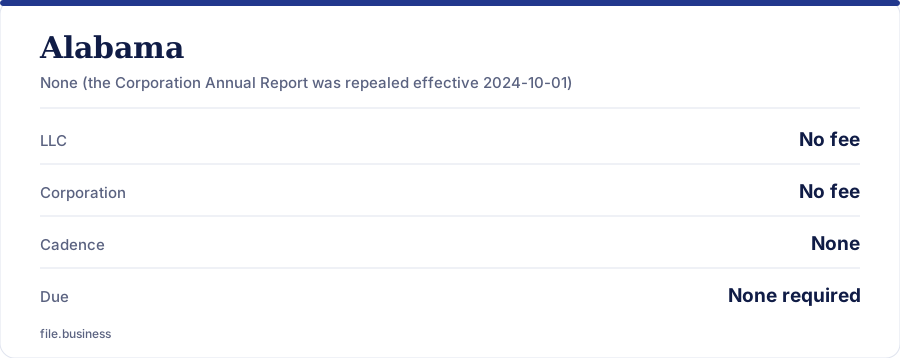

The honest answer for most Alabama companies in 2026 is this: nothing. Alabama has no annual report for limited liability companies and, since October 1, 2024, none for corporations either. Ala. Code 10A-2A-16.11, which created the Corporation Annual Report, was repealed by Act 2024-213, so there is no recurring Secretary of State report at any price. The business privilege tax that used to catch every entity in the state now carries a full exemption where the calculated tax due is $100 or less. A taxpayer inside that band does not file a return at all.
Two offices sit behind the paperwork. Confusing them is the single most common reason a filer looks in the wrong place. The business privilege tax belongs to the Alabama Department of Revenue. The public entity record, the one a bank or a title company pulls when it wants to see whether you exist, belongs to the Alabama Secretary of State at sos.alabama.gov.
Until January 1, 2024, the annual report traveled with the tax return. It then moved to the Secretary of State as a standalone filing, and nine months later Act 2024-213 abolished it entirely. What is left with the Secretary of State is the register itself: the registered agent appointment, amendments and the entity record. A problem on the tax side still surfaces at the register, usually at the worst moment. That is why the Alabama certificate of good standing is the first thing to break when something goes unfiled.
Which Alabama entities file, and which file nothing
Nobody files. Domestic for-profit corporations and professional corporations formed under Alabama law used to file the Corporation Annual Report; the requirement was repealed effective October 1, 2024. The same is true of those entity types formed elsewhere that completed foreign qualification in Alabama. Limited liability companies file nothing and never did, whether they were organized here or qualified in from another state.
A Delaware holding company with one Alabama warehouse therefore has no Alabama report deadline whatever its entity type. Sole proprietorships and general partnerships that never registered with the state fall outside all of it too, because there is no chartered entity for a report to describe.
What the repeal does not do
Losing the report does not update your record for you. There is now no annual filing that carries a new address or officer roster to the state, so every change has to be filed on its own. A registered agent change is its own filing, and a change to the entity's name or structure runs through Alabama articles of amendment.
Nor does the repeal settle anything on the tax side. An entity whose calculated privilege tax exceeds $100 still owes the Department of Revenue its return. Reading “no annual report” as “nothing to do in Alabama” is how a company ends up with a stale agent address and an unfiled privilege tax return at the same time.
The Repeal, and What Is Left
There is no window and no fee. Ala. Code 10A-2A-16.11, which set the January 1 to March 15 requirement, was repealed by Act 2024-213 effective October 1, 2024, and the Secretary of State no longer accepts or charges for a Corporation Annual Report. What remains with the Business Services Division is the register: the agent appointment, amendments, and the entity record itself.
| Item | Value |
|---|---|
| Report name | Corporation Annual Report (abolished) |
| Who files it | Nobody. No entity type files a Secretary of State annual report |
| LLC obligation | None, and never was |
| Corporation obligation | None since October 1, 2024 |
| Filing window | None |
| Corporation fee | $0 |
| Statute | Ala. Code 10A-2A-16.11, repealed by Act 2024-213 effective October 1, 2024 |
| Register agency | Alabama Secretary of State, Business Services Division |
| Privilege tax | Exempt where the calculated tax is $100 or less, no return required |
The practical effect is that an Alabama entity has no registry deadline to hit at all. The recurring work is a review rather than a filing: confirm the agent, confirm the address, and run the privilege tax computation. Anyone who wants the full picture of what a year of Alabama compliance costs can compare the line items on the Alabama annual report cost page.
The Privilege Tax Exemption in Practice
The Alabama business privilege tax used to be the reason every entity in the state filed something each spring. Act 2022-252 changed that. For taxable years beginning after December 31, 2023 there is a full exemption from the business privilege tax where the calculated tax due is $100 or less, and the Department of Revenue is explicit that a taxpayer inside that band is not required to file a Business Privilege Tax Return at all. The old minimum tax no longer creates a filing obligation for an ordinary small entity, because the minimum itself sits inside the exempt band.
Read the threshold carefully, because it turns on calculated tax rather than on revenue. Alabama computes the privilege tax against net worth apportioned to the state. So the question is not whether the company had a good year, but what the computation produces. A single-member consultancy with a laptop and a client list computes to nothing and owes nothing.
A manufacturer with a plant, held inventory and years of retained earnings can compute well above the threshold. That company still files and pays with the Department of Revenue on the ordinary schedule. The exemption removes a filing for most small entities. It does not remove the tax from the entities that genuinely owe it.
Two practical consequences follow. The first is that an Alabama LLC under the threshold has nothing to file with either agency in a normal year. That is a lighter recurring load than any of its neighbors impose. The second is that the exemption is a computation rather than a status the state grants and stamps. So you are expected to be able to produce the working if anyone asks.
Keep the net worth figures, keep the apportionment, and keep the registered agent record current so that anything arriving from Montgomery reaches a person who reads it. Entities that would rather not track any of this by hand sit on compliance monitoring.
One more thing is worth stating plainly, because the change is recent enough that most published guidance still describes the old regime. The Secretary of State annual report left the tax return on January 1, 2024 and was then abolished outright on October 1, 2024. If a checklist tells you an Alabama corporation owes a report every March, or that an Alabama LLC owes a return every April, that checklist predates the change.
What Happens When an Alabama Filing Is Missed
There is no annual report left to miss, so the cost of an Alabama lapse is never a report fee. What an inattentive entity loses is the clean record behind it. The expense arrives through good standing, through the certificate a counterparty asks for, and eventually through administrative dissolution. An entity whose calculated privilege tax exceeds $100 has a second exposure on the Revenue side, where the late-filing penalty and interest do run against the tax owed.
| Situation | What Alabama expects | State cost |
|---|---|---|
| LLC, calculated privilege tax $100 or less | No annual report and no privilege tax return | $0 |
| Corporation, any size | No annual report; requirement repealed October 1, 2024 | $0 |
| Any entity, calculated tax above $100 | Business Privilege Tax Return to the Department of Revenue | Tax as computed, plus penalty and interest if late |
| Registered agent allowed to lapse, or tax left unfiled | Good standing lapses, then administrative dissolution | Reinstatement inside a 24-month window |
Read that table as a decision tree rather than as a price list. Most small Alabama entities land on the first two rows and owe the state nothing at all in a normal year, whatever their type. The rows that carry real money are the third and the fourth. Neither of them is reached by the size of a fee. They are reached by a company that stopped paying attention, which is a different failure and a more expensive one.
Losing good standing before anyone notices
The expensive part is rarely the fee. It is the week a lender asks for a certificate of existence and Alabama will not issue one, because the entity record or the tax account is not clear. Deals stall. A commercial landlord postpones a lease assignment. A payment processor freezes a merchant account pending proof of good standing. None of that shows up as a state fee at all, and all of it lands before the state takes any formal action.
Administrative dissolution and the way back
Continue past roughly 36 months of non-compliance and Alabama moves to administrative dissolution. The charter closes, the name stops being protected, and the liability shield an LLC exists to provide becomes an argument rather than a fact. Reinstating means filing an Application for Reinstatement inside a 24-month window. Alabama gates that on tax clearance: any privilege tax the entity actually owed has to be filed and paid, with interest, before the Secretary of State will restore the record.
The bill is therefore driven by whatever was genuinely due rather than by the size of a report fee, plus the reinstatement application fee the agency sets, plus the professional time to reconstruct several years of accounts for a company that has not kept books. Our Alabama reinstatement walkthrough covers the sequencing when the window is already running.
File your Alabama annual report
We pull your record from the state, prefill every field, and track next year’s deadline. Or keep reading and file it yourself; this guide covers both.
Three Alabama Filings in Practice
Scenario one: a single-member consultancy in Huntsville
A defense-sector contractor runs a single-member Alabama LLC with no employees and a home office. Her whole 2026 obligation is a review rather than a filing. In late February she opens the entity file and confirms the legal name still matches the Secretary of State record down to the comma before LLC. She confirms her own address as agent, and runs the privilege tax computation against a balance sheet whose net worth is a laptop and three months of receivables.
The result lands under the exemption threshold, so no return is required. An LLC has no annual report to file in the first place. Total cost for the year: nothing, and about twenty minutes of checking. The twenty minutes are the point, because the year nobody checks is the year the agent address goes stale.
Scenario two: a Mobile corporation refreshing its officers
A marine logistics corporation in Mobile has four officers on its own books. Its treasurer resigned in November, and a new one was appointed in December. Before the repeal, the February annual report was the moment that change reached the state. There is now no such filing, and nothing carries the officer roster forward automatically. The corporation pays nothing, but the work does not disappear.
It is the twenty minutes spent confirming that the board minutes appointing the replacement are on file, that the registered agent record is current, and that the corporate book is the authoritative roster because no state record is being refreshed. Companies that skip that reconciliation find out about it two years later, during diligence, when a buyer's counsel asks who actually held signing authority in 2024.
Scenario three: one company, three state deadlines
A Tennessee equipment dealer qualifies in Alabama, Florida, and Colorado. Three states, three different clocks. Alabama wants nothing at all from a foreign-qualified LLC, because there is no LLC annual report here and the privilege tax computation comes out under the threshold. Florida wants its annual report by May 1 at $139 for an LLC, with a $400 penalty for a single day late. Colorado wants a Periodic Report at $25 in the entity's anniversary month, which for this company is September.
The year costs $164 in state fees, which is trivial. But the risk is concentrated entirely in one of the three. Forget Florida and the penalty alone is nearly double the year's total fees. Multi-state filers who track one deadline rather than three usually track the wrong one. A shared compliance calendar and a single registered agent provider across all three states removes most of that exposure.
Five Mistakes That Cost Alabama Filers Money
Mistake 1: Waiting for a notice from the state
What happens. The owner treats a state reminder as the trigger to act. Why it fails. Notices are a courtesy, not a statutory condition, and since the annual report was repealed Alabama sends fewer of them than it used to. They go to the address and agent on record. Move offices, change agents, or let an old inbox lapse, and nothing reaches anybody.
Consequence. A privilege tax notice or a service of process goes to an address nobody watches, and the first sign of trouble is a refused certificate. Prevention. Put your own annual review in the calendar rather than waiting to be prompted, and treat any state notice as confirmation rather than as the alarm.
Mistake 2: Assuming Alabama still has a report date at all
What happens. A filer carries over an anniversary rule from Colorado or Arizona, or the old Alabama January to March 15 window, and goes looking for a form. Why it fails. Alabama has no annual report date of any kind since October 1, 2024, and the Secretary of State will not take the filing. Consequence. Time is spent hunting for a form that no longer exists, or a filing service is paid for a submission the state cannot accept. Prevention. Record "no annual report, repealed by Act 2024-213" against Alabama in the compliance file, and keep the anniversary and fixed-window conventions visible only for the states that still use them.
Mistake 3: Filing against a stale agent or address
What happens. The report is submitted with the agent and principal address that were true two years ago. Why it fails. Alabama validates the submission against its current record. A resigned agent or a mail-forwarded address produces either a rejection or, worse, an accepted filing that entrenches bad data. Consequence. Service of process goes to an address nobody reads, which is how default judgments happen. Prevention. Confirm the agent before you start, and if it has changed, file the Alabama registered agent change first so the report matches the record.
Mistake 4: Reading no fee, or an exemption, as no obligation
What happens. An owner who hears that Alabama abolished the annual report, or hears the word exemption, stops thinking about Alabama entirely. Why it fails. The absence of a fee and the size of the consequence are unrelated, and the exemption is conditional on a computation that can move. A company that grows into real net worth crosses the $100 threshold without anyone noticing, and an agent address nobody has checked since 2023 is still the address the state serves.
Consequence. The cheapest item on the calendar becomes the most expensive one on it. Prevention. Rank compliance tasks by what failure costs rather than by what the fee is, re-run the privilege tax computation each year rather than assuming last year's answer, and file the cheap things first because they are the ones that get forgotten.
Mistake 5: Assuming no report means no first-year obligations
What happens. A new Alabama entity treats the repeal of the annual report as meaning the state wants nothing from it at all. Why it fails. The report is gone, but the registered agent appointment and the privilege tax computation are not, and a first-year entity is the one most likely to have neither settled.
Consequence. The agent address goes stale before the first customer is invoiced, and an entity that computes above the $100 threshold misses its first return. Prevention. On the day the charter is issued, look up the entity on the Alabama business search, note the status, confirm the agent, and diary the privilege tax computation for the first year end.
A Routine That Survives a Busy First Quarter
The companies that never have an Alabama problem share one habit. They do the work in January. A January review means the entity name, agent, principal address, and officer or member list are verified while there is still time to fix any of them. A rejection then becomes an inconvenience rather than a missed window. It is also when the privilege tax computation should be run, so that an entity crossing the $100 threshold learns it in January rather than from a notice.
Keep a one-page record of the exact legal name, state file number, agent name and street address, and current officers. Update it the day any of those facts change, rather than the week a filing is due. If your company has an Alabama footprint plus filings elsewhere, our annual report service tracks each jurisdiction separately, because the only thing worse than one missed deadline is a system that hides four of them.
How File.Business Handles Alabama Annual Reports
We pull the current record before we advise on anything, so what we tell you matches what the state already holds. For both corporations and LLCs the answer in Alabama is now the same: there is no Secretary of State annual report to file, and we confirm that in writing, which is the answer most owners are actually looking for. We also run the privilege tax computation, so the exemption is a checked fact rather than an assumption.
Entities on our compliance service also get Alabama registered agent coverage and status monitoring, so a change in standing reaches you as an alert rather than as a surprise during a financing. The Alabama Secretary of State annual report page carries the agency-side detail if you would rather file it yourself.
Alabama annual report FAQ
When is the Alabama annual report due?
There is no Alabama annual report and no due date. An LLC never had one, and the Corporation Annual Report was repealed by Act 2024-213 (HB 230), signed May 7, 2024 and effective October 1, 2024. The only recurring Alabama items are the business privilege tax, where any is owed, and keeping a registered agent on the register.
How much does the Alabama annual report cost?
Nothing. There is no Alabama annual report to pay for. The Corporation Annual Report was repealed effective October 1, 2024, and an LLC never filed one. A company whose calculated business privilege tax comes to more than $100 owes that tax separately to the Department of Revenue.
Which agency receives the Alabama filing?
No agency receives an annual report, because none is filed. The business privilege tax, where any is owed, goes to the Alabama Department of Revenue. The public entity record, including your good-standing status and your registered agent appointment, sits with the Business Services Division of the Alabama Secretary of State at sos.alabama.gov.
Does an Alabama LLC still file a Business Privilege Tax Return?
For taxable years beginning after December 31, 2023, there is a full exemption from the business privilege tax where the calculated tax due is $100 or less. A taxpayer inside that band is not required to file a return at all. Most small Alabama LLCs are inside it. An entity whose calculated tax exceeds $100 still files and pays on the ordinary schedule.
How long do I have to reinstate an Alabama entity?
Alabama allows an Application for Reinstatement within 24 months of administrative dissolution. Tax clearance comes first. Any privilege tax the entity actually owed has to be filed and paid with interest before the record is restored.
Do foreign-qualified companies file in Alabama too?
No. A foreign-qualified corporation is in exactly the same position as a domestic one: the Corporation Annual Report was repealed on October 1, 2024, so neither files. A foreign-qualified LLC files no annual report in Alabama either. Both still have to maintain an Alabama registered agent.
Can File.Business handle the Alabama filing for me?
There is no Alabama annual report for us to file. For both corporations and LLCs we validate the entity record and confirm in writing that nothing is due to the Secretary of State. Alabama registered agent service and good-standing monitoring are included for entities on our compliance plan.
File your Alabama annual report
We pull your record from the state, prefill every field, and track next year’s deadline. Or keep reading and file it yourself; this guide covers both.
Working through this in Alabama: Alabama annual report filing covers the service side, closing an Alabama entity covers the exit, and Alabama registered agent service covers the address the state writes to.
This guide is written from the official sources below. Fees, forms, and deadlines change. Confirm the current requirement with the agency before you file.
Disclosure. File.Business is a private filing service, not a government agency and not a law firm. We prepare and submit filings at your direction, and nothing on this page is legal or tax advice. Filing fees, deadlines, and statutory references are current as of the last-updated date shown above and can change. Confirm current requirements with the relevant state agency before you file.


